
Beyond the Checklist: How AR and Remote Support Are Improving Hazardous Site Communications
A checklist is a static snapshot. It captures what someone expected to matter before the job started. What it can't do is adapt to what the worker is actually looking at once they're in the field.
In hazardous environments, that limitation has consequences. Inspection and maintenance tasks in classified zones carry inherent risk, and the communication structures built around them often weren't designed for the pace and complexity of modern operations. A paper-based form, a radio call to the control room, a shift handover note written at the end of a long day. These are the channels through which critical information moves in a lot of facilities. They work until they don't.
AR and remote support are changing the communication layer in hazardous environments in ways that go well beyond better procedures.
Why Hazardous Site Communication Breaks Down
Communication failures in industrial settings rarely happen because people didn't try. They happen because the systems in place weren't built to handle the volume, complexity, or timing of the information that needs to flow.
A worker in a Zone 1 area completing an inspection has a radio and a paper form. If they spot something anomalous, the options for communicating it are limited: describe it verbally over radio to someone who isn't looking at it, make a note on the form that gets reviewed hours later, or make a judgement call on the spot. None of these channels transfer the full picture. The person receiving the information is working from a description, not an observation.
Shift handovers carry the same structural weakness. What gets communicated is what the outgoing shift thought was worth mentioning. The anomaly that felt minor at the time, the valve that was slightly stiff but within procedure tolerance, the reading that was at the edge of the acceptable range. These details get filtered out before they make it into the handover. Sometimes that's fine. Sometimes it isn't.
The problem compounds in larger facilities, where the physical separation between work zones and control areas means the people with decision-making authority are often furthest from where the work is happening.
What AR Adds to the Communication Picture
Augmented reality in a maintenance or inspection context isn't primarily a training tool, though it functions well as one. Its most immediate value is as a communication layer between the field and everyone else who needs to understand what's happening there.
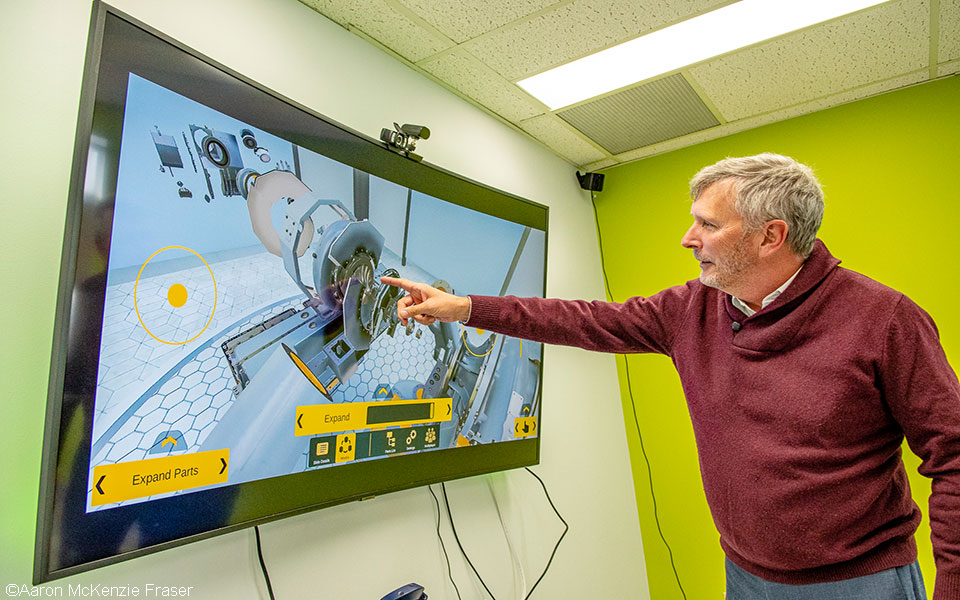
An AR-enabled device worn or carried by a field worker creates a shared view of the physical environment. Annotations can be added directly to that view: markers on specific components, tolerances overlaid onto live readings, flags on areas that have been previously identified as requiring attention. The information isn't described and then interpreted. It's shown.
For communication between workers on site, this changes the handover problem considerably. Instead of a verbal description or a written note, the outgoing shift can annotate the actual asset. The incoming technician sees not a summary of what happened but a view of what was found, in context, on the equipment itself. The stiff valve has a marker. The edge-of-tolerance reading has a flag with the timestamp and the name of the person who logged it. The incoming technician isn't interpreting a summary. They're looking at the same thing the outgoing shift looked at.
Remote Support as a Communication Channel
The other side of this is remote support, and it deserves to be understood as a communication technology rather than just a technical assistance tool.
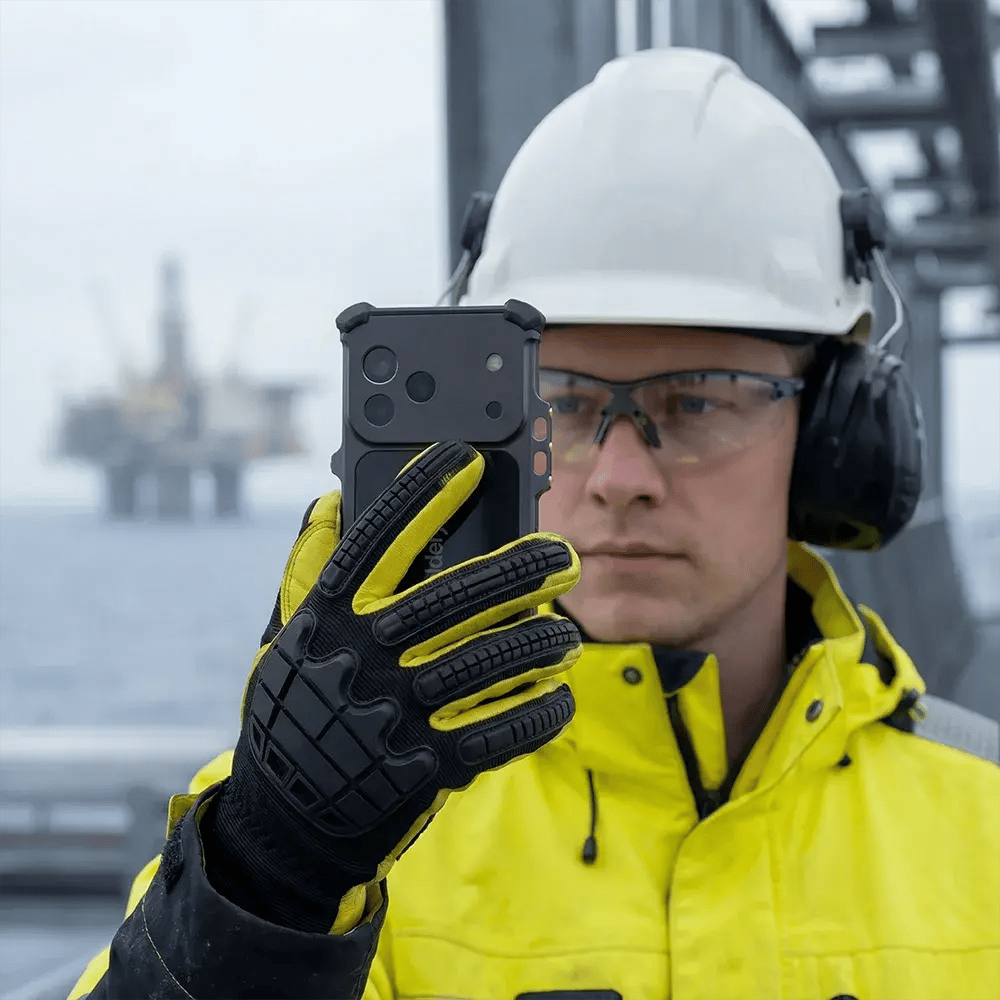
When a field worker in a classified zone opens a remote support session, they're not just getting help with a task. They're creating a live, annotated, bidirectional communication channel between the field and subject matter expertise wherever that expertise happens to sit. The expert sees exactly what the worker sees. They can mark up the view, highlight components, point to specific areas. The communication isn't verbal description followed by interpretation. It's shared observation.
This matters outside technical difficulty too. A field worker who encounters something outside their experience needs to communicate that situation clearly and quickly. The traditional channel is a radio call: describe what you're seeing, wait for a response from someone interpreting your description, act on guidance given without direct sight of the issue. The margin for miscommunication in that process is significant.
Remote support collapses that margin. The expert isn't working from a description. They're working from the same visual field as the person in the zone.
The Shift Handover Problem, Specifically
Shift handovers in hazardous environments are a known risk point. The UK Health and Safety Executive has identified poor handover communication as a contributing factor in multiple major incidents in the process industries. Information that seems minor gets omitted. Verbal communication degrades over a long shift. Written records get completed in a hurry at the end of one.
Connected inspection workflows on certified devices change this in a practical way. Every observation logged during a shift is timestamped, attributed, and attached to the specific asset it relates to. The incoming shift doesn't receive a handover note. They receive a live record of what was found, when, by whom, and what was done about it.
The incoming technician can review that record before entering the zone. They can ask questions about specific findings before the outgoing shift has left the site. The communication happens in sequence and in context rather than compressed into a twenty-minute overlap at the end of a twelve-hour shift.
This is where explosion-proof and intrinsically safe certified devices become part of the communication infrastructure, not just the compliance requirement. The field worker in a Zone 1 or Zone 2 area needs a device that can carry the application, run the session, and log the data from where the work actually happens. A device that can only be used outside the classified zone records the observation after the fact, which reintroduces the same lag and accuracy problems that the technology is meant to solve.
Incident Communication and the Speed Problem
In a standard incident scenario, the communication chain runs from the point of incident outward: worker to supervisor, supervisor to control room, control room to response team. Each link introduces delay and the possibility of information loss.
A connected worker with a certified device can initiate that chain directly and with supporting information. A live video feed from the point of incident gives the control room immediate visual context. The response is calibrated to what's actually happening rather than to a verbal account of it.
For sites running lone worker protocols, connected devices also close the gap between a missed check-in and a confirmed welfare issue. Automated monitoring reduces the time between something going wrong and a response being initiated. In a classified zone, that window matters.