
.webp?width=300&name=Ex%20Zone%20(1).webp)
Understanding ATEX, IECEx & Zone Classifications for Mobile Phones
This page is designed to serve as a complete guide to explosion protection standards, zone ratings, certification schemes, and how they apply to mobile phones in hazardous areas.
ATEX vs IECEx vs NEC: What's the Difference?
Every piece of equipment used in a classified hazardous area must be certified under a recognised scheme. The problem is that three major schemes exist, each with its own scope, geography, and legal weight. Understanding which applies to your site is the starting point for any compliant mobile device decision.
ATEX is the European standard, and it's mandatory. Two separate directives are at play: ATEX 114 (2014/34/EU) governs what manufacturers must prove before equipment can be sold in the EEA, while ATEX 137 (1999/92/EC) places obligations on site operators to classify areas and match equipment to those zones. In the UK, ATEX 137 is enforced through DSEAR. If your workers carry a mobile phone inside a classified zone in Europe, that device must carry ATEX certification.
IECEx is the international scheme, built on the IEC 60079 series of standards. It's voluntary but widely respected. One certificate covers multiple markets, with a public online database allowing procurement teams to verify claims directly. For multinational operations, IECEx removes the need to source separately approved devices for each country.
NEC and CEC govern the USA and Canada respectively. The traditional system uses Classes and Divisions rather than zones: Class I for flammable gases, Class II for combustible dusts, with Division 1 meaning the hazard is present under normal conditions and Division 2 meaning it only appears during abnormal ones. NEC Articles 505 and 506 introduced a Zone-based alternative, but adoption still depends on sign-off from local Authorities having jurisdiction. ATEX or IECEx certification alone does not satisfy North American requirements.
|
Scheme |
Region |
Mandatory? |
Classification System |
Who It Applies To |
|
ATEX |
Europe (EEA) |
Yes |
Zones (0 / 1 / 2) |
Manufacturers + Site operators |
|
IECEx |
International |
No |
Zones |
Manufacturers |
|
NEC / CEC |
USA / Canada |
Yes |
Classes & Divisions (Zones via Art. 505/506) |
Equipment users & installers |
For most organisations with European operations, ATEX is the floor. For those operating globally, a device carrying both ATEX and IECEx certification is the practical choice. North American deployment requires separate NEC confirmation regardless.
Want more information? Here is a full breakdown of ATEX vs IECEx vs NEC
Zone 0, 1 & 2 Explained
Certification schemes define the rules. Zone classifications define the risk level of the physical environment. Before any equipment decision can be made, the site must be assessed and areas categorised according to how frequently and for how long an explosive atmosphere is likely to be present.
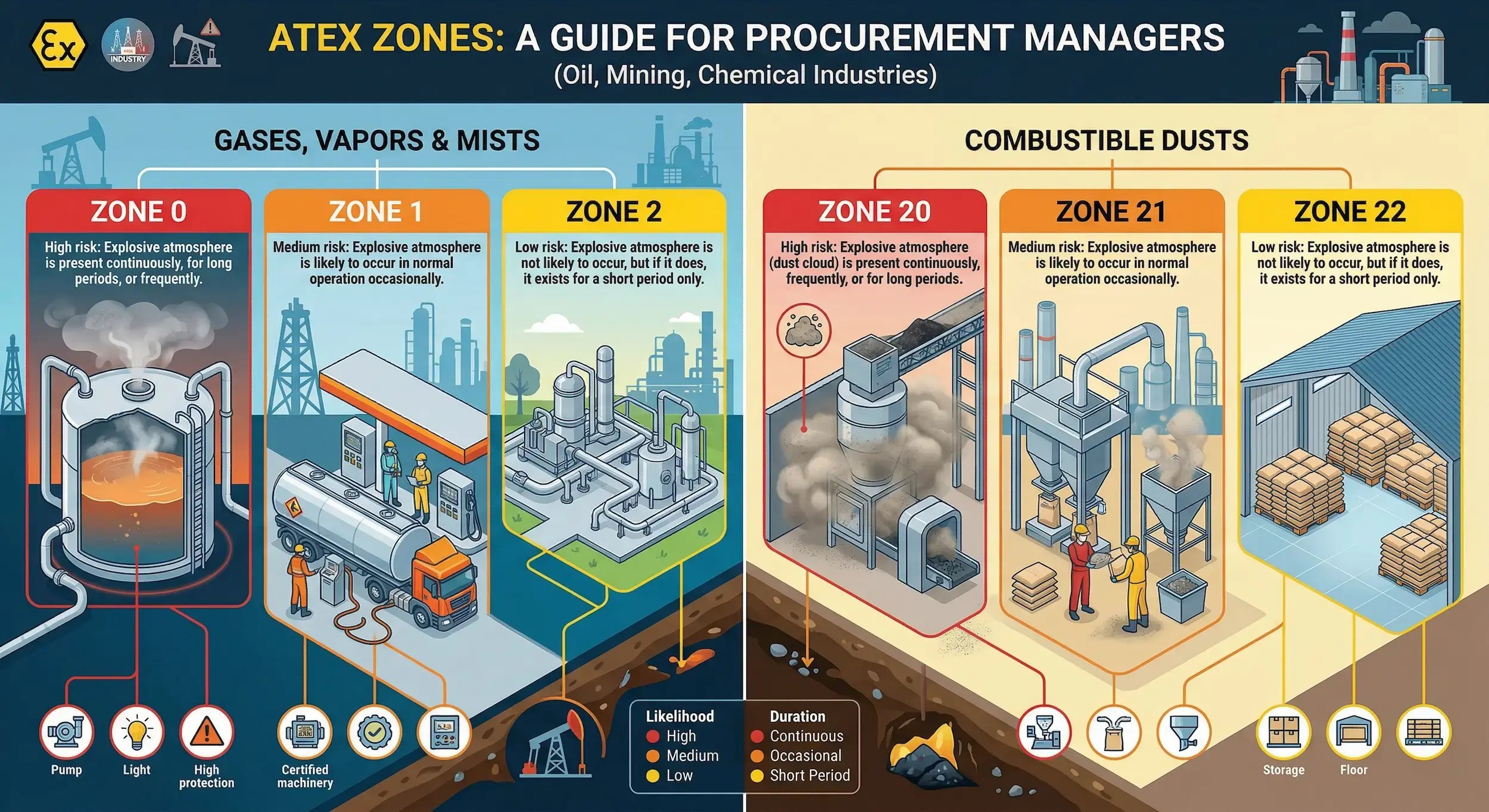
Gas and vapour environments use Zones 0, 1, and 2. Dust environments use the parallel system: Zones 20, 21, and 22. The logic is identical - only the hazard type differs.
Zone 0 — Explosive atmosphere is present continuously or for long periods during normal operation. More than 1,000 hours per year. Typical example: inside a fuel storage tank.
Zone 1 — Explosive atmosphere is likely to occur during normal operations. Between 10 and 1,000 hours per year. The benchmark for serious industrial device certification. Covers areas around pump seals, filling stations, sample points, and loading bays.
Zone 2 — Explosive atmosphere is unlikely during normal operation and would only occur due to equipment failure. Less than 10 hours per year. Covers the majority of industrial plant space where hazardous materials are contained in sealed pipes or vessels.
For dust environments, the same frequency logic applies: Zone 20 for continuous dust cloud presence, Zone 21 for occasional, Zone 22 for unlikely. Common settings include grain handling, pharmaceutical production, and woodworking facilities.
A device certified for a higher-risk zone is always acceptable in a lower-risk zone. A Zone 1 phone can be deployed in Zone 2. The reverse is never true. Also note: gas zone certification does not automatically cover dust zones. A device marked only with a G must not be used in dust environments without a matching D certification.
When you see a marking like Zone 1/21, the slash confirms certification for both the gas and dust variants of the same risk level. For sites that include both types of hazard, Zone 1/21 with IP68 is the most practical single specification to standardise around.
For a full outline of ATEX Zone Classifications, check out this blog
Ex i, Ex d & Ex t: How Devices Achieve Safety
Zone classification tells you where a device can be used. The Ex protection concept tells you how it achieves that safety. Two Zone 1 certified devices can use entirely different engineering approaches to get there.
Ex i — Intrinsic Safety. Limits electrical energy within the device's circuits to a level that cannot ignite the surrounding atmosphere, even under fault conditions. No energy above the ignition threshold means no ignition source. This is the most widely used method in certified handsets and explosion proof phone cases. There are three levels: Ex ia tolerates two simultaneous faults (required for Zone 0), Ex ib tolerates one fault and is the standard for most Zone 1 applications, and Ex ic covers Zone 2 only with no built-in fault tolerance.
Ex d — Flameproof. Accepts that an internal ignition might occur and engineers the enclosure to contain it. Precision-machined joints create a flame path: if internal gases ignite, they exit through narrow gaps and cool below ignition temperature before reaching the outside atmosphere. Most commonly seen in certified phone cases that convert consumer devices for hazardous area use.
Ex t — Dust Tight. Protects against combustible dust by sealing the enclosure so dust cannot reach internal components. Requires a minimum IP6X rating at the higher protection levels. Essential for any device used in dust zones.
Ex m — Encapsulation. Seals specific components, typically the battery, in solid resin so the atmosphere cannot physically reach them. Often used alongside Ex i rather than as a standalone method. Ex mb is commonly applied to lithium battery packs in Zone 1 phones.
Most certified phones don't rely on a single concept. A typical device might use Ex i for its main circuits, Ex m for the battery pack, and Ex t with IP68 for dust protection. The full certification string reflects all methods applied across all parts of the device.
For more in-depth detail on Ex Protection Concepts, we created this guide.
Gas Groups, Temperature Classes & EPL
Zone rating and protection methods are necessary, but they don't confirm whether a device is safe for the specific substances present on your site. That's what gas groups, temperature classes, and Equipment Protection Levels clarify.
Gas Groups reflect how little energy is needed to ignite a given substance. Group IIA covers lower-risk gases like propane. Group IIB covers ethylene and similar compounds. Group IIC (hydrogen and acetylene) represents the highest ignition sensitivity and demands the most stringent engineering. A device rated IIC is backwards compatible with IIB and IIA environments; a device rated IIA cannot be used where IIB or IIC gases are present. For operations that include any hydrogen handling, IIC is the specification to standardise on.
|
Gas Group |
Representative Gas |
Risk Level |
|
IIA |
Propane |
Lowest |
|
IIB |
Ethylene |
Moderate |
|
IIC |
Hydrogen / Acetylene |
Highest - backwards compatible with IIA and IIB |
Temperature Classes indicate the maximum surface temperature a device can reach under fault conditions. That figure must remain below the auto-ignition temperature of the gases present on site. A common misconception: T1 is not the safest — it permits up to 450°C. T6 is the strictest, holding the surface to a maximum of 85°C. Higher T-class number means lower maximum surface temperature. T4 (135°C) covers the large majority of industrial applications. Sites processing carbon disulfide or similar low-AIT substances require T6.
|
T-Class |
Max Surface Temp |
Notes |
|
T1 |
450°C |
Methane, ammonia |
|
T2 |
300°C |
Butane, propane |
|
T3 |
200°C |
Petrol, diesel, jet fuel |
|
T4 |
135°C |
Standard for most mobile devices |
|
T5 |
100°C |
Less common requirement |
|
T6 |
85°C |
Most sensitive environments, e.g. carbon disulfide |
Equipment Protection Level (EPL) is the IECEx framework's equivalent of the ATEX category, expressed with letters rather than numbers. Ga, Gb, and Gc correspond to Zones 0, 1, and 2 for gas environments. Da, Db, and Dc cover the equivalent dust zones. On dual ATEX/IECEx certified devices, you'll typically see both the ATEX category (e.g. 2G) and the EPL (e.g. Gb) on the same label — they convey the same information in different formats.
.jpg?width=1440&height=400&name=IMAGE%20(3).jpg)
Decoding the ATEX Marking String
Every certified device carries a marking string that looks like a code but is a precise technical summary. Two ATEX-certified phones can appear identical on paper and be completely unsuitable for each other's environments. The label is how you tell them apart.
Take this real-world example: II 2G Ex ia IIC T4 Gb
II — Equipment Group. Group II covers surface industries: refineries, chemical plants, pharmaceutical facilities. Group I covers underground mining only.
2G — ATEX Category and environment type. The number 2 means Category 2, which maps to Zone 1. G means gas or vapour environment. D means dust. A marking of 2G/2D covers both.
Ex — Explosion protection confirmed. Appears inside a hexagon on physical labels. Confirms the device has gone through formal explosion protection assessment, not just general industrial testing.
ia — Protection concept. Ex ia is intrinsic safety at the highest level, tolerating two simultaneous faults. Required for Zone 0 and Zone 1. Ex ib tolerates one fault and is acceptable for Zone 1. Ex ic is Zone 2 only.
IIC — Gas Group. The most demanding classification, covering hydrogen and acetylene. A device rated IIC is compatible with IIA and IIB environments. A device rated IIA cannot be used where IIB or IIC gases are present.
T4 — Temperature Class. Maximum surface temperature of 135°C under fault conditions. Covers most industrial gases. T6 (85°C) is required for the most sensitive atmospheres.
Gb — Equipment Protection Level. Gb confirms IECEx Zone 1 gas protection. Appears alongside the ATEX category on dual-certified devices.
When evaluating any certified device, cross-reference the gas group against your site's chemical inventory and the T-class against the auto-ignition temperatures of the substances present. Zone rating alone is not sufficient.
For more on how to decode ATEX labels, check out this practical guide
Intrinsically Safe vs Explosion Proof
These two terms are often used interchangeably. They describe two fundamentally different engineering philosophies, and the distinction matters when specifying equipment.
Intrinsically Safe (IS) devices work through prevention. The electrical energy within the device's circuits is permanently limited, using components like Zener diodes and resistors to a level below the minimum ignition energy of the surrounding atmosphere. An ignition cannot occur because the energy required to cause one is simply not available. This approach typically produces lighter, slimmer devices and underpins most modern certified handsets.
Explosion Proof (Ex d) takes a containment approach. It accepts that an internal ignition might occur and builds an enclosure strong enough to withstand it. The joints are machined to precise tolerances to create a flame path: if internal gases ignite, they exit through those narrow gaps and cool to a safe temperature before reaching the outside atmosphere. This is most commonly seen in certified phone cases that convert consumer devices for hazardous area use.
|
Feature |
Intrinsically Safe (Ex i) |
Explosion Proof (Ex d) |
|
Philosophy |
Prevention |
Containment |
|
Mechanism |
Limits circuit energy below ignition threshold |
Enclosure survives internal blast; cools exiting gases |
|
Device profile |
Lighter, slimmer |
Heavier, more robust |
|
Common use |
Purpose-built certified handsets |
Certified cases for consumer devices |
|
Zones |
0, 1, 2 (depending on level) |
1, 2 |
Both approaches can meet the same zone requirements. The practical difference for procurement teams lies in form factor, usability, and whether you want to deploy existing consumer device platforms. A certified explosion proof iPhone case lets you run high-performance consumer hardware within a compliant enclosure, without the limitations that typically come with purpose-built industrial handsets.
Compare Intrinsically Safe and Explosion Proof in more detail
For a broader buying overview, read our definitive guide to intrinsically safe and explosion-proof mobile devices.
Can an iPhone Be ATEX Certified?
Standard iPhones are not ATEX or IECEx certified. Apple designs its devices to consumer safety standards, not to the explosion protection requirements that govern equipment used in classified hazardous areas. An uncertified iPhone used inside a Zone 1 or Zone 2 environment is a compliance failure and a potential ignition source.
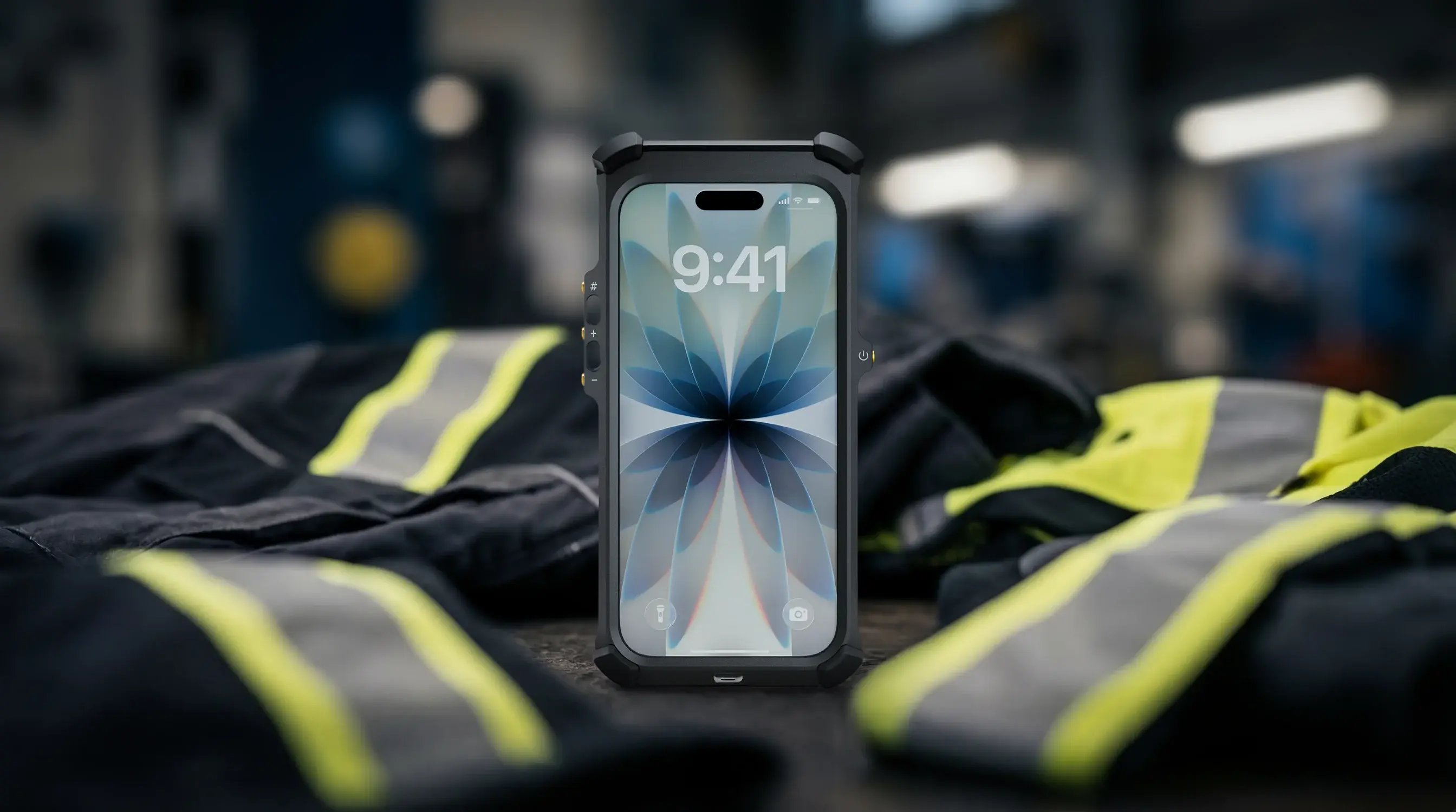
What can be certified is an enclosure. A precision-engineered explosion proof iPhone case that has passed the full ATEX and IECEx assessment process transforms an iPhone into a compliant device for use in classified zones. The case carries the certification; the iPhone provides the performance.
Explore our intrinsically safe iPhone 17 Pro Max solution for Zone 1/21 gas and dust environments
This approach has become the dominant model for serious industrial deployments in 2026 because it solves a problem that dedicated industrial handsets have never fully addressed: the technology gap. Purpose-built IS phones typically run hardware that is two to three years behind current consumer flagships. An iPhone 17 Pro in a certified Zone 1/21 case gives field teams access to the latest camera hardware, on-device AI capabilities, and the iOS ecosystem - within a fully compliant package.
The case must carry the certification, not just the phone inside it. Verify the full ATEX/IECEx marking on the case itself, including gas group, T-class, and zone rating, before deploying any device in a classified area.
To learn more about how iPhones can be intrinsically safe, read here
How to Choose an ATEX / IECEx Phone or Case
Certification scheme and zone rating are the starting points, but a compliant procurement decision involves several more specific checks. Working through these in order prevents the gaps that most buying teams miss.
Confirm your zone classification first. Zone 1/21 and Zone 2/22 demand different certification levels. Don't specify equipment before the site classification is confirmed.
Match the gas group to your site's chemical inventory. IIC is the broadest coverage. If hydrogen or acetylene is present at your facility, IIC is non-negotiable.
Check the T-class against auto-ignition temperatures. T4 (135°C) covers most applications. Sites with particularly sensitive substances may need T6.
Verify dust coverage if required. A G-only label is not sufficient for dust zones. Look for D certification and IP68 minimum ingress protection.
Consider operational requirements. Camera resolution, battery life across a 12-hour shift, glove-compatible operation, and cellular and Wi-Fi performance in metal-heavy environments all affect daily usability.
Assess IT integration. MDM compatibility (Intune, Jamf, SOTI), update cadence, and support lifecycle all affect long-term total cost. A device that sits outside your standard management infrastructure creates ongoing overhead.
Calculate total cost of ownership, not just unit price. Support lifecycle, repairability, and how long the device remains current hardware all factor into the real cost over a fleet's lifetime.
Consider future zones. If there is any chance your teams will work in more demanding environments in future, specifying one zone above current requirements now is more efficient than a mid-cycle fleet replacement.
Best ATEX iPhone Cases (2026)
If the procurement checklist points you toward a certified case around flagship consumer hardware, Xshielder's Zone 1/21 · IIC · T4 · IP68 explosion proof iPhone cases are built to that specification, combining full ATEX and IECEx certification with the performance of current Apple hardware and full compatibility with iOS MDM platforms.
Explore Xshielder’s intrinsically safe iPhone range for certified mobile use in hazardous areas.
Glossary Cheat Sheet
Hazardous area compliance carries a heavy vocabulary burden. ATEX, IECEx, Ex ia, EPL, IIC, T4, DSEAR, AHJ - each term has a precise meaning, and using them incorrectly creates real risk in the field. We built a comprehensive reference covering every major term across certification, zone classification, protection methods, material hazards, and hardware, organised by category for fast lookup.
The Master Glossary of Hazardous Areas & Explosion Protection
Not sure which certification applies to your site? Speak to the Xshielder team for a straightforward assessment of what your environment actually requires.