
Decoding the ATEX Labels on Intrinsically Safe Phones
Every ATEX or IECEx certified phone carries a string of letters, numbers, and symbols that looks indecipherable at first glance. Most people ignore it and trust that ‘certified’ means ‘compliant’. That's a mistake.
That marking is a condensed technical summary of exactly what the device can and can't do. Two phones can both be ATEX certified and still be completely unsuitable for each other's environments. Reading the label correctly is how you know the difference.
What a Typical ATEX Marking Looks Like
Take a real-world example from a certified Zone 1 smartphone. The marking reads:
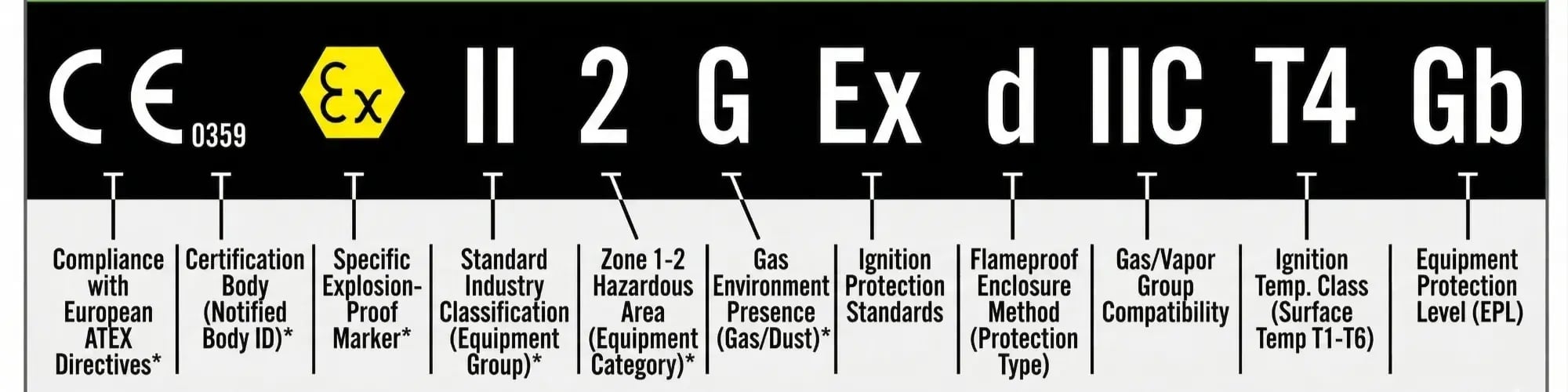
II 2G Ex ia IIC T4 Gb
Each segment means something specific. Here's how to read it left to right.
II — Equipment Group
The Roman numeral tells you the broad category of environment the device is designed for.
- Group I covers underground mines, where methane and coal dust are the primary hazards.
- Group II covers surface industries: refineries, chemical plants, pharmaceutical facilities, and anywhere above ground where explosive atmospheres can occur.
If you're working at a refinery or processing plant, every device you use should carry the II marking. A Group I marking means it was designed for a completely different set of hazards.
2G — ATEX Category
The number indicates the level of protection, which maps directly to the zone the device can be used in.
- Category 1 = Zone 0 (continuous hazard)
- Category 2 = Zone 1 (occasional hazard)
- Category 3 = Zone 2 (unlikely, short-duration hazard)
The letter after the number indicates the environment type:
- G = gas, vapour, or mist
- D = dust
So 2G means the device is certified for Zone 1 gas environments. A device marked 2G/2D covers both Zone 1 gas and Zone 21 dust. If you only see a G and no D, the device has not been assessed for dust environments and shouldn't be used in them.
Ex — Explosion Protection Symbol
This confirms the device has been certified for use in explosive atmospheres. On physical labels, this appears inside a hexagon. It's the baseline indicator that the device has gone through formal explosion protection assessment rather than just general industrial testing.
ia — Protection Concept
This tells you the method used to prevent the device from becoming an ignition source. For mobile phones and intrinsically safe phones, the protection concept is almost always intrinsic safety, denoted by the letter i.
- ia = the highest level of intrinsic safety. The device remains safe even if two faults occur simultaneously. Required for Zone 0 and Zone 1.
- ib = high level of intrinsic safety. Safe with one fault. Also acceptable for Zone 1.
- ic = suitable for Zone 2 only.
The distinction matters if you're specifying devices for Zone 1. Both ia and ib are acceptable, but ic is not.
Intrinsic safety works by limiting the electrical energy in the device to a level that cannot ignite a flammable atmosphere, even under fault conditions. This is why a properly certified intrinsically safe phone or intrinsically safe case is fundamentally different from a ruggedised consumer device: the energy limitation is engineered in from the ground up, not added as an afterthought.
IIC — Gas Group
This is one of the most important parts of the label, and one of the most commonly misunderstood.
Gases and vapours vary significantly in how little energy it takes to ignite them. The gas group classification reflects this:
|
Gas Group |
Representative Gas |
Risk Level |
Typical Application |
|
IIA |
Propane |
Lowest |
Oil refineries, natural gas |
|
IIB |
Ethylene |
Moderate |
Chemical production, solvents |
|
IIC |
Hydrogen / Acetylene |
Highest |
Hydrogen storage, electronics manufacturing |
A device marked IIC meets the strictest requirements and is compatible with IIB and IIA environments. It's backwards compatible. A device marked IIA cannot be used where IIB or IIC gases are present.
For most industrial operations, IIC is the specification to standardise on. It gives you the broadest coverage and eliminates the need to cross-reference device specs against every chemical present on site.
The same logic applies to dust environments:
- IIIA: Combustible flyings such as cotton or wood chips
- IIIB: Non-conductive dusts such as grain, flour, or sugar
- IIIC: Conductive dusts such as aluminium, magnesium, or carbon dust
IIIC is the most hazardous dust group, and a device rated for IIIC covers the less sensitive groups below it.
T4 — Temperature Class
This is where a genuinely dangerous misconception is worth addressing directly.
The temperature class indicates the maximum surface temperature the device can reach under fault conditions. That maximum must sit below the auto-ignition temperature (AIT) of the surrounding atmosphere.
|
T-Class |
Max Surface Temp |
Suitable If Gas AIT Is |
Common Gases |
|
T1 |
450°C |
Above 450°C |
Methane, ammonia |
|
T2 |
300°C |
Above 300°C |
Butane, propane |
|
T3 |
200°C |
Above 200°C |
Gasoline, diesel |
|
T4 |
135°C |
Above 135°C |
Ethyl ether, most industrial gases |
|
T5 |
100°C |
Above 100°C |
Acetaldehyde |
|
T6 |
85°C |
Above 85°C |
Carbon disulfide |
Here's the misconception: T1 is not "safer" than T6. It's the opposite. A T1-rated device is permitted to reach 450°C before it fails the standard. That temperature would ignite almost any flammable substance. A T6-rated device is held to a maximum of 85°C, which is a far stricter requirement.
Higher T-class number = lower maximum surface temperature = suitable for more sensitive atmospheres.
Most Zone 1 phones and ATEX phone cases carry a T4 rating, which covers the majority of common industrial gases. But in environments where carbon disulfide or ethyl nitrate is present, T4 is not enough. A T6-rated device is mandatory. Deploying a T4 device in a T6 environment because both are "ATEX certified" is a compliance failure with serious consequences.
Gb — Equipment Protection Level
The EPL is the IECEx system's equivalent of the ATEX category. It gives you the same information in a slightly different format:
- Ga = Zone 0, gas (highest protection)
- Gb = Zone 1, gas
- Gc = Zone 2, gas
- Da = Zone 20, dust
- Db = Zone 21, dust
- Dc = Zone 22, dust
Gb on the label confirms this is a Zone 1 gas device under the IECEx framework. You'll often see both the ATEX category (2G) and the EPL (Gb) on the same label, as many devices carry dual ATEX and IECEx certification.
Putting It All Together
Going back to the full marking: II 2G Ex ia IIC T4 Gb
In plain English: this is a surface industry device, certified for Zone 1 gas environments, using intrinsic safety as its protection method, safe to use around the most sensitive gases including hydrogen, with a maximum surface temperature of 135°C, confirmed to IECEx Zone 1 standard.
That single string tells a compliance officer everything they need to match the device to a specific site and chemical environment. Two devices can both display ATEX certification and be completely unsuitable for each other's locations if their gas groups or T-classes don't align with what's actually present on site.
When specifying an explosion proof phone or ATEX phone case for your operation, don't stop at the zone rating. Check the gas group against your site's chemical inventory. Check the T-class against the auto-ignition temperatures of the substances present. Those two checks are where real compliance decisions are made.
Or, if you need help matching a certified device to your site's specific hazard profile, then talk to the Xshielder team.
Ps:
For the full compliance context, read our ATEX and IECEx certification guide for mobile phones.