
Understanding ATEX Zones: What They Mean & Why They Matter for Mobile Phones
Before you can choose compliant technology for a hazardous area, you need to understand how that area is classified. ATEX / IECEx Zone classifications are the foundation of explosion protection. Get it wrong and every equipment decision downstream is built on shaky ground.
Here's a plain-English breakdown of how the zone system works, what the classifications actually mean in practice, and how to read the zone markings on certified devices.
Why Zone Classification Exists
Not every corner of an industrial site carries the same level of risk. A sealed process vessel and an open filling station are both potentially hazardous, but the likelihood of an explosive atmosphere being present differs significantly between them.
Zone classification is the process of analysing how frequently and for how long a flammable atmosphere is likely to exist in a given area. That analysis directly determines what level of protection any equipment used in that area must meet. For mobile devices, that means your phone, tablet, or ATEX phone case must be rated for the zone it's entering.
There are two separate sets of zones: one for gas, vapour, and mist environments, and one for dust environments. Both follow the same underlying logic.
To understand how zone requirements differ by region, read our guide to ATEX, IECEx and NEC.
What are ATEX Zones 0 / 1 / 2?
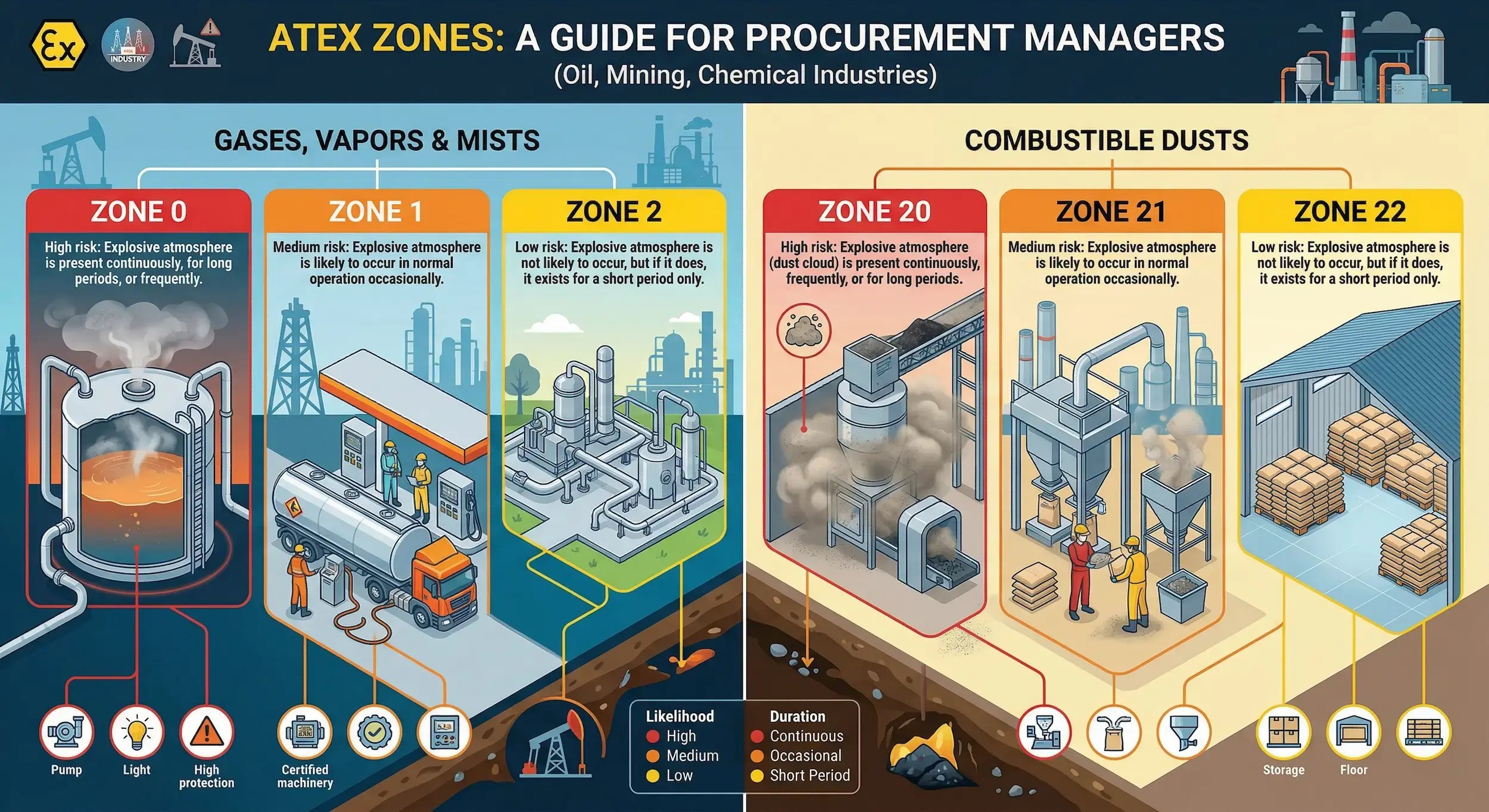
Zones 0, 1, and 2 apply wherever flammable gases or vapours can mix with air to create an ignitable atmosphere.
Zone 0
An explosive atmosphere is present continuously, for long periods, or frequently. In practical terms, this means more than 1,000 hours per year, or more than an hour per shift. The inside of a fuel storage tank is a typical example.
Certifying a modern smartphone for Zone 0 is extremely difficult. The protection level required (Ex ia, intrinsic safety at the highest level) demands such tight energy limits that the processing power needed to run a functional smartphone almost certainly exceeds what's permissible. In reality, certified Zone 1 phones are the most protection-intensive devices you'll find in regular use. Zone 0 remains largely impractical for mobile devices.
Zone 1
Zone 1 means that an explosive atmosphere is likely to occur occasionally during normal operation, typically between 10 and 1,000 hours per year. This typically covers areas around pump seals, filling stations, sample points, and loading bays.
Zone 1 is the benchmark for serious hazardous area mobile device certification. A phone or ATEX phone case rated for Zone 1 is built to a standard that accounts for the realistic presence of flammable atmospheres during everyday operations. If your site has Zone 1 areas and your workers need mobile devices, Zone 1 certification is the minimum you should be looking for.
Zone 2
Zone 2 means that an explosive atmosphere is unlikely during normal operation, and if it does occur, it will be brief. Less than 10 hours per year is the general threshold. This covers the majority of industrial plant space: areas where hazardous materials are contained in sealed pipes or vessels, and a release would only happen due to equipment failure.
Zone 2 certification covers a wider range of devices. Many explosion proof phones and explosion proof cases on the market are Zone 2 rated. For some sites that's sufficient, but it's worth confirming your actual zone classification, and considering future projects before assuming a Zone 2 device will meet your compliance requirements.
To check whether a device is rated for the right zone, read our guide on how to read ATEX markings.
What are Zones 20 / 21 / 22?
Zones 20, 21, and 22 apply when talking about dust levels. Combustible dust is a distinct hazard from flammable gas. Grain handling facilities, pharmaceutical plants, and woodworking operations all deal with dust that can ignite and explode when suspended in air or accumulated in layers. The dust zones follow the same frequency-based logic as the gas zones.
- Zone 20: Combustible dust cloud is present continuously or for long periods.
- Zone 21: A dust cloud is likely to occur occasionally during normal operation.
- Zone 22: A dust cloud is unlikely, but possible for short durations if something goes wrong.
One important consideration for dust environments that doesn't apply in the same way to gas is Ingress Protection (IP). In these zones, the IP rating of the device becomes critical. Conductive dust, particularly Group IIIC materials, can work its way inside a device and create bridging circuits that trigger an internal ignition. A device that might be fine in a gas zone could fail catastrophically in a dust environment if it isn't properly sealed.
To understand how the device achieves its zone rating, read our guide to Ex protection concepts.
This is why most devices certified for dust environments carry an IP68 rating: dust-tight and capable of surviving prolonged water immersion. In summary, if you're working in a dust zone, the IP rating on your intrinsically safe phone or intrinsically safe case deserves as much attention as the zone marking itself.
Reading Zone Markings: What Does the Forward Slash Mean?
This is where a lot of people get confused. You'll often see certified devices labelled with something like Zone 1/21 or Zone 2/22. The forward slash doesn't indicate a range or a compromise. It means the device is certified for both a gas zone and the corresponding dust zone simultaneously.
Here's how the pairing works:
|
Marking |
Covers |
|
Zone 1/21 |
Zone 1 (gas/vapour) and Zone 21 (dust) |
|
Zone 2/22 |
Zone 2 (gas/vapour) and Zone 22 (dust) |
|
Zone 0/20 |
Zone 0 (gas/vapour) and Zone 20 (dust) — rare |
A Zone 1/21 certified phone or ATEX phone case has passed testing for both explosive gas atmospheres and combustible dust environments. In practice, this is what most well-specified hazardous area devices carry, because many industrial sites contain both types of risk, sometimes in adjacent areas.
You may also see markings like Ex II 2G/2D, which is the formal ATEX category notation. Breaking this down:
- Ex confirms it's explosion-protected equipment
- II refers to the equipment group (surface industries, as opposed to Group I which covers mines)
- 2 is the category (Category 1 = Zone 0/20, Category 2 = Zone 1/21, Category 3 = Zone 2/22)
- G stands for gas; D stands for dust
So II 2G/2D means: surface industry equipment, certified for Category 2 gas environments and Category 2 dust environments. That maps directly to Zone 1 and Zone 21.
Explore our intrinsically safe iPhone 17 Pro Max solution for Zone 1/21 gas and dust environments.
When a device carries only a G marking (no D), it has only been assessed for gas environments. Using it in a dust zone without checking the specific certification could leave you non-compliant and your workers exposed.
Choosing the Right Certified Phone / Case for Your Zone
The zone classification on your site determines the minimum certification your equipment must carry. A quick reference:
|
Your zone |
Minimum device certification needed |
|
Zone 0 |
Zone 0 (Ex ia) — very limited device options |
|
Zone 1 |
Zone 1 or better |
|
Zone 2 |
Zone 2 or better (Zone 1 devices are acceptable in Zone 2) |
|
Zone 21 |
Zone 21 or better |
|
Zone 22 |
Zone 22 or better |
One rule worth remembering: a device certified for a higher-risk zone is always acceptable in a lower-risk zone. A Zone 1 phone can be used in Zone 2. The reverse is not true.
For most organisations working across mixed-hazard sites, a device rated Zone 1/21 with IP68 offers the most practical coverage. It handles both gas and dust environments, satisfies the most common high-risk zone requirement, and gives procurement teams a single specification to standardise around rather than managing multiple device types across the fleet.
The Bottom Line
An explosion proof phone or ATEX phone case is only as good as the zone it's certified for, and only useful if that certification matches the environment it's actually being used in.
Check your site's zone classification. Match it to your device specification. And if your workers are crossing between gas and dust areas, make sure the certification covers both. Lastly, consider future-proofing - will you always work in this environment? If not, consider opting for a zone above so you’re always covered.
Need a phone case certified for Zone 1/21. See Xshielder's certified range.
FAQs
What does Zone 1/21 mean on a phone or case?
The forward slash means the device is certified for two environments: Zone 1 (flammable gas or vapour) and Zone 21 (combustible dust). A Zone 1/21 rating is the most common certification for phones and ATEX phone cases used across mixed industrial sites.
Are Zone 1 phones the same as intrinsically safe phones?
Not exactly. Intrinsic safety (Ex i) is one specific type of protection method used to achieve Zone 1 certification. A Zone 1 phone may use intrinsic safety or another approved protection concept. The zone rating tells you where a device can be used; the protection method tells you how it achieves that safety level.
What IP rating should an ATEX phone case have?
For any dust zone environment, IP68 is the standard to look for. It confirms the device is dust-tight and can withstand prolonged water immersion, which prevents conductive dust from entering the device and creating an ignition risk internally.
Can a Zone 1 phone be used in Zone 2?
Yes. A device certified for Zone 1 can always be used in Zone 2. Because Zone 1 certification is built to a higher standard, it covers the lower-risk environment as well. This only works in one direction. A Zone 2 certified device cannot be used in Zone 1, regardless of how similar the areas might appear on paper. However, Zone 1 gas certification does not automatically permit use in dust zones (zones 20-22), so it’s important to check this.