
Can You Make an iPhone 15 Intrinsically Safe? Yes - But Here’s What to Consider First
The straightforward is yes, the iPhone 15 can be made suitable for use in classified hazardous areas through a certified explosion proof case. These cases are precision-engineered enclosures that contain any fault, spark, or heat the device could generate, limiting it to levels below what is needed to ignite the surrounding atmosphere. With the right enclosure and the right zone rating, an iPhone 15 becomes a compliant field device.
However, the second question that should be asked is this: given that you are making a device procurement decision, should the iPhone 15 actually be the model you choose? Certified enclosures are also available for the iPhone 16 Pro Max and the iPhone 17 series — and the difference between deploying an iPhone 15 today versus a current model is wider than it might first appear. Battery life, camera capability, software longevity, and access to on-device AI workflows all shift meaningfully between generations. Over a typical deployment lifecycle, those differences have a real cost.
In this piece we cover the features of an iPhone 15 in an ex-proof case, and how it compares to the newer models now available.
What an iPhone 15 in an Ex proof case actually gives you
The iPhone 15 brings a genuinely capable camera into the field. The 48MP main sensor and 12MP ultrawide are a significant step up from older handsets, and for site documentation, inspection photography, and remote support, the image quality is more than adequate. It runs USB-C, which simplifies charging logistics across a mixed device fleet. And as with any iPhone, it integrates naturally with Outlook, Teams, SharePoint, and the inspection and maintenance apps most operations are already using.
Paired with a certified explosion proof case, it becomes a compliant Zone 1 or Zone 2 device depending on the solution you choose. For operations where the device is primarily used for communication, basic documentation, and access to existing workflows, the iPhone 15 in an Ex-rated enclosure does the job.
The question worth asking is whether it is the right tool for the next five years, not just today.
Where the iPhone 15 starts to show its age
The iPhone 15 runs an A16 Bionic chip with 6GB of RAM. That is a capable processor, but it sits below the hardware threshold Apple set for its on-device AI platform. Apple Intelligence — which covers AI-assisted writing tools, visual intelligence, on-device Siri enhancements, live translation, and notification summarisation — requires a minimum of 8GB of RAM and an A17 Pro chip or newer. The standard iPhone 15 has neither.
That distinction may feel abstract today. It becomes more concrete when you consider that workflows on the iPhone 16 Pro Max and iPhone 17 already include things like visual intelligence for real-time object identification, AI-assisted report drafting, and live translation for multilingual teams — all running locally on the device without needing a cloud connection. In environments where network coverage is unreliable, on-device processing matters more than it does in an office.
The standard iPhone 15 does not support Apple Intelligence. It lacks the 8GB of RAM and A17 Pro or newer chip that Apple requires. The iPhone 16 Pro Max, iPhone 17, and iPhone 17 Pro Max all support the full feature set.
The display is another gap. The iPhone 15 runs at 60Hz — a fixed refresh rate that was already a step behind when the phone launched. The iPhone 16 Pro Max and all iPhone 17 models use ProMotion displays with adaptive refresh rates up to 120Hz. That difference is perceptible in everyday use: scrolling is smoother, touchscreen response feels faster, and for workers reviewing technical drawings, inspection photos, or video footage in the field, screen fluidity has a direct effect on usability. The iPhone 17 series also pushes outdoor peak brightness to 3,000 nits, up from 2,000 nits on the iPhone 15 and 16 Pro Max. On a bright day on an offshore deck or an open chemical plant, screen legibility without shade matters.
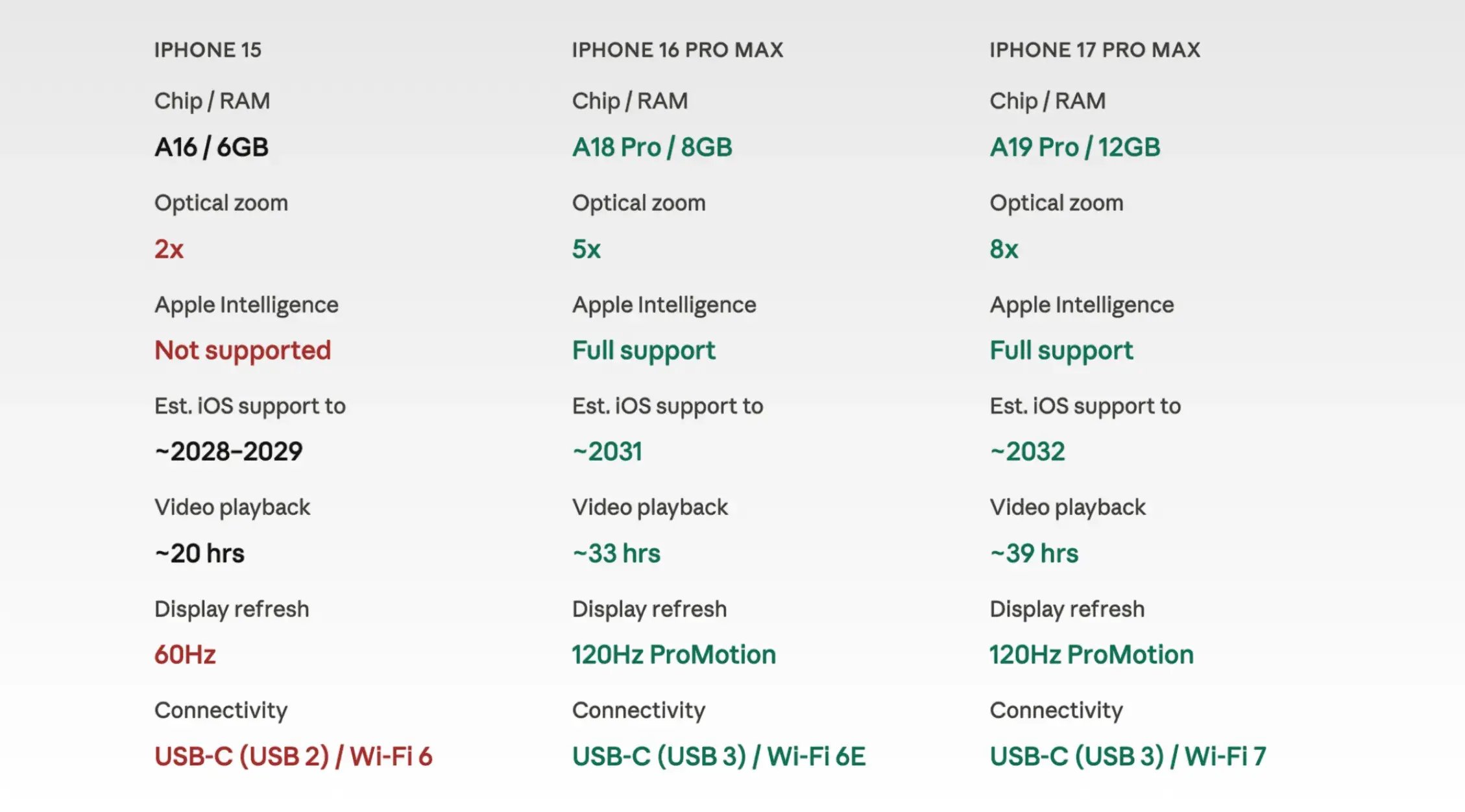
Connectivity follows the same trajectory. The iPhone 15 supports Wi-Fi 6. The iPhone 16 Pro Max steps up to Wi-Fi 6E, and the iPhone 17 series supports Wi-Fi 7. In practical terms, Wi-Fi 7 delivers higher throughput and significantly more stable connections in RF-congested industrial environments — the kind where multiple devices, control systems, and wireless networks are competing for bandwidth in a confined space. For workers transferring large inspection files, streaming live video for remote support, or connecting to site-specific applications, that stability is not a marginal gain. The iPhone 15's USB-C port also runs at USB 2.0 speeds, while the 16 Pro Max and 17 series run USB 3 — meaning wired data transfers are substantially faster when syncing documentation or offloading footage on site.
The other gap is optical zoom. The iPhone 15's main camera stops at 2x optical zoom. The iPhone 16 Pro Max delivers 5x optical zoom, while the 17 Pro Max offers 8x. For remote inspection work where workers need to document equipment from a distance, that is not a minor upgrade — it is the difference between a usable image and one that requires physically approaching the subject.
The total cost of ownership case for an iPhone 15 vs newer devices
For operations that are price-conscious (and most are) the instinct is to choose the lowest-cost certified device that meets the zone requirement. That logic is sound up to a point. Where it starts to break down is when you factor in the full ownership timeline rather than just the upfront number.
Apple formally commits to a minimum of five years of software updates from first supply date, documented in its UK PSTI compliance statement starting with the iPhone 15 series. In practice, major iOS versions have historically run to six or seven years on eligible hardware. The iPhone 15, launched in September 2023, is therefore realistically approaching the midpoint of its active support window. The iPhone 16 Pro Max, launched in 2024, and the iPhone 17, launched in 2025, both carry expected full iOS support through 2031 and 2032 respectively.
That gap translates directly into operational cost. A device that reaches end of software support while still inside a certified enclosure creates a compliance and security problem. At that point, the organisation is either running an unsupported operating system in a classified area — which raises questions about app compatibility and security posture — or replacing the handset inside the case ahead of schedule. The enclosure cost is sunk either way.
Battery life is another factor. The iPhone 15 delivers around 20 hours of video playback. The iPhone 16 Pro Max extends that to around 33 hours, and the iPhone 17 Pro Max — running the A19 Pro chip with Apple's most efficient architecture to date — pushes to 39 hours. For a field worker on a long shift who cannot easily return to a charging point, that headroom is practical, not theoretical.
The iPhone 15 vs new generations: practical differences in the field
Battery life, zoom, display, and connectivity are the four areas where day-to-day field use feels the gap most acutely. A worker carrying an iPhone 15 through a twelve-hour offshore shift may find themselves managing battery anxiety in a way that a worker on a current generation device simply does not. When a colleague needs photographic evidence of a valve condition 30 metres away, 8x optical zoom returns a usable image where 2x returns a guess. And when reviewing that image on deck in direct sunlight, the 120Hz ProMotion displays on current models are noticeably more responsive than the 60Hz screen on the 15 — while the 3,000 nit peak brightness available on the latest generation makes outdoor legibility a non-issue entirely.
The connectivity picture is similarly concrete. Industrial sites — particularly offshore platforms and chemical plants — are RF-dense environments. Multiple wireless systems, personnel devices, and control infrastructure compete across the same spectrum. Wi-Fi 6E and Wi-Fi 7, available on current certified models, are built for exactly this kind of congestion. The iPhone 15's Wi-Fi 6 holds up in less contested environments, but in dense industrial settings the newer standards deliver more consistent throughput when it matters. For operations running video-based remote inspections or real-time collaboration tools, a stable connection is not a nice-to-have. The move from USB 2.0 to USB 3 speeds over the same USB-C port, standard on newer models, also means substantially faster wired data transfers when syncing documentation or offloading footage on site.
The software picture follows the same direction. Inspection apps, maintenance platforms, and reporting tools are already building Apple Intelligence integration into their development roadmaps. Features like AI-assisted anomaly flagging in inspection footage, automatic report generation from voice notes, and real-time translation for offshore teams working across languages are no longer speculative. They are in active development for devices that support the platform. The iPhone 15 will not receive them.
Check out the Intrinsically Safe iPhone 17 Pro Max to see what your team could be running with.
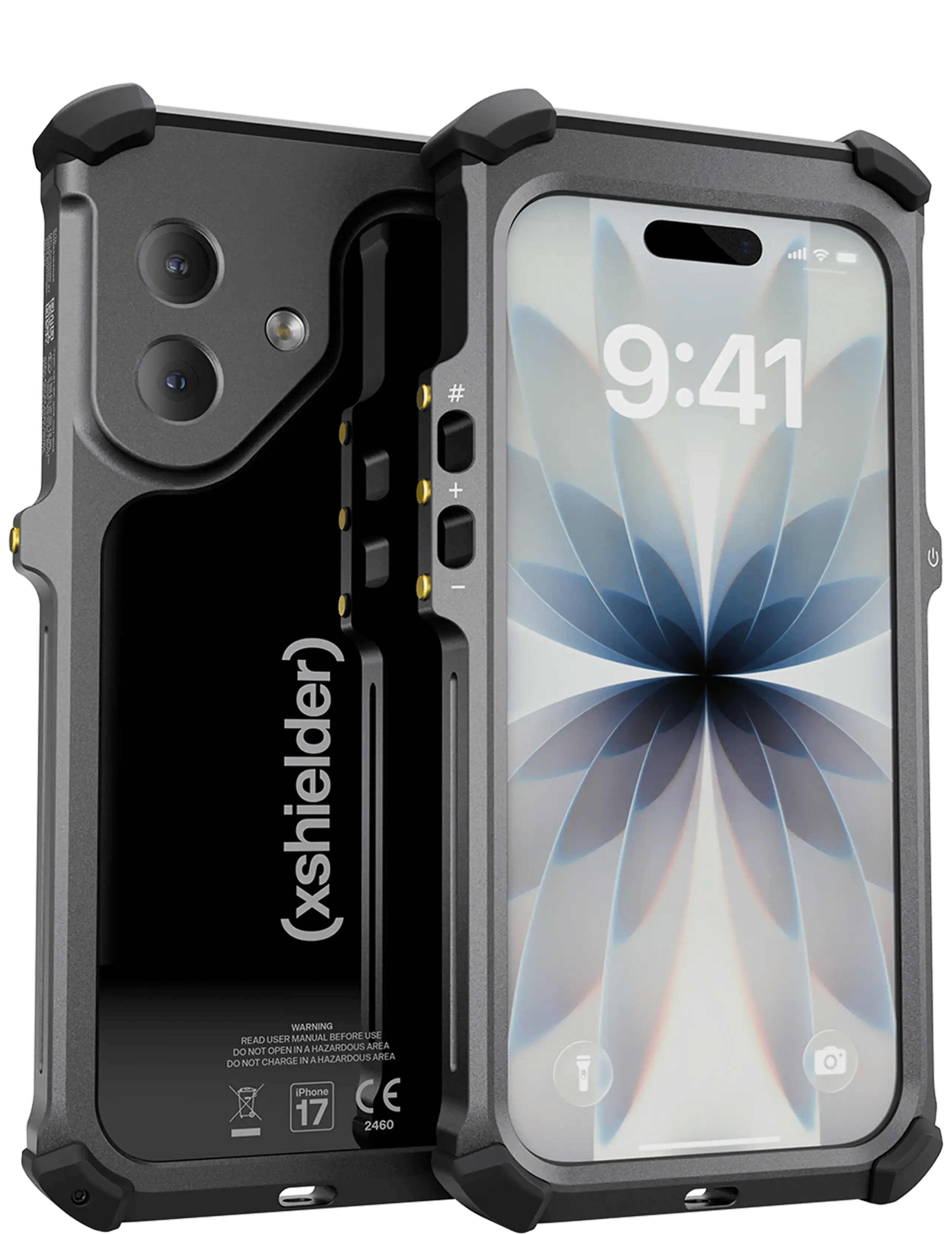
The iPhone 17 presents a meaningful upgrade to field teams
What this means if you are buying now
If you already have iPhone 15 devices in an Ex-rated enclosure and the fleet is performing well, there is no immediate reason to replace them. The device is still supported, the certification is still valid, and a forced refresh before the hardware earns its keep is its own cost.
If you are making a procurement decision now - either building out a new fleet or replacing older equipment - the calculus is different. The iPhone 17 Pro Max is undoubtedly the most powerful choice. It boasts the longest remaining support, significantly better battery life, 8x optical zoom, full Apple Intelligence compatibility, and a host of other benefits. For operations that are more price sensitive, the iPhone 16 Pro Max and iPhone 17 are also incredibly powerful options. The 17 offers the longest support window currently available, while the iPhone 16 Pro Max has enough camera power to satisfy most hazardous site needs. The best choice depends on your specific operation.
To find out which option is best for your fleet, contact one of Xshielder’s experts.
FAQs
Can you make an iPhone 15 intrinsically safe?
Yes. An iPhone 15 can be made suitable for use in classified hazardous areas by housing it inside a certified explosion proof case. The enclosure — not the phone itself — carries the ATEX and/or IECEx certification, and the device and case together form a compliant system rated for Zone 1 or Zone 2 depending on the solution. The iPhone 15 on its own has no hazardous area rating.
Can the iPhone 15 be used in a Zone 1 hazardous area?
Yes, but only inside a certified explosion proof enclosure rated for Zone 1. A bare iPhone 15 carries no ATEX or IECEx certification and cannot be used in any classified zone without one. The certification belongs to the enclosure, which must be specifically tested and approved for Zone 1 use with the iPhone 15 as the device inside it.
How does an intrinsically safe iPhone 15 compare with an intrinsically safe iPhone 16 Pro Max?
The iPhone 16 Pro Max offers a significant step up in battery life (around 33 hours of video playback versus 20), 5x optical zoom versus 2x, a 120Hz ProMotion display versus the iPhone 15's 60Hz screen, Wi-Fi 6E, faster USB 3 data transfer, and full Apple Intelligence support. It also carries a longer estimated iOS support window, making it the stronger total cost of ownership case for most new deployments.
How does an intrinsically safe iPhone 15 compare with an intrinsically safe iPhone 17?
The iPhone 17 brings Wi-Fi 7, a 120Hz ProMotion display, improved battery life, and full Apple Intelligence support — none of which are available on the standard iPhone 15. As the most accessible current-generation certified model, it offers a longer support runway and meaningful day-to-day improvements for field workers at a price point closer to the iPhone 15 than the Pro Max models.
How does an intrinsically safe iPhone 15 compare with an intrinsically safe iPhone 17 Pro Max?
The iPhone 17 Pro Max represents the largest gap in the range — with up to 39 hours of battery life, the A19 Pro chip, 3,000 nit peak outdoor brightness, Wi-Fi 7, 12GB of RAM, and the longest projected iOS support window currently available. For operations where maximum performance, camera capability, and deployment longevity are the priority, it is the strongest certified option available.