
.webp?width=300&name=pexels-aksbykas-14979020%20(1).webp)
.webp?width=1200&height=800&name=pexels-aksbykas-14979020%20(1).webp)
How To Make An iPhone 14 Intrinsically Safe & Is It Worth It?
Making an iPhone 14 suitable for use in classified hazardous areas comes down to one thing: a certified explosion proof case. The enclosure, not the phone itself, is what carries the ATEX and/or IECEx certification. It contains any fault, spark, or heat the device could generate, limiting it to levels below what is needed to ignite the surrounding atmosphere. Paired with the right zone-rated enclosure, an iPhone 14 becomes a compliant field device.
That is the how. The ‘is it worth it’ is whether the iPhone 14 should be the device you are deploying at all. Certified enclosures are also available for the iPhone 16 Pro Max and the iPhone 17 series, and the gap between an iPhone 14 and a current certified model has widened to the point where it materially affects operational performance and total cost of ownership. Battery life, camera capability, connectivity, and software longevity all shift considerably between generations.
This piece covers the benefits of an intrinsically safe iPhone 14, and how it stacks up against the newer models now available in certified enclosures.
What an iPhone 14 in an Ex proof case actually gives you
The iPhone 14 is a capable device for basic field use. It runs iOS 26, integrates naturally with Outlook, Teams, and the inspection and maintenance apps most operations are already using, and in a certified explosion proof enclosure it becomes a compliant Zone 1 or Zone 2 device depending on the solution you choose.
For operations where the device is primarily used for communication, access to existing workflows, and straightforward documentation, it does the job. The question worth asking is whether it is the right tool for the next four years, not just today, because the iPhone 14 is already well into its support window, and the hardware gaps to current models are considerable.
Where the iPhone 14 starts to show its age
The iPhone 14 runs an A15 Bionic chip with 6GB of RAM. That chip predates the hardware threshold Apple set for its on-device AI platform. Apple Intelligence requires a minimum of 8GB of RAM and an A17 Pro chip or newer - the iPhone 14 has neither, and it will never receive these features regardless of future iOS updates. That matters because current generation devices running the iPhone 16 Pro Max and iPhone 17 already support things like visual intelligence for real-time object identification, AI-assisted report drafting, and live translation for multilingual teams, all running locally on the device without needing a cloud connection. In environments where network coverage is unreliable, on-device processing matters considerably.
The camera gap is also starker on the iPhone 14 than on later base models. The iPhone 14 has no dedicated telephoto lens. Its main 12MP sensor delivers no true optical zoom beyond 1x, relying on digital crop for any magnification. Current certified models offer up to 5x optical zoom. For remote inspection work where workers need to document equipment from a distance, that is not a marginal difference - it is the difference between a usable image and one that is too degraded to act on.
The iPhone 14 has no optical zoom and does not support Apple Intelligence. Both are hardware limitations that cannot be addressed through software updates, regardless of how long the device remains in service.
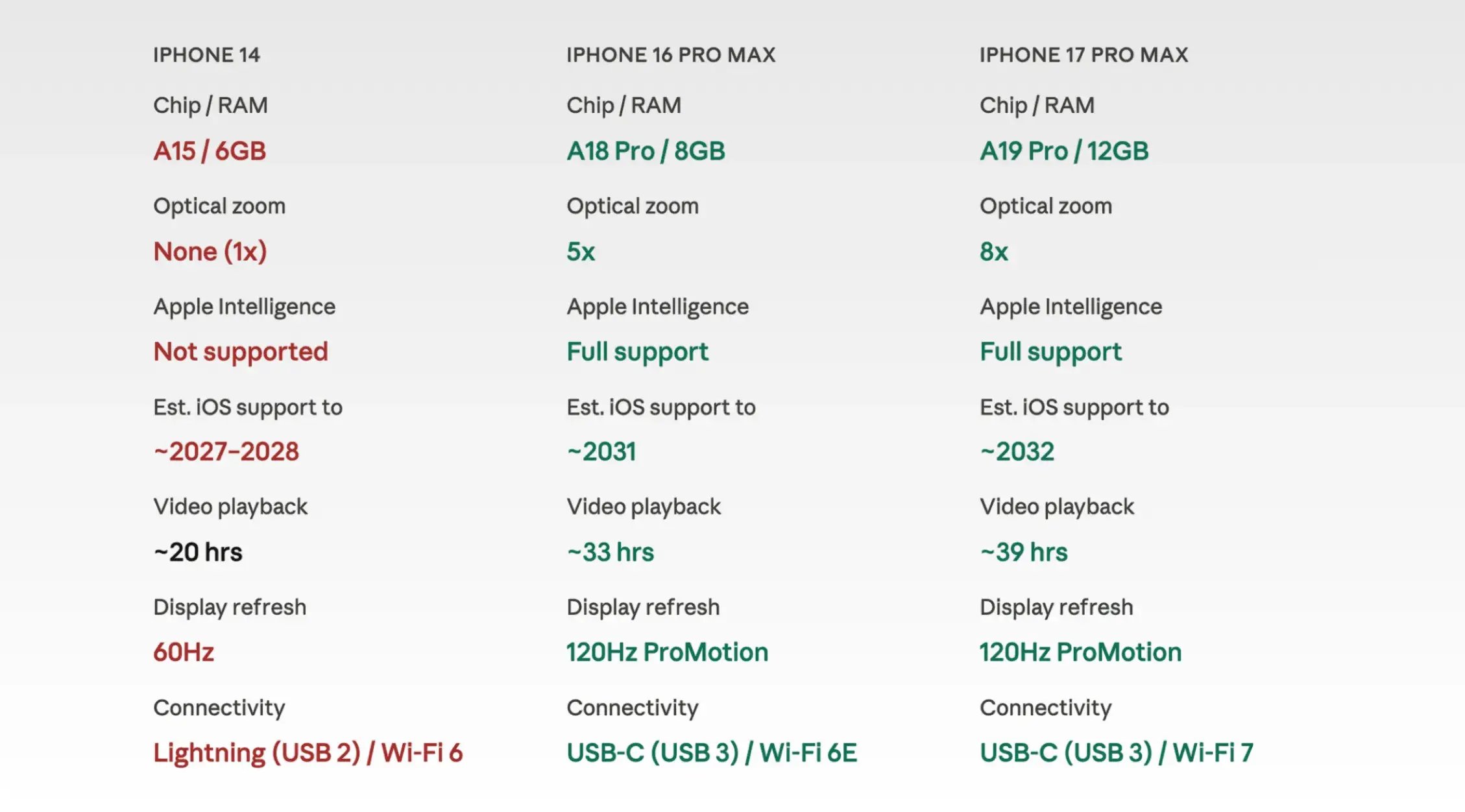
The display is a further gap. The iPhone 14 runs at 60Hz, the same fixed refresh rate it launched with in 2022. Current certified models use ProMotion displays with adaptive refresh rates up to 120Hz. For workers reviewing technical drawings, inspection photos, or video footage in the field, screen fluidity and responsiveness have a direct effect on usability. The iPhone 17 series also pushes outdoor peak brightness to 3,000 nits, up from the iPhone 14's 2,000 nits, which matters for legibility on bright offshore decks or open plant environments.
Connectivity follows the same direction. The iPhone 14 uses a Lightning connector and supports Wi-Fi 6. Current certified models use USB-C with USB 3 data transfer speeds, and support Wi-Fi 6E or Wi-Fi 7. In RF-congested industrial environments where multiple wireless systems compete for bandwidth, the newer standards deliver more stable throughput when it matters most. The Lightning connector is also a practical inconvenience for operations running mixed USB-C fleets across laptops, tablets, and other field devices.
The total cost of ownership case for a current certified model
For price-conscious operations, the instinct is to choose the lowest-cost certified device that meets the zone requirement. That logic is sound up to a point. Where it breaks down is when you factor in the full ownership timeline rather than just the upfront number.
The iPhone 14 launched in September 2022 and is currently estimated to reach end of active iOS support around 2028, based on Apple's historical track record of six to seven years of major updates. That means, at the time of writing, the iPhone 14 has approximately two years of its full active support window remaining. A device deployed now inside a certified enclosure may reach software end-of-life well before the enclosure itself does.
When that happens, the organisation faces a choice between running an unsupported operating system in a classified hazardous area - which raises legitimate questions about app compatibility, security posture, and compliance, or replacing the handset inside the enclosure ahead of schedule. Either way, there is a cost that a longer-supported device avoids entirely. The iPhone 16 Pro Max and iPhone 17 series carry expected iOS support through 2031 and 2032 respectively, offering three to four additional years of active support over the iPhone 14.
Battery life reinforces the same picture. The iPhone 14 delivers around 20 hours of video playback. The iPhone 16 Pro Max extends that to around 33 hours, and the iPhone 17 Pro Max reaches 39 hours. For a field worker on a long shift who cannot easily return to a charging point, that headroom is not a luxury.
The iPhone 14 vs new generations: practical differences in the field
The gaps between the iPhone 14 and current certified models are felt across nearly every aspect of field use. A worker carrying an iPhone 14 through a twelve-hour offshore shift has no optical zoom, a 60Hz screen, a Lightning cable that doesn't match the rest of the fleet, and a device that may reach software end-of-life within the next couple of years. Each of those limitations has a direct operational consequence.
The zoom gap alone changes how field workers can do their jobs. Documenting plant equipment, pressure gauges, or structural condition from a safe distance requires meaningful optical zoom. The iPhone 14 has none. Current generation certified models offer up to 8x optical zoom, returning sharp, usable images without requiring the worker to physically approach the subject.
The connectivity picture matters in dense industrial environments. Offshore platforms and chemical plants are RF-congested by nature. Wi-Fi 6E and Wi-Fi 7, available on current certified models, handle that congestion substantially better than the iPhone 14's Wi-Fi 6. For operations running video-based remote inspections, real-time collaboration tools, or large file transfers, connection stability translates directly into operational efficiency. The move from Lightning to USB-C with USB 3 speeds also matters for operations where wired data sync is part of the site workflow.
The software picture follows the same direction. Inspection apps, maintenance platforms, and reporting tools are already building Apple Intelligence integration into their development roadmaps. Features like AI-assisted anomaly flagging in inspection footage, automatic report generation from voice notes, and real-time translation for offshore teams working across languages are in active development for devices that support the platform. The iPhone 14 will not receive them.
Check out the Intrinsically Safe iPhone 17 Pro Max to see what your team could be running with.
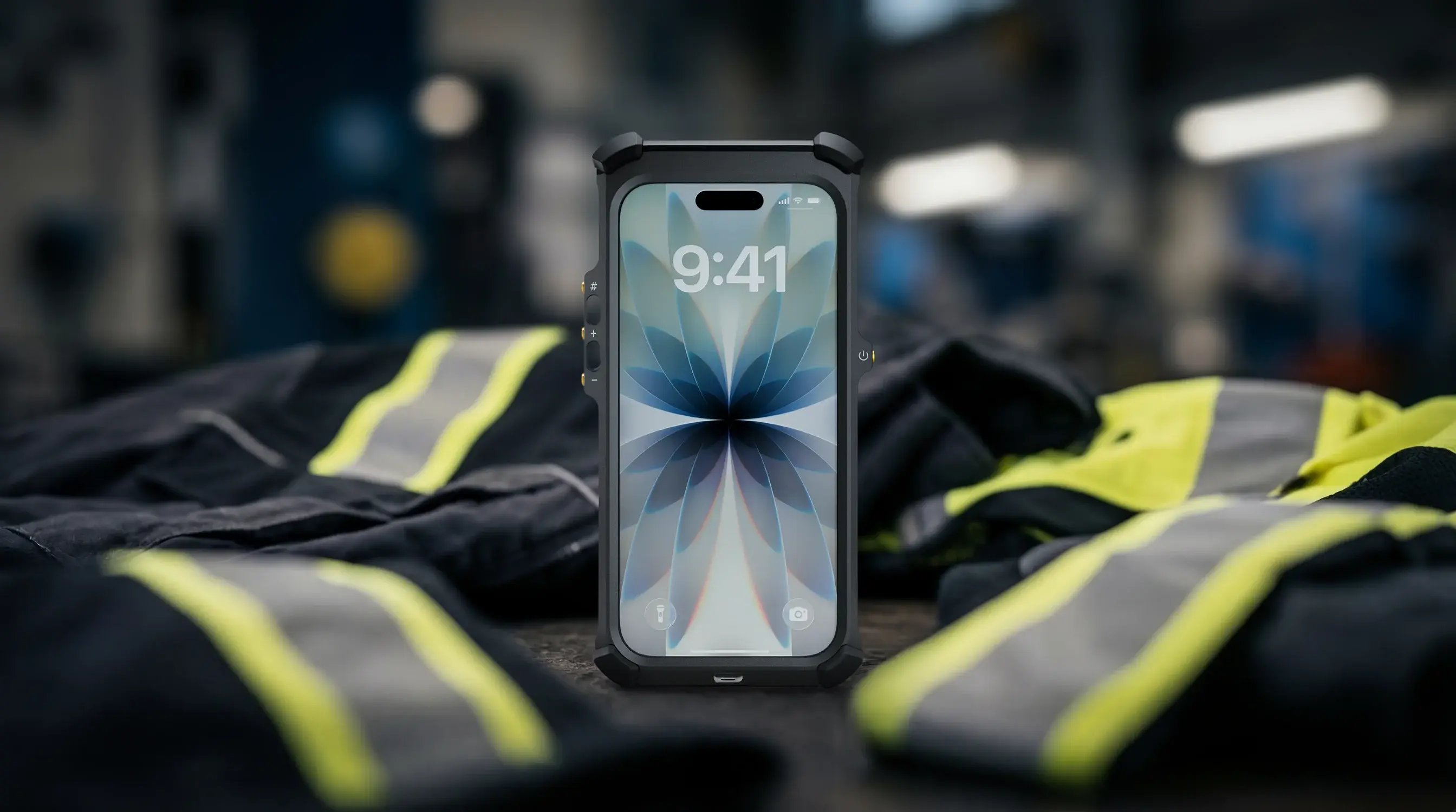
The iPhone 17 in an explosion proof case is a meaningful upgrade
What this means if you are buying now
If you already have iPhone 14 devices in a certified enclosure and the fleet is performing adequately, there may not be an immediate reason to replace them. The devices are still supported, certifications remain valid, and a forced refresh before the hardware earns its keep has its own cost.
If you are making a procurement decision now, the calculus is different. The iPhone 14's remaining support window is short, its hardware gaps to current models are significant, and the total cost of ownership case for a current generation device is strong. The iPhone 16 Pro Max is the practical choice for most operations: a meaningfully longer support runway, dramatically better camera capability, full Apple Intelligence compatibility, faster and more stable connectivity, and battery life that comfortably covers a long shift. For operations that want the maximum runway at the top end of the budget, the iPhone 17 and iPhone 17 Pro Max extend that further still.
To find out which option is best for your fleet, contact one of Xshielder’s experts.
FAQs
Can you make an iPhone 14 intrinsically safe?
Yes. An iPhone 14 can be made suitable for use in classified hazardous areas by housing it inside a certified explosion proof case. The enclosure carries the ATEX and/or IECEx certification, and the device and case together form a compliant system rated for Zone 1 or Zone 2 depending on the solution chosen. The iPhone 14 on its own carries no hazardous area rating.
Can the iPhone 14 be used in a Zone 1 hazardous area?
Yes, but only when housed inside a certified explosion proof enclosure rated for Zone 1. A bare iPhone 14 has no ATEX or IECEx certification and cannot be used in any classified zone without one. The certification belongs to the enclosure, which must be specifically tested and approved for Zone 1 use with the iPhone 14 as the device inside it.
How does an intrinsically safe iPhone 14 compare with an intrinsically safe iPhone 16 Pro Max?
The iPhone 16 Pro Max delivers 5x optical zoom versus no optical zoom on the iPhone 14, around 33 hours of battery life versus 20, a 120Hz ProMotion display versus 60Hz, Wi-Fi 6E and USB-C USB 3 versus Lightning and Wi-Fi 6, full Apple Intelligence support, and an estimated three to four additional years of active iOS updates. For most operations making a new deployment decision today, the 16 Pro Max represents a substantially stronger total cost of ownership case.
How does an intrinsically safe iPhone 14 compare with an intrinsically safe iPhone 17?
The iPhone 17 brings Wi-Fi 7, a 120Hz ProMotion display, meaningfully better battery life, USB-C connectivity, full Apple Intelligence support, and a support window extending to approximately 2032 — all absent on the iPhone 14. As the most accessible current-generation certified model, it addresses every major hardware gap the iPhone 14 presents at a price point closer to the base end of the range.
How does an intrinsically safe iPhone 14 compare with an intrinsically safe iPhone 17 Pro Max?
The iPhone 17 Pro Max represents the largest gap in the range, with up to 39 hours of battery life, the A19 Pro chip with 12GB of RAM, 5x optical zoom, 3,000 nit peak outdoor brightness, Wi-Fi 7, and the longest projected iOS support window currently available. Against the iPhone 14's aging hardware and closing support window, it is the most future-proof certified option on the market.