

Intrinsically Safe Phone Cost: Why Support Life Is Key to TCO
Outside of technology-focused work environments, Apple products often carry a reputation for being on the pricier side, with the perception that users are paying as much for the brand and prestige as they are for the underlying product. In hazardous-area procurement that reputation tends to settle the buying decision early - with the assumption that choosing a purpose-built Android device is the safer, and more budget-friendly choice.
While it is true that the initial outlay for a Zone 1 certified Android phone is typically slightly cheaper than that of an equivalent iPhone, the cost over the course of its lifetime - referred to as Total Cost of Ownership - is a more interesting story. The reason largely comes down to how long the device can remain a viable part of an organisation's IT systems.
The hardware is rarely the concern - it's the software that needs to be monitored. Once an operating system stops receiving security updates, the device can quickly become an IT, security and audit concern. Therefore, a device that costs less upfront but reaches end of support after four years is a very different financial proposition from one that remains supported for eight.
This article sets out what intrinsically safe phones currently cost to buy, examines the software support Apple has actually delivered across shipped iPhone and iPad models, compares it with the Android platforms used by current Zone 1 alternatives, and uses those figures to calculate cost per year - a calculation you can apply to your own procurement quotes.
What intrinsically safe phones cost in 2026
Before getting to the lifetime picture, it is worth establishing where the market currently sits. Zone 1 certification is demanding and the pricing reflects it. The table below shows how the leading dedicated intrinsically safe handsets compare, anonymised.
| Device | Key benefits | Approx. price (exc. VAT) |
|---|---|---|
| Android industrial phone #1 | 5G, Wi-Fi 6 | ~ €2,600 |
| Android industrial phone #2 | Compact 5G, flagship specifications | ~ €1,900 – €2,500 |
| Android industrial phone #3 | Modular accessory support | ~ €2,200 – €2,700 |
| Android industrial phone #4 | Proven offshore track record | §1 |
Across these devices you are looking at roughly €1,900 to €2,700 per unit. For a fleet of 50 workers that is an outlay of €95,000 to €135,000 before accessories, data plans or deployment are added.
A growing number of operators are taking a different route, pairing a standard consumer smartphone with a certified explosion-proof case. Xshielder produces ATEX and IECEx certified cases engineered specifically for the latest iPhones and iPads, which brings these devices into use in Zone 1 without modifying the product itself.
The latest iPhone combined with a Zone 1 case is competitive with the higher ranges listed above. So, if the day-one numbers are close, then the decision should hinge on what happens across the seven or eight years that follow.
The cheapest device to buy is not necessarily the cheapest device to own.

The staying power of Apple products:
|
> 7 years iPhone 11 has been / continues to be supported by iOS |
> 9 years 2017 iPad Pro, in support through September 2026 |
~ 2033 Minimum projected iPhone 17 security support |
Above are the top-line figures for the software support Apple devices have already received, along with what the same pattern points to for a device bought today. The third number is a projection rather than a published date, since Apple publishes no specific support period for any of its devices.
What can be established is something arguably more useful for planning, which is a long and consistent record of shipped devices with verifiable release dates and verifiable end-of-update dates. That record has held steady across more than a decade of hardware, and a pattern of that length carries less risk than a stated commitment on a platform with no comparable history behind it.
How long do iPhones receive iOS updates
The headline statistic here is that every iPhone released since September 2019 runs the same current version of iOS as a handset bought last month. A phone that is now seven years old is not simply receiving patches - it is on the current platform, with the current security model and current app compatibility.
| Model | Released | Newest OS supported | Status | Years in support |
|---|---|---|---|---|
| iPhone 17 | September 2025 | iOS 26 | Supported | 1, ongoing |
| iPhone 16 series | September 2024 | iOS 26 | Supported | 2, ongoing |
| iPhone 15 series | September 2023 | iOS 26 | Supported | 3, ongoing |
| iPhone 14 series | September 2022 | iOS 26 | Supported | 4, ongoing |
| iPhone 13 series | September 2021 | iOS 26 | Supported | 5, ongoing |
| iPhone 12 series | October 2020 | iOS 26 | Supported | 5.9, ongoing |
| iPhone 11 series | September 2019 | iOS 26 | Supported | 7, ongoing |
| iPhone XR, XS, XS Max | September 2018 | iOS 18 | Ended April 22, 2026 | 7.6 |
| iPhone 8, 8 Plus, X | September 2017 | iOS 16 | Ended March 31, 2025 | 7.5 |
| iPhone 6S, 6S Plus | September 2015 | iOS 15 | Ended March 31, 2025 | 9.5 |
Years in support are measured from general availability to the final security update, or to August 31, 2026 for models still receiving updates.
How long do iPads receive iPadOS updates
For those considering an Apple iPad, the data is even more impressive. Tablet support windows in this dataset run longer than phone windows, which matters for anyone using tablets for inspection rounds, permit-to-work or documentation access in the field. The 2017 iPad Pro has now been in support for over nine years, and the 2018 model is still on the current release of iPadOS.
| Model | Released | Newest OS supported | Status | Years in support |
|---|---|---|---|---|
| iPad Pro 11-inch (M5) | October 2025 | iPadOS 26 | Supported | 0.9, ongoing |
| iPad Pro 11-inch (M4) | May 2024 | iPadOS 26 | Supported, in production | 2.3, ongoing |
| iPad Air (3rd gen), iPad mini (5th gen) | March 2019 | iPadOS 26 | Supported | 7.5, ongoing |
| iPad Pro 11-inch (1st gen) | November 2018 | iPadOS 26 | Supported | 7.8, ongoing |
| iPad Pro 10.5-inch and 12.9-inch (2nd gen) | June 2017 | iPadOS 17 | Ends September 17, 2026 | 9.3 |
Every row above was entered by hand and checked against Apple's own supported-models documentation rather than passed through from a third-party feed.
Why Zone 1 Android alternatives have a shorter runway
The data above is more meaningful when put into context. The comparison that matters for a hazardous-area fleet is not simply Apple versus Android, but the underlying operation systems and support runway offered by each platform.
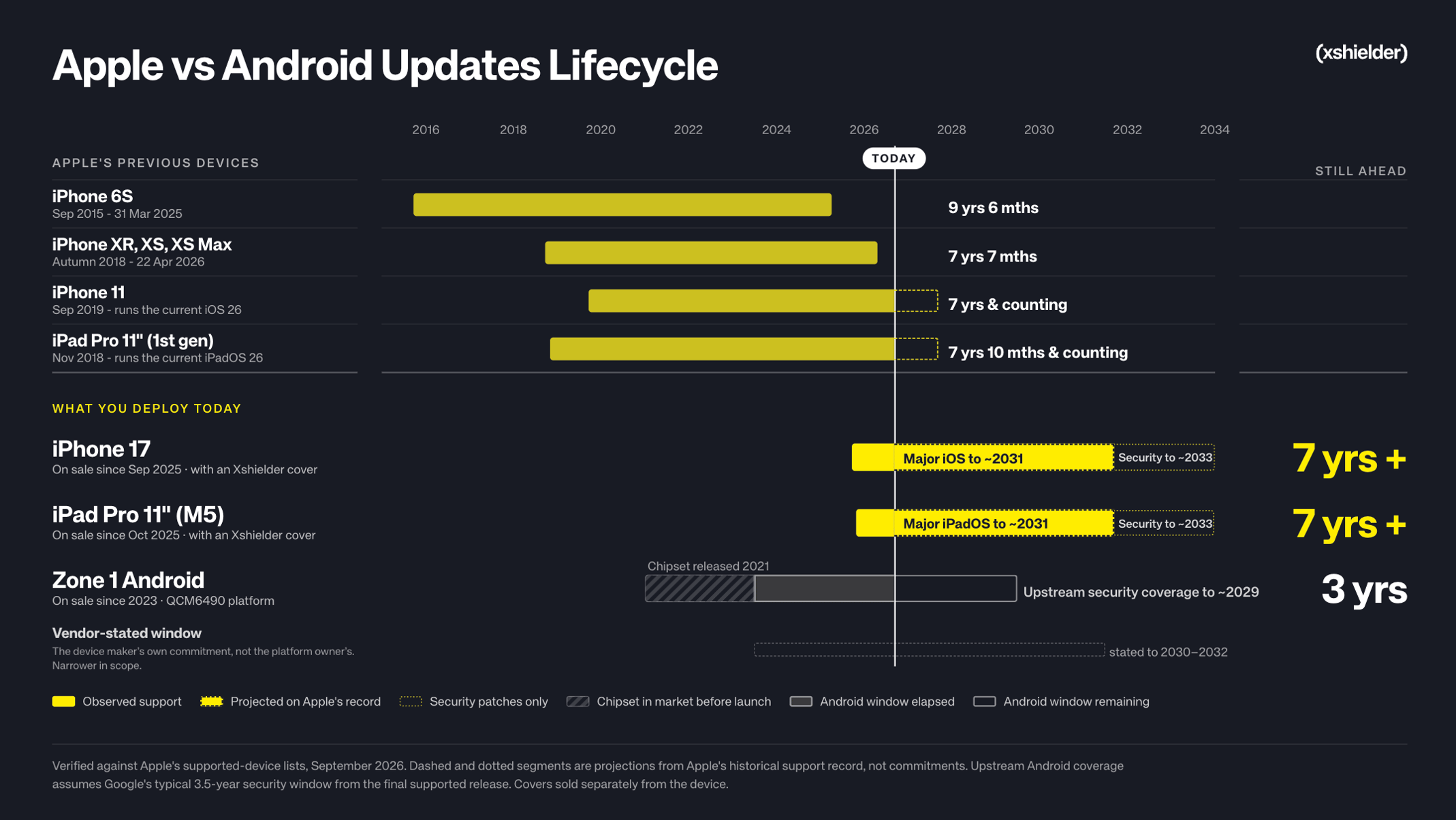
Current Zone 1 Android alternatives are built around the Qualcomm QCM6490, a chipset introduced in 2021. Devices using it launched in 2023 and 2024, meaning the underlying silicon was already around three years old when it became standard in Zone 1 devices.
The version gap has continued too. Android 17 became the current release in June 2026, while most Zone 1 Android devices on the market today ship with Android 14, released in October 2023. A buyer placing an order today is therefore purchasing a device that is already three major Android versions behind, with Android 16 expected to be the final major release supported on the platform.
Google typically maintains security fixes for an Android release for around three and a half years. Android 12, released in October 2021, dropped out of the monthly security bulletins in March 2025; Android 13 followed in March 2026. On that basis, upstream coverage for a QCM6490 device is likely to run into 2029–30. Some device manufacturers publish patch end dates extending into 2030–32, but these represent updates assembled by the manufacturer from Google and chipset-supplier fixes rather than support delivered directly by the platform owner.
Qualcomm's 2025 announcement of eight years of Android updates is sometimes cited as evidence that this gap is narrowing. That programme applies to the Snapdragon 8 Elite and newer generations of the 8 and 7 series; the QCM6490 is not included.
The underlying issue is structural. Zone 1 Android devices are typically refreshed on a five- to six-year cycle, using silicon that is already several years old when the device launches. The result is a support runway that is already partly consumed before the customer takes delivery.
Apple's annual product cycle works differently. Each replacement brings the customer onto the current generation, with its support window effectively beginning at purchase rather than being inherited from an older hardware platform.
Check out the image below for a clear visualisation:
What this means for a Zone 1 deployment
The practical takeaway from the tables above is that teams can plan their device lifecycle with greater confidence. Seven to eight years of software support is a reasonable assumption for iPhone and iPad based on Apple's track record with shipped devices. That allows refresh cycles to be planned around the expected hardware lifespan, rather than an end-of-support date arriving while devices are still perfectly capable of doing their job.
The performance of the latest iPhone 17 and 17 Pro Max strengthens that case. Their current-generation hardware provides substantial headroom, making it reasonable to expect the devices to remain technically capable throughout a seven- to eight-year deployment window, rather than becoming obsolete simply because they have aged.
There is an IT policy dimension as well as a cost one. Corporate security policies increasingly set a floor on how old an operating system may be, and we regularly see IT teams that will not accept a device running an OS more than two years behind current, with frequent security patching required alongside it. A device that stops receiving major OS releases can therefore stop satisfying that policy years before it physically fails. At that point, it either comes out of service early or remains in use as an accepted exception.
The cost of getting the lifecycle wrong is rarely limited to the handsets. A mid-cycle platform change brings MDM reconfiguration, re-testing of field applications, updated work instructions and retraining across every shift and site. These costs typically fall on operations rather than the IT hardware budget, which is why they are often absent from the initial tender comparison.
Understanding Total Cost of Ownership for Intrinsically Safe Phones
As we've discussed throughout this article, the purchase price is only the starting point. Total Cost of Ownership (TCO) looks at what a device costs over its entire useful life, including the cost of replacing it, supporting it, and managing it.
Techstep’s analysis puts 60-70% of a mobile device’s lifetime cost after the point of purchase, in management, repairs and lost resale value.
Source: Techstep Report
For a hazardous-area fleet, five factors have the greatest influence on that calculation: service life, residual value, operational and security overhead, the number of devices each worker has to carry, and the additional hardware the device does or does not make necessary.
The procurement decision is therefore not simply about choosing a cheaper handset. It is about choosing a device and platform that can minimise those costs over time. The support data above is particularly important because it helps establish how long the investment can realistically remain in service.
1. Longer service life, lower replacement cost
Every additional year a device remains in service is a year in which the organisation does not need to buy, provision and deploy a replacement. That means fewer hardware purchases, but also less procurement activity, configuration work, application testing and field deployment.
As we've stressed throughout this blog, software support is a particularly important part of this calculation. A device may remain physically capable of doing its job, but once its operating system stops receiving security updates, it can become difficult to justify from an IT, security and audit perspective.
There is also a wider operational benefit to a longer service life. Most industrial organisations already manage iPhones and iPads outside hazardous areas. Extending the same platform into Zone 1 means existing MDM configurations, application environments, patching processes and work instructions can carry across, rather than creating a separate device ecosystem for a relatively small part of the workforce.
A longer-supported device therefore does more than delay the next handset purchase. It can delay the wider cost and disruption of a fleet refresh.
2. Residual value at end of life
The second question is what value remains when the device leaves the fleet. A handset that can be traded in or resold reduces the net cost of the original purchase.
This is where the economics of the Xshielder approach are particularly different. Because the patented cover is removable, the iPhone can be taken out at the end of its deployment and traded in or resold through the same channels as a standard corporate handset. The cover protects the phone throughout its hazardous-area deployment, while the underlying device retains a residual value that can be put towards its replacement.
The same principle applies during deployment, not only at the end of it. If the outer protection is damaged in the field, you replace the cover rather than the whole device. With a sealed unit, physical damage to the housing and damage to the electronics amount to the same replacement decision.
Both components can also be recycled, providing a more favourable outcome for organisations tracking Scope 3 emissions and the carbon footprint of IT procurement.
A sealed rugged Android device, by contrast, reaches end of life as a single unit: the electronics remain inside the housing, leaving little comparable value to recover.
3. Lower operational and security overhead
TCO also includes the cost of keeping a device secure, compliant and operational throughout its life.
The Xshielder cover has no user-accessible ports, reducing potential routes for moisture and contamination to reach the device. And because iOS updates and security patches are delivered directly by Apple, there is no additional chipset or device-manufacturer layer between the platform owner and the end user.
For devices connected to the same corporate network as the rest of the workforce, maintaining a current and supportable operating system is not optional. A hazardous-area device should not become the weak link in an organisation's security posture simply because it is deployed in a different physical environment.
There is also a human cost to consider. If employees already use iPhones elsewhere in the organisation, putting the same interface and workflows in their hands in the field reduces training requirements and avoids the disruption that can come with introducing an unfamiliar platform.
4. One device instead of two
Many hazardous-area workers currently carry two phones: a site-certified handset for use in the classified area, and a separate work smartphone for everything else. That means two devices to procure, two data plans to pay for and two estates for IT to manage and secure, for the same employee.
Because an iPhone in an Xshielder cover is a standard corporate handset with protection added, it can be the only device the worker needs, on site and off. Removing the second device removes a recurring line item that sits outside the hardware budget entirely, which is why it rarely appears in a tender comparison and often turns out to be one of the larger numbers in a lifetime cost model.
5. Fewer pieces of additional hardware
Certification constraints mean dedicated handsets frequently ship with limited camera systems. Where inspection photography, defect reporting or video documentation matters, operators often end up procuring separate certified cameras to get usable images, at meaningful additional cost per user.
A current iPhone handles high-resolution stills and video natively, along with the apps the images feed into. Anything the device covers on its own is hardware that does not need separate procurement, certification, management or replacement.
How To Calculate Total Cost of Ownership
Once these factors are recognised, the comparison becomes much simpler.
Take the delivered cost of the device, subtract the residual value expected at end of life, and divide the result by the number of years the device can realistically remain supported and in service.
Cost per year = (Purchase price − Residual value) ÷ Supported service life
Applying that formula to the price bands above makes the difference visible. A certified Android handset priced between roughly €1,900 and €2,700 has little established secondary market, so residual value at end of life sits close to zero. Set against a supported software life of three to four years, which is the window in which the underlying platform continues to receive security updates, cost per year lands somewhere between €540 and €770 at the midpoint of that range.
The iPhone plus Zone 1 case starts at a higher initial upfront cost. However, because iOS updates run for typically 7+ years, and because the handset holds a real resale value at the end of that period, the overall yearly cost comes down significantly.
Request a custom TCO analysis
If you are building a multi-year business case for hazardous-area devices, the support record above is the part most tenders leave out. Our explosion-proof covers for iPhone and iPads are built so the handset lasts for years to come, and can be uncovered at end of life so its residual value comes back to you. Request a quote and we will run the cost-per-year numbers for your fleet size and refresh cycle.
Frequently asked questions
How much does an intrinsically safe phone cost to buy?
Dedicated intrinsically safe handsets certified for Zone 1 currently sit at roughly €1,900 to €2,700 per unit excluding VAT, which is €95,000 to €135,000 for a fleet of 50 before accessories, data plans or deployment. A standard iPhone paired with a certified explosion-proof cover sits at the upper end of that range.
How much does an intrinsically safe phone cost per year over its service life?
Take the delivered device cost, subtract the residual value recoverable at end of life, and divide by the years the platform will still be supported.
How long do intrinsically safe iPhones receive iOS updates?
Recent iPhone models have received software updates for between seven and nine and a half years, with the iPhone 6S reaching nine and a half years and every model since September 2019 still running the current iOS release. Apple publishes no guaranteed period, so these figures describe shipped devices rather than a commitment.
How long are intrinsically safe Android phones for Zone 1 supported with security updates?
Current Zone 1 Android devices run on the Qualcomm QCM6490, a 2021 chipset, with Android 16 expected to be its final major version and realistic upstream security coverage ending around 2029 or 2030. Most ship today running Android 14, three major versions behind the current release.
Do intrinsically safe phone certifications change when the operating system is updated?
No. ATEX and IECEx certification attaches to the enclosure and its assessment against the relevant standards, so an iOS or Android update neither extends nor affects certification status.
How many years should I budget for an intrinsically safe phone deployed in Zone 1?
Seven to eight years of software support is a defensible planning assumption for iPhone based on models that have already completed their support windows. Budgeting a Zone 1 Android device on the same horizon is harder to justify, since upstream platform coverage for current models is likely to end sooner.
Do intrinsically safe tablets last as long as phones in hazardous areas?
iPad support windows in this dataset run slightly longer than iPhone windows, with the 2017 iPad Pro supported for over nine years and the 2018 model still on the current iPadOS release. Physical service life then depends on the protective enclosure and the conditions the device works in.
Sources and method
Release dates and end-of-update dates are drawn from the community-maintained trackers at endoflife.date for iPhone and endoflife.date for iPad, then verified row by row against Apple's own supported iPhone models documentation and the equivalent iPad documentation before publication. Where the two disagree, Apple's documentation is used.
Android platform figures come from Google's Android security bulletins, which show which releases still receive monthly fixes, and from published coverage of Qualcomm's 2025 update commitment. Chipset launch dates and device release dates are taken from manufacturer specification sheets.
Dedicated handset pricing is indicative list pricing excluding VAT, gathered from published reseller and manufacturer sources in Q3 2026, and is shown anonymised as a market range rather than as a quotation for any named product. Xshielder pricing shown is list pricing as of Q3 2026, and residual value is an estimate rather than a guaranteed figure. The proportion of lifetime device cost falling after purchase is drawn from analysis published by Techstep, a mobility services provider rather than an independent analyst.
This page is reviewed and updated quarterly. Apple is not affiliated with Xshielder and has not reviewed or endorsed this analysis. Support windows described here are an observed historical pattern based on devices Apple has already shipped, and they carry no commitment from Apple regarding future models.