

Intrinsically Safe and Explosion Proof Phones: How to Choose in 2026
If you are specifying mobile devices for a hazardous area, the decision comes down to two main routes. You either buy a dedicated intrinsically safe handset, built from the ground up for the environment and priced accordingly, or you put a certified explosion proof cover around a current consumer smartphone. Regardless of the direction you choose, both contain options permitted for Zone 1 and Zone 2.
This guide works through both options, what each costs across a fleet, and the specification decisions that tend to determine whether a deployment succeeds.
Your Two Options in 2026
Most procurement teams reading this would have already established that standard phones are not permitted on site. The question is which of the two compliant routes fits the work.
| Consideration | Dedicated IS handset | Certified cover on a consumer phone |
|---|---|---|
| Typical unit price | EUR 1,900 to 2,700 | Cover plus a standard handset |
| Zone coverage | Zone 0, 1 and 2 (certification dependent) | Zone 1 and 2 (certification dependent) |
| Hardware generation | Often two to three years behind flagship | Current-generation iPhone |
| Camera | Basic industrial sensors | Full flagship camera system |
| Operating system | Proprietary or older Android builds | Current iOS |
| MDM integration | Often needs specialist handling | Native to existing Apple management |
| Support lifecycle | Historically, 2-4 years | iOS support into the 2030s |
| Form factor | Lighter, simpler | Heavier, enclosure based |
The two rows that decide most deployments are zone coverage and support lifecycle. If any part of your site is Zone 0 (uncommon), the first row settles it. If not, the last few rows usually carry more weight than the price difference. The sections below take each option in turn, and if you want the technical background on how the two protection concepts differ, that is covered further down.
Option A: A Dedicated Intrinsically Safe Handset
These are purpose-built devices, certified from the ground up for hazardous environments. They limit the electrical and thermal energy available inside the device, which is what allows the highest-certified versions to be used in Zone 0 where an explosive atmosphere is present continuously.
They are the right answer in three situations. Where any part of the work happens in Zone 0. Where a site standard specifies intrinsic safety by name rather than specifying a zone. And where the lightest possible device outweighs everything else, since an IS handset carries no enclosure.
The trade-off is capability. Processing power, battery capacity and camera performance are all constrained by the same energy limits that provide the protection. Most units run two to three years behind flagship consumer hardware, and the operating system is often proprietary or an older Android build, which brings its own training and management overhead. Support lifecycles of two to three years are common, so the replacement cycle arrives sooner than IT departments tend to assume at procurement.
Option B: A Certified Ex-Proof Case on a Current iPhone
The second route houses standard consumer hardware inside an enclosure certified under an explosion proof, or flameproof, protection concept. Certification applies to the assembly, so the cover and the specific handset models it is approved for are certified together.
This has become an increasingly common approach across offshore energy, chemical processing and large-scale industrial operations, because the device inside is the same one the rest of the business uses. Field teams get the full camera system, on-device processing and an interface they already know. IT gets a device that sits inside existing Apple management with no separate stack. Security patches arrive when Apple releases them.
The trade-off is that these enclosures are not certified for Zone 0 usage.
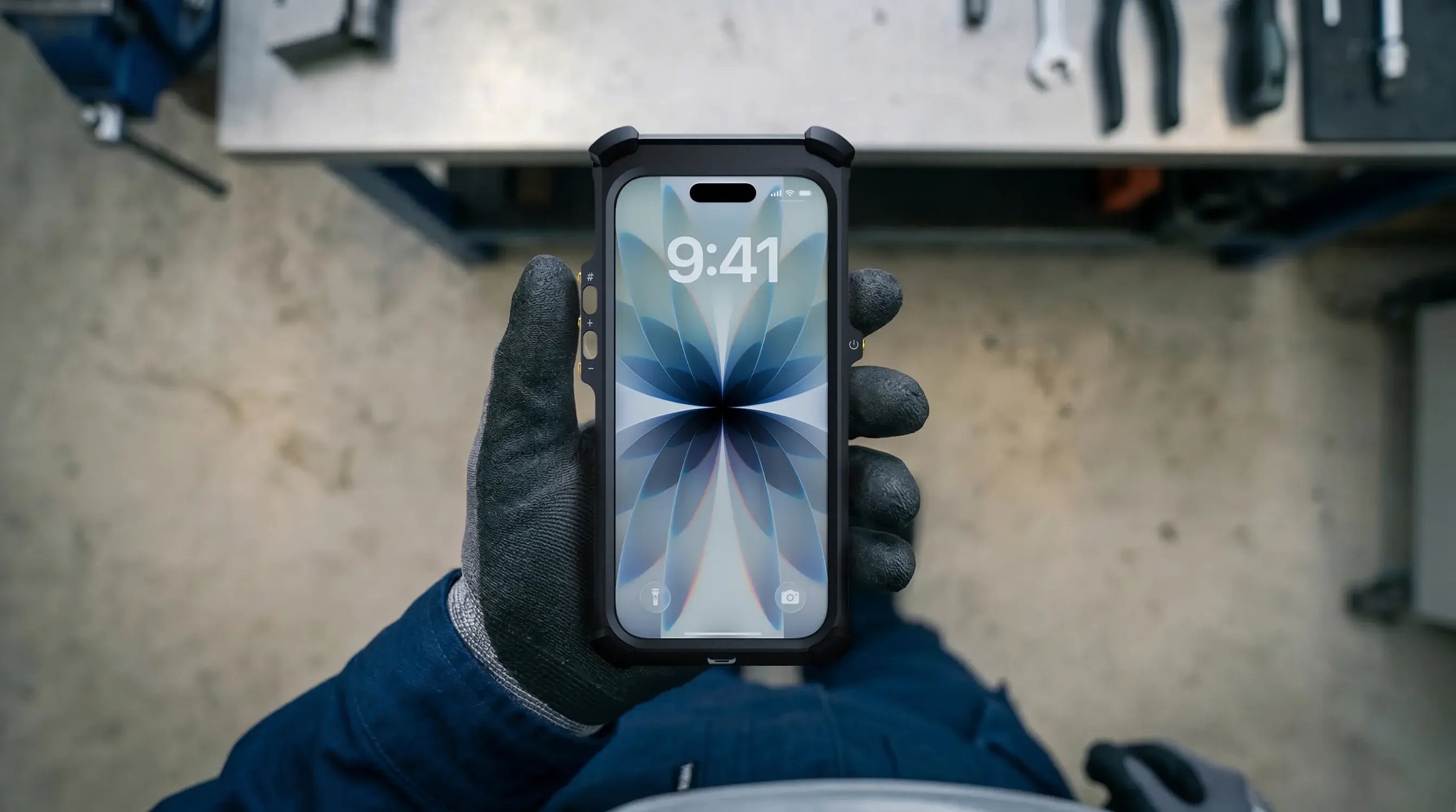
Xshielder covers house current iPhone hardware inside a precision-engineered enclosure certified for Zone 1/21 and Zone 2/22 under ATEX and IECEx. You can compare models across the full range of certified iPhone covers.
Intrinsically Safe or Explosion Proof?
Before we continue, it's worth clearing this question up. The two terms are used interchangeably in everyday conversation, including by us at times, because zone compatibility is usually what matters on site. They describe opposite engineering approaches, though, and the difference occasionally decides what you are permitted to deploy.
An intrinsically safe phone limits the electrical and thermal energy available inside the device, so that even under fault conditions it cannot produce a spark or surface temperature capable of igniting the surrounding atmosphere. That is achieved through specially engineered circuits and strict power and temperature thresholds.
An explosion proof, or flameproof, enclosure works the other way around. It accepts that ignition may occur inside and contains it, using a housing built to withstand the internal pressure and stop flame reaching the atmosphere outside. The enclosure is not sealed against the surrounding atmosphere, which is a common misunderstanding. Its job is containment rather than isolation.
| Feature | Intrinsically safe | Explosion proof |
|---|---|---|
| Approach | Limits ignition energy | Contains ignition |
| Zone suitability | Zone 0, 1, 2 | Zone 1, 2 |
| Hardware performance | Limited by design | Full performance possible |
| Form factor | Lighter, simpler | Heavier, enclosure based |
| Flexibility | Low | High |
For the detailed comparison, read our full comparison of intrinsically safe and explosion proof phones.
How Much Do Intrinsically Safe / Ex-Proof Phones Cost?
Dedicated IS devices typically run from EUR 1,900 to EUR 2,700 per unit, and higher for specialized configurations. For a mid-sized fleet that is a substantial capital outlay before anything else has been accounted for.
The larger cost usually sits further out. A realistic model accounts for lifespan, repairability, support lifecycle and the indirect costs that rarely reach a purchase order. Support overhead, accelerated replacement cycles, lost productivity from limited device capability and the expense of running a separate device ecosystem alongside the rest of the business all accumulate across a fleet lifetime.
Support lifecycle is consistently underweighted. A device supported for three years needs replacing far sooner than one supported for six, and once procurement, deployment and retraining are included, a longer support cycle represents meaningful savings at scale. An iPhone housed in a certified cover is expected to receive software and security support well into the 2030s, which makes financial planning more predictable and reduces the number of hardware refresh cycles.
There is an indirect cost that deserves naming. Underpowered devices create workarounds. If a worker cannot capture a usable photograph with the certified device, the temptation is to reach for an uncertified personal phone. That happens on sites worldwide, and providing capable equipment at the outset is the most reliable way to reduce it.
Our breakdown of intrinsically safe phone prices in 2026 covers the full picture, including the costs that rarely appear on a purchase order.
Are iPhones Intrinsically Safe or Explosion Proof?
Standard iPhones carry no hazardous area certification, and lithium-ion batteries and unrestricted electrical circuits present ignition risks in a classified environment. So, an uncased iPhone is not permitted in a hazardous area.
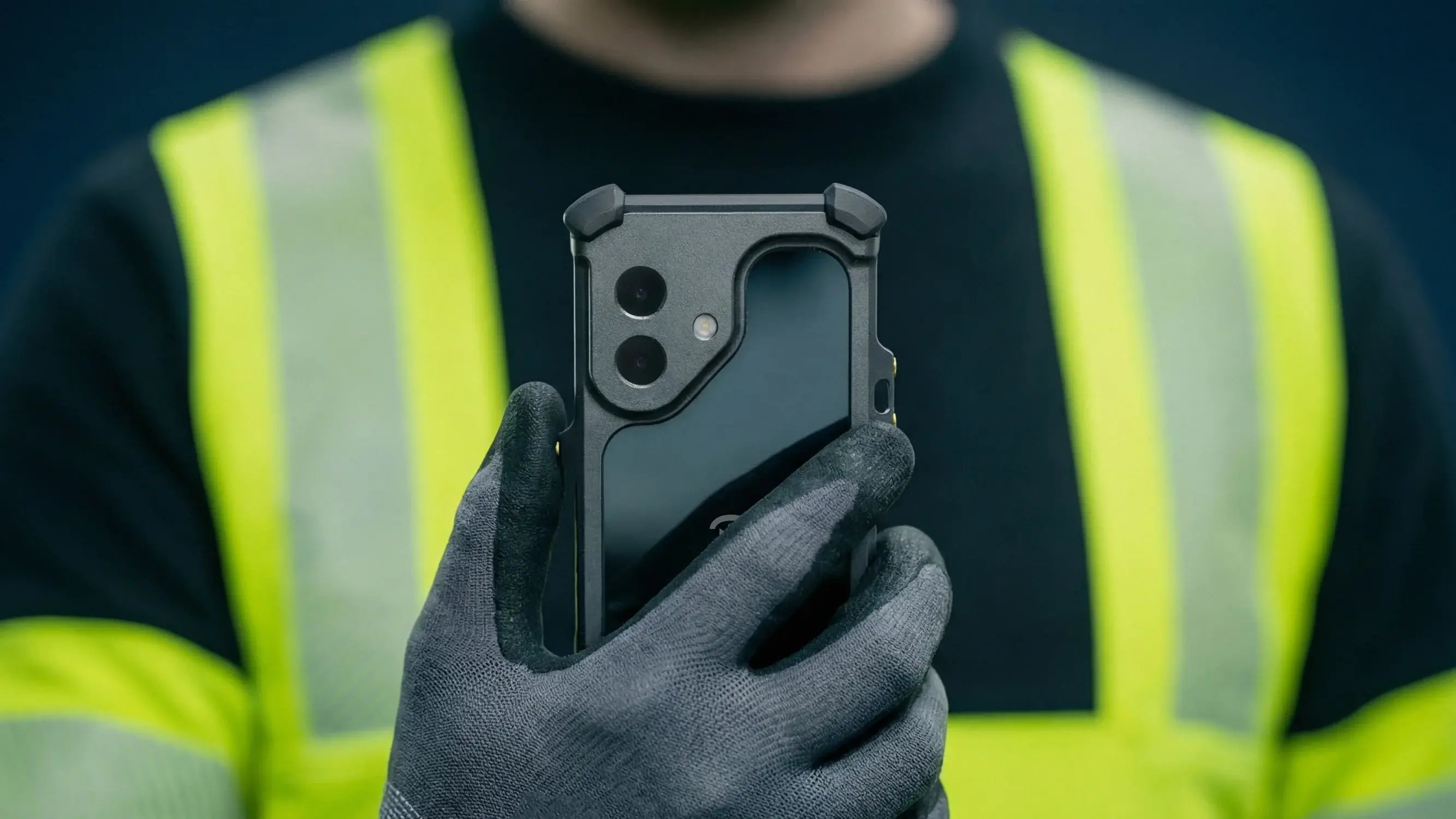
The equation changes when it is housed in a certified explosion proof cover. When that is the case, the latest iPhones can be deployed in Zone 1 and Zone 2 environments, which is why the approach has spread so quickly across offshore energy and chemical processing.
These cases are certified under an explosion proof, or flameproof, protection concept rather than under intrinsic safety. Both concepts are approved for Zone 1 and Zone 2, so for the majority of sites the distinction does not change what you are permitted to deploy. However, if your site specifically calls for intrinsic safety by name, or if you are working in Zone 0, that is where the difference becomes decisive.
How to Choose an Intrinsically Safe or Explosion Proof Device
Now that you have a solid understanding of the safety requirements and expectations on cost, it’s time to dig deeper on how to choose a device.
Many procurement decisions go wrong at this stage, not because teams don't understand safety, but because they focus on the device in isolation rather than the deployment as a whole.
1. Check Zone Classification
If you're still unsure where to start, confirm your zone before you look at a single product. Every other specification decision follows from it, and a mismatch here invalidates a deployment after it has been paid for.
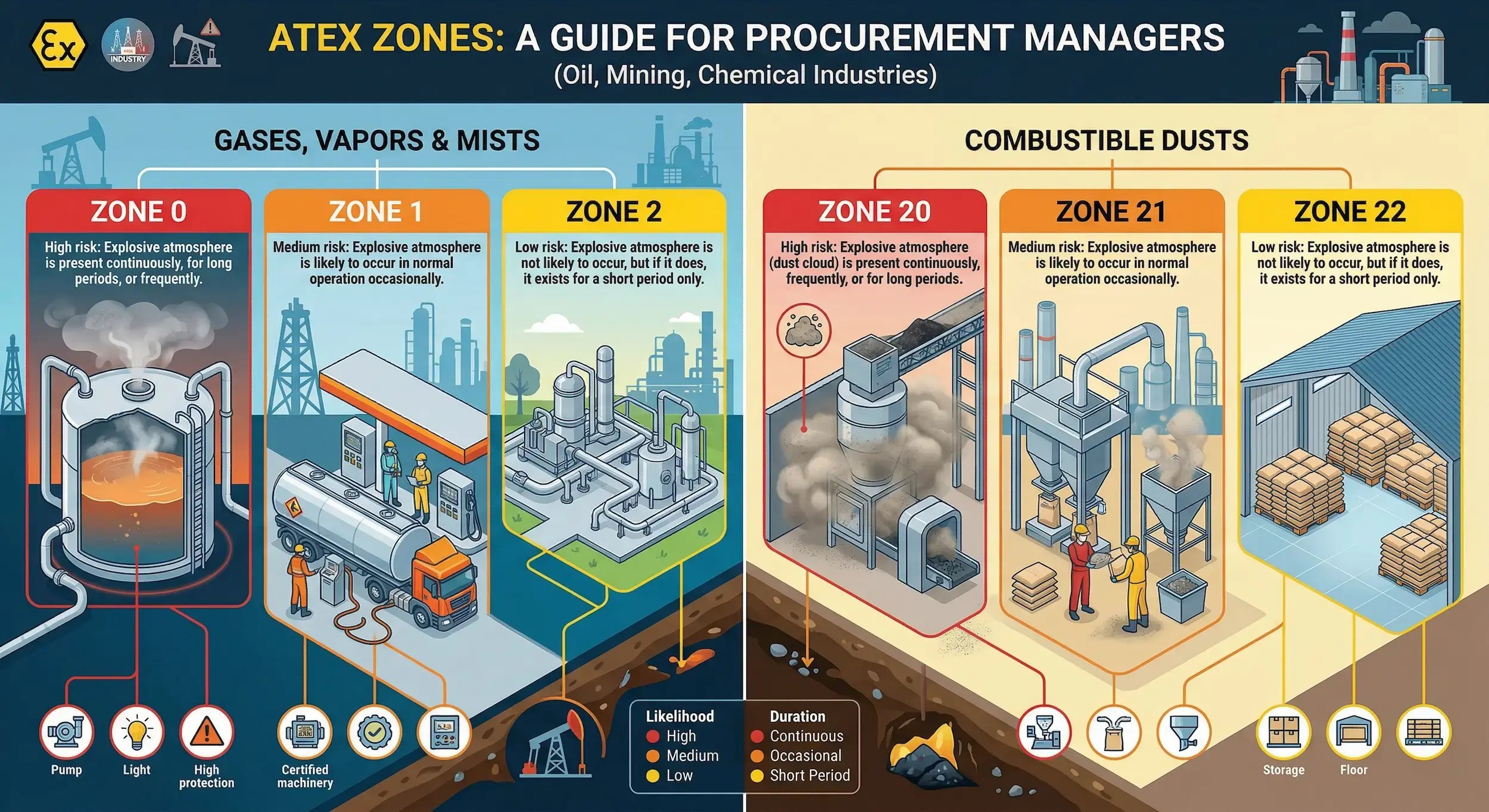
ATEX zone classifications describe how often an explosive atmosphere is expected to be present. Zone 0 means it is present continuously or for long periods. Zone 1 means it is likely during normal operation. Zone 2 means it is unlikely, but possible under abnormal conditions. The dust equivalents are Zone 20, 21 and 22, following the same logic for combustible dust clouds.
One rule applies throughout. A device certified for a higher-risk zone can be used in a lower-risk zone, but not the reverse. That means Zone 1/21 certification also covers Zone 2/22 work, which is why most industrial fleets standardize on Zone 1/21 rather than buying separately for each area.
Two further parameters sit alongside the zone. Gas group describes the volatility of what is present, where IIA covers propane, IIB covers ethylene, and IIC covers hydrogen and acetylene. Temperature class describes the maximum surface temperature the equipment may reach, where T4 caps at 135°C and T6 at 85°C. Each step up either scale demands more rigorous engineering.
ATEX is mandatory across the EU. IECEx is a voluntary international scheme, though it is widely recognized and useful if you deploy across borders. Specifying both simplifies procurement for multinational operations considerably. In the US and Canada, the Class and Division system has traditionally applied, although many sites are now harmonizing toward the Zone system.
For a fuller breakdown of what each zone permits, read our guide to ATEX, IECEx and zone classifications for mobile phones.
2. Confirm What You Need Your Devices To Do
Procurement decisions tend to go wrong when the device is assessed in isolation rather than against the work it has to support. Modern field workflows go well beyond calls and data entry, and the capability gap between the two options is widest exactly where those workflows are most demanding.
Display quality matters more than buyers often expect. Workers read schematics, review inspection reports and capture documentation in direct sunlight, so brightness, resolution and glare resistance are practical requirements. Processing power and memory matter for the same reason, since field software now expects several applications to run at once. A slow interface in a hazardous environment is a distraction at the moment focus matters most.
Camera capability is where dedicated industrial devices have historically fallen furthest behind. High-resolution photography supports defect capture and remote support, and optical zoom is valuable when workers cannot get physically close to an asset. Battery life across a full 12-hour shift is a baseline requirement, as is reliable Wi-Fi and cellular connectivity in the metal-heavy environments typical of refineries, offshore platforms and chemical plants. Bluetooth support for barcode scanners and wearables adds further flexibility.
Our Zone 1 certified cover for iPhone 17 Pro Max is built for teams running LiDAR-based capture and high-performance field workflows on current iOS.
The 2026 Trend
The most demanding workflows are increasingly built around edge AI, where data is processed locally on the device instead of being routed to the cloud. That supports real-time anomaly detection and automated inspection reporting, and it keeps working where connectivity is intermittent. Built-in LiDAR, now standard on flagship consumer hardware, allows 3D digital twins to be created directly on site. And 5G standalone connectivity has become the expectation for high-definition remote expert support, particularly in environments where earlier generations struggled with latency and device density.
3. Consider Durability, Ergonomics and Heat
A device has to survive the grit, heat and drops of a 12-hour shift without becoming awkward to use. A phone that workers find cumbersome creates its own risks, and that applies to the enclosure as much as to the hardware inside it.
IP65 is a reasonable baseline for active industrial use, covering full dust protection and resistance to water jets from any angle. Higher ratings extend that to submersion. Xshielder covers are rated IP68, which suits washdown areas and offshore work where spray and immersion are routine.
Ergonomics deserve more attention than they usually get at specification stage. The device must be operable in heavy-duty work gloves and should feel balanced in the hand. Compatibility with industrial lanyards, tool-tethering systems and vehicle mounts matters daily, since keeping hands free for climbing and manual tasks is a constant practical need.
The 2026 Trend
As mobile processors have become more powerful, thermal management has become a specification issue in its own right. An enclosure restricts how readily heat moves away from the device inside it, and sustained AI processing in direct sunlight generates a good deal of it. Passive heat-sink engineering that draws warmth away from the battery and processor helps to reduce throttling and shutdowns during extended use.
4. Check Out The IT Integration & Security Lifecycle
The hidden cost of a mobile deployment is nearly always management overhead. A device that needs its own policies, its own update cadence and specialist knowledge to support becomes a long-term liability, and this is where solutions built on standard consumer platforms have a clear advantage.
Whatever you choose needs to integrate natively with your MDM platform, whether that is Microsoft Intune, Jamf, SOTI or another system. That enables zero-touch deployment, remote configuration and immediate wiping of a lost device. Patch speed matters equally. Industrial environments are increasingly targeted by sophisticated threats, and a fleet should receive OS and security updates when the manufacturer releases them rather than weeks later once an intermediary has processed them.
The 2026 Trend
Standardization on a single platform is the dominant IT theme of 2026. CIOs are moving field teams onto the same operating system used across the rest of the business, typically iOS, which gives them one security policy, consistent app management and considerably less training time when onboarding.
5. Calculate Total Cost of Ownership
As mentioned earlier, purchase price is the starting point, not the full picture. The real cost of an intrinsically safe device fleet includes managing multiple device types, training and support overhead, shorter replacement cycles, and limited resale value.
In many cases, a high-performance smartphone in a certified explosion proof case delivers significantly lower lifetime cost, while offering better usability and longer hardware relevance.
6. Don't Forget About Adoption
A device that's slow, difficult to use, or missing key features doesn't just frustrate workers, it creates risk. When people find workarounds, those workarounds are often uncertified. Therefore, the best safety device is one that people actually use correctly.
In this detailed guide, we break down all of the key factors to consider when choosing an intrinsically safe or ex-proof device →
Specifying a Fleet for 2026 - A Recap
The zone sets the boundary and everything else is a judgment call. In Zone 0, intrinsic safety is the only route. In Zone 1 and Zone 2, both options are permitted, and the decision comes down to capability, IT overhead and lifetime cost. Where sites have that freedom, cover-based solutions have become the practical default for high-performance work, while a dedicated handset remains the better fit where a site standard names intrinsic safety or where weight outweighs everything else.
If you are working through a device specification and want a second opinion on zone requirements or fleet economics, our team works on this daily. Browse our certified iPhone cover range, or speak to a hazardous area specialist about your site.
Frequently Asked Questions
Can an iPhone be used in a Zone 1 hazardous area?
Yes, when housed in a cover certified for Zone 1 under ATEX or IECEx. An uncased iPhone carries no hazardous area certification and is not permitted in a classified environment.
Does Zone 1 certification also cover Zone 2 areas?
Yes. Equipment certified for a higher-risk zone may be used in a lower-risk zone, so a Zone 1/21 certified device is also suitable for Zone 2/22 work. The reverse does not apply.
What is the difference between intrinsically safe and explosion proof phones?
Intrinsic safety limits the energy available inside the device so it cannot ignite the atmosphere, while explosion proof design contains any ignition within the enclosure. Both are permitted in Zone 1 and Zone 2, but only intrinsic safety is approved for Zone 0.
What does the X mean on an ATEX certificate number?
An X suffix indicates specific conditions for safe use, listed within the certificate and forming part of the approval. Those conditions may cover cleaning, permitted accessories or charging, and they have to be followed for the certification to hold.
How much does an intrinsically safe phone cost in 2026?
Dedicated intrinsically safe handsets typically cost between EUR 1,900 and EUR 2,700 per unit, with specialized configurations costing more. Total cost of ownership is usually a more useful comparison than unit price.
Which MDM platforms work with hazardous area iPhones?
An iPhone in a certified cover manages exactly like any other iPhone, so it works natively with Microsoft Intune, Jamf, SOTI and other standard platforms. No separate device management stack is required.