
Intrinsically Safe Cameras in 2026: What Actually Matters for Hazardous Area Operations
In a Zone 1 environment, the camera a technician carries is not an afterthought. It is a compliance requirement, a documentation tool, and in some scenarios, a safety-critical piece of equipment. Choose the wrong one and you introduce ignition risk. Choose a poor-performing one and you produce evidence that cannot support an audit, an insurance claim, or an engineering decision.
This pillar page covers everything a safety manager or procurement lead needs to know about intrinsically safe cameras in 2026: what they are, what they need to do, how the technology has evolved, and which applications they support in modern industrial operations.
What Is an Intrinsically Safe Camera?
Before evaluating performance, features, or use cases, it’s critical to establish what “intrinsically safe” actually means in a hazardous area context. Without that foundation, it’s easy to misunderstand both the risks and the certification requirements that govern these devices.
An intrinsically safe camera is a device certified for use in potentially explosive atmospheres. The certification confirms that the device cannot produce sufficient electrical energy, spark, or surface heat to ignite a flammable gas, vapour, or dust under normal operating conditions or under defined fault conditions.
This is governed by international standards, primarily ATEX in Europe and IECEx globally. These frameworks define hazardous area zones based on the likelihood of an explosive atmosphere being present:
- Zone 0 / Zone 20: Explosive atmosphere present continuously or for long periods
- Zone 1 / Zone 21: Explosive atmosphere likely to occur in normal operation
- Zone 2 / Zone 22: Explosive atmosphere unlikely in normal operation, but possible briefly
A device must carry the correct zone rating, gas group, and temperature class for the specific environment where it will be used. Zone 2 certification does not cover Zone 1 areas. These are not interchangeable, and using a lower-rated device in a higher-risk zone is a safety violation regardless of how good the camera performs.
Gas group matters too. A camera certified for Group IIA gases (propane equivalents) is not approved for Group IIC environments such as hydrogen or acetylene atmospheres, even if it carries Zone 1 certification. Always verify the full certification documentation, not just the headline zone rating.
Why Camera Quality Has Become a Compliance Issue
Understanding certification is only part of the picture. Once a device is approved for use, the next question is whether it is actually capable of producing documentation that meets modern regulatory and operational standards.
There was a time when any photographic record was considered adequate for inspection and maintenance documentation. But in recent years regulators, safety auditors, and insurance underwriters in the energy sector have significantly raised expectations for photographic evidence. The HSE, OSHA, and Process Safety Management frameworks now treat photographic documentation as primary evidence rather than supplementary material. The Energy Institute and International Association of Oil and Gas Producers increasingly reference it as a discrete, mandatory step in investigation and inspection processes.
The practical implication: a blurred photo of a corroded flange, an underexposed image of a valve position, or a video clip so shaky it cannot be paused on a specific frame is not just unhelpful. In an audit or insurance arbitration, it is an evidentiary gap that the opposing position can exploit.
High-resolution, well-exposed, properly documented images remove ambiguity. A sharp 48MP close-up tells a maintenance planner exactly what they are dealing with from hundreds of miles away. A low-resolution image creates more questions than it answers and often requires a return visit to clarify what should have been captured the first time.
The 9 Features That Actually Matter in an Intrinsically Safe Camera
If camera quality now directly impacts compliance, then the next step is understanding what “quality” actually looks like in practice. Not all specifications are equally important, and some are actively misleading.
Here is what to evaluate when making a procurement decision.
1. Image Sensor Quality Sensor size matters more than megapixel count. A larger sensor captures more light per pixel, which directly affects sharpness, colour accuracy, and performance in low light. Look for a sensor of at least 1/2.55 inches diagonally. Pixel size of around 1.4 micrometres or larger gathers significantly more light than budget sensors that compensate with noise reduction software, which simultaneously softens fine detail.
2. Low-Light and HDR Performance Confined spaces, pump rooms, and enclosed process areas combine dim ambient light with highly reflective surfaces. A camera without strong HDR processing forces a choice between exposing correctly for the bright area or the dark area, rarely both. Look for a wide aperture (f/1.8 or better) and computational HDR that handles this contrast range automatically.
3. Lens Quality and Field of View A 24 to 28mm equivalent wide-angle lens is the practical minimum for general inspection work. Barrel distortion at the edges of wide-angle lenses can make straight structures appear curved, which is not acceptable for dimensional compliance documentation. Multiple focal lengths built into one device remove the need to reposition or carry additional equipment into classified areas.
4. Video Resolution, Stabilisation, and Frame Rate 4K at 30fps is the practical standard. It allows still frames to be extracted at sufficient resolution for inspection reports, meaning one recording session can produce both video and still documentation. Optical image stabilisation, where the lens or sensor physically compensates for movement, is essential. Workers in PPE operating in vibrating environments cannot maintain steady hand-held footage without it.
5. Autofocus and Macro Capability Phase-detection autofocus systems lock focus substantially faster than contrast-detection systems, particularly in low light. Dedicated macro capability at 5 centimetres or less is essential for nameplate data, serial numbers, thread integrity, and surface finish on machined components.
6. Optical Zoom vs. Digital Zoom This distinction matters significantly in practice. Optical zoom moves physical lens elements, preserving full resolution. Digital zoom crops and upscales the existing image, degrading quality and potentially obscuring the detail being documented. A minimum of 2x to 3x optical zoom allows readable documentation of equipment that cannot be safely approached. Ask vendors specifically what proportion of their stated zoom range is optical.
7. Zone Certification As covered above. Verify zone, gas group, temperature class, and IP rating. Do not accept a headline zone rating without reviewing the full certificate.
8. Usability and Proximity The best camera for incident documentation is the one that is actually in the technician's pocket when something happens. Dedicated pool cameras stored in a charging room require a sign-out process that creates a practical barrier. Workers make a judgement call, and many decide the documentation task is not worth the effort. Usability is not a soft consideration.
9. Integration and Workflow Compatibility Capturing an image is the start of a documentation chain. A camera that outputs to a proprietary format, requires a USB transfer, or cannot connect directly to your CMMS or inspection management platform creates administrative overhead that delays action. Verify Wi-Fi and LTE connectivity, file format compatibility with JPEG and MP4 standards, and geotagging accuracy in EXIF metadata.
For a detailed breakdown of each feature and how to evaluate vendor specifications, read our full guide:
The 9 Essential Features to Look for in an Intrinsically Safe Camera
Why Inspection Documentation Depends on Camera Quality
To understand the importance of the features we just covered, it helps to look at how they’re actually used in the field, in the form of inspection documentation.
In inspection documentation, the gap between what a written description says and what a photograph shows is the gap where expensive mistakes happen. One person's "minor surface rust" is another person's structural integrity risk. Visual evidence closes that gap because a photograph does not have an opinion.
For inspection reports to support engineering decisions, the camera must resolve fine details at close range. A hairline crack in a weld, microscopic pitting on a gasket seat, thread integrity on a pressure-bearing fitting: these are the details that change a maintenance outcome. A 48MP sensor provides the spatial resolution to zoom into a 12MP crop without losing the definition needed to distinguish surface discolouration from early-stage corrosion.
Macro capability and optical zoom together mean technicians no longer have to choose between getting close enough to document a detail and maintaining a safe working distance from high-pressure or energised equipment. LiDAR depth mapping, now integrated into flagship smartphones, adds instant autofocus in low-light environments and enables dimensional measurement directly from a photograph.
The workflow after capture matters equally. A photo that sits in a local gallery for three weeks because transferring it requires a USB cable is not contributing to plant safety. Direct sync to cloud-based platforms, automatic GPS tagging, and native apps for SAP or Maximo mean the 48MP image the technician just captured is attached to the relevant work order before they leave the equipment.
For a full analysis of the documentation gap and how camera quality closes it:
Why Camera Quality Matters More Than You Think for Hazardous Area Inspections
LiDAR Scanning in Hazardous Areas
While still images and video form the backbone of inspection documentation, they are no longer the only data capture methods available. New sensor technologies are expanding what field teams can record during routine operations.
LiDAR capability in a certified camera device represents a significant shift in how as-built documentation and digital twin maintenance can be approached in classified areas.
Traditional terrestrial laser scanning using FARO or Leica instruments delivers high accuracy but requires specialist operators, significant setup time, and scheduled access that conflicts with daily plant operations. The cost and disruption of a formal scanning campaign makes it impractical to update records frequently, which means as-built documentation drifts from reality.
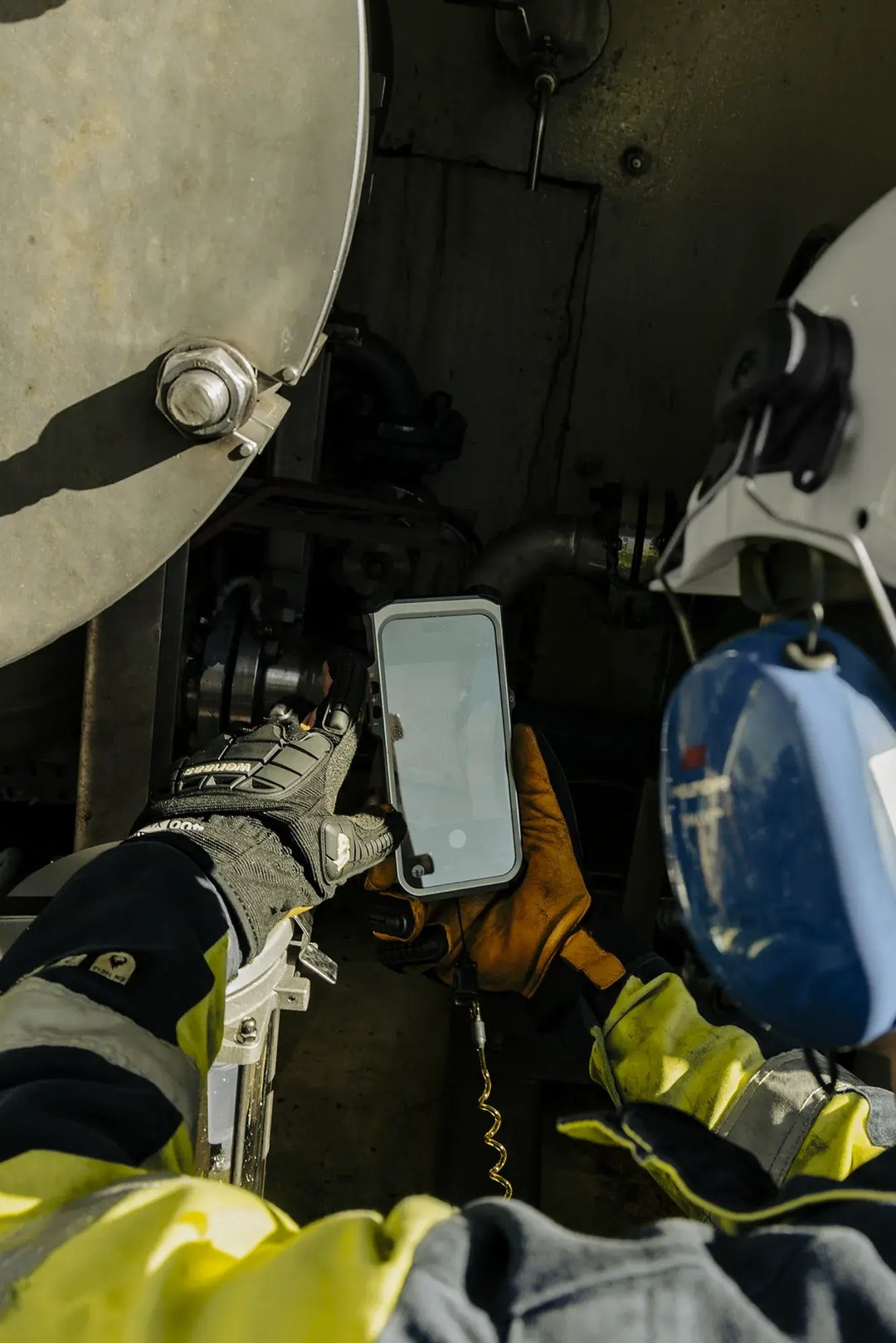
The LiDAR sensor in the iPhone 17 Pro Max, when deployed in a certified case for hazardous area use, allows field engineers to capture accurate 3D spatial data as part of a routine inspection walkthrough. Applications such as Polycam and Matterport's mobile capture mode process the data in real time, allowing engineers to watch a model develop on screen as they walk through a space.
The practical scope is important to understand. The iPhone LiDAR sensor is optimised for focused, high-value documentation tasks at up to approximately 5 metres, rather than large-scale surveys of entire refinery blocks. For capturing pipework runs, valve arrangements, equipment footprints, and structural interfaces before modifications, it is a highly capable tool. For whole-facility surveys, it supplements rather than replaces professional-grade scanning campaigns.
The key operational benefit is frequency. A field engineer can update spatial records far more often using a certified iPhone and a LiDAR app than through formal scanning campaigns, which means the digital twin stays current rather than becoming a static snapshot that grows obsolete within months.
To understand how this works in practice and where the technology reaches its limits:
LiDAR Scanning in Hazardous Areas: How the iPhone 17 Pro Max Is Changing As-Built Documentation
Remote Expert Support and the Role of Video Quality
Beyond documentation and spatial capture, cameras are now central to real-time collaboration. In many cases, the value of a camera is defined not just by what it records, but by what it enables others to see remotely.
Remote expert support has shifted from a useful capability to an operational necessity. As experienced technical workforces retire, specialised knowledge is concentrating in fewer people who must support multiple sites globally. The camera a field technician holds has become the primary interface between the physical problem and the person who can diagnose it.
A senior specialist guiding a technician through a valve repair or a fault diagnosis needs to read component labels, verify serial numbers, and assess the exact condition of seals and thread engagement. These details require high resolution and stable focus. A grainy or poorly focused live stream does not just frustrate the remote expert. It leads to misdiagnosis and wrong decisions in high-stakes scenarios where every minute of downtime carries a production cost.
4K video at 60fps provides smooth, clear live streaming even when documenting moving parts. Optical image stabilisation keeps the feed steady when a technician is navigating a confined or vibrating environment. The triple camera system on the iPhone 17 Pro Max allows real-time switching between wide and telephoto lenses, giving the remote expert both site context and granular component detail within a single call.
Augmented reality platforms including TeamViewer Frontline, Scope AR, and PTC Vuforia extend this further. These tools allow remote experts to draw digital annotations directly onto the live feed, marking specific bolts, highlighting steps in a process, or flagging safety concerns with digital ink that stays locked to the physical object. The reliability of these AR overlays depends entirely on the resolution and stability of the underlying camera feed. On a blurry or unstable stream, AR markers drift and create confusion.
For a detailed assessment of what remote experts need to see and how camera hardware delivers it:
Remote Expert Support in Hazardous Areas: Why Video Quality Is Not a Secondary Consideration
Incident Investigation: What Cameras Need to Capture
The importance of image and video quality becomes even more pronounced in high-pressure scenarios. Nowhere is this clearer than during incident response, where documentation must stand up to forensic scrutiny.
The first twenty minutes of documentation after an incident often determines whether the investigation succeeds. Scene conditions change fast. Evidence can be disturbed, weather alters the appearance of a site, and the as-found state of equipment is quickly lost to recovery efforts. The person with the camera is usually a field technician, not a professional investigator, and they are working under pressure with whatever device they have.
Understanding what to photograph, in what order, and at what technical quality is the difference between an investigation that identifies root causes and one that cannot substantiate its conclusions.
The sequence matters. Start with wide establishing shots from multiple angles before anything is touched, to give investigators spatial context. Move to medium shots covering adjacent pipework, valve positions, instrumentation, and tooling found at the scene. Then go into detail: component labels, serial numbers, gauge readings, seal conditions, thread engagement, and any visible damage. Finally, document the state of PPE and tooling found at or near the scene.
The camera's technical capability directly shapes what the investigation can conclude. Low-light performance determines whether confined space documentation produces usable images or dark, noisy frames. Macro capability determines whether a photograph of a seal face resolves clearly enough to distinguish a compression groove from a crack initiation point. Optical zoom determines whether a failure point that cannot be safely approached can be documented with forensic clarity.
Chain of custody is also a legal consideration. Images taken on unmanaged personal devices and transferred via consumer messaging apps often lack the metadata integrity needed for legal admissibility. Enterprise-managed devices with Mobile Device Management, automated geotagging, and direct sync to secure corporate servers address this. The metadata accompanying an image can be as important as the image itself in an insurance arbitration or legal proceeding.
For the full evidence capture framework and device recommendations:
Incident Investigation in Hazardous Areas: What Evidence Cameras Need to Capture
AI-Powered Visual Inspection and Why Image Quality Is the Deciding Variable
As inspection processes become more data-driven, visual documentation is no longer only interpreted by humans. Increasingly, it serves as the input for automated analysis systems.
AI defect detection in industrial inspection has moved from pilot to production. Accuracy rates above 99% for defined defect classes are achievable in practice. However, these figures are conditional on the quality of the images the model receives. They are not properties of the software alone.
Computer vision models trained on industrial imagery can identify corrosion grades, detect coating failures across large surface areas, flag crack propagation patterns in weld inspections, and identify equipment anomalies from photographic input. In applications where the defect class is well-defined and the training dataset is large and consistent, these models are fast, repeatable, and do not fatigue.
What they cannot do is compensate for poor input. When image quality deviates from the conditions the model was trained on, whether through different lighting, inconsistent focal distance, lower resolution, or motion blur, detection accuracy drops. The camera is not separate from the AI system. It is an integral part of it.
The iPhone 17 Pro Max brings specific advantages to AI inspection workflows. Its computational photography engine produces consistently sharp, well-exposed images in the uneven lighting found in industrial plants. The integrated LiDAR sensor provides depth data that allows AI models to understand the physical volume of a defect and the exact distance between components. On-device processing through Apple's Neural Engine allows lightweight AI models to run locally, providing instant feedback without depending on a network connection.
This edge AI capability is particularly significant in classified areas with limited connectivity. A technician can point the camera at a flange and receive an immediate on-device assessment rather than waiting for the data to travel to a cloud server and back. In remote or disconnected zones, this is not a performance enhancement. It is the difference between a functional inspection workflow and one that stalls every time the 5G signal drops.
For a detailed look at AI inspection in production use and how device selection determines model performance:
AI-Powered Visual Inspection in Hazardous Areas: Why the Camera You Start With Determines the Results You Get
The Case for Smartphone-Based Intrinsically Safe Camera Solutions
All of these use cases - inspection, LiDAR capture, remote support, incident investigation, and AI analysis - place growing demands on camera hardware. This raises an important question about whether traditional intrinsically safe devices are still fit for purpose.
Dedicated intrinsically safe cameras were, for a long time, the only option. They were also, for a long time, significantly behind consumer smartphone technology in imaging capability. Most dedicated industrial cameras peak at 12 to 16MP. Many rely on contrast-detection autofocus systems that are slow in low light. Video stabilisation is often absent or electronic only, producing cropped, degraded footage.
The iPhone 17 Pro Max now outperforms dedicated intrinsically safe cameras in every measurable imaging category: sensor size, low-light capability, autofocus speed, optical zoom range, video stabilisation, and computational photography. The gap is not marginal.
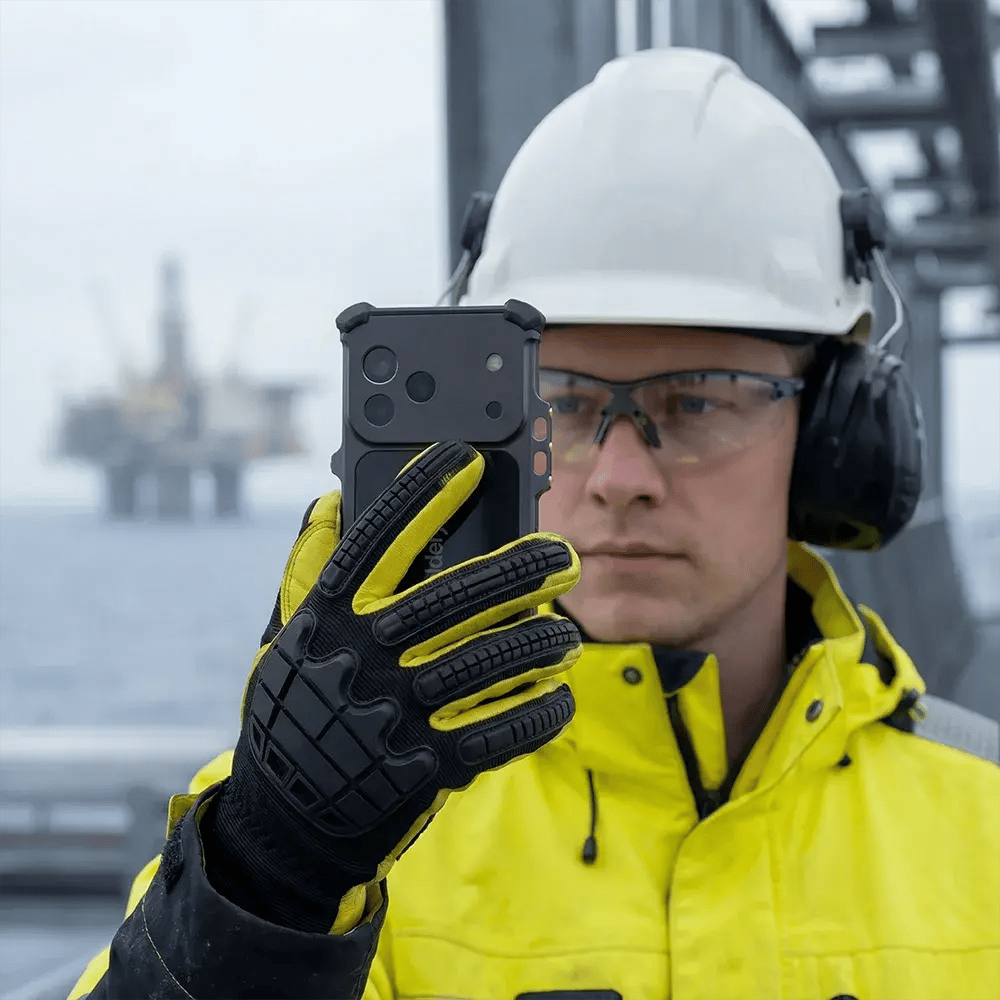
The limitation has always been certification. A standard smartphone cannot enter a classified atmosphere.
Certified explosion-proof cases engineered for Zone 1 and Zone 2 environments address this directly. The Xshielder case for the iPhone 17 Pro Max allows the full imaging capability of the device to be used in hazardous areas while meeting the stringent safety standards required for classified zone operation. The LiDAR scanner, the multi-lens camera system, and all software functions are retained.
For organisations already managing smartphones as standard-issue equipment, this approach also simplifies procurement, software integration, and maintenance compared to running a separate fleet of dedicated industrial cameras.
The question worth asking is not whether your current intrinsically safe camera takes adequate photos. It is whether adequate is the standard your safety documentation, your AI inspection systems, and your regulatory exposure actually require.