
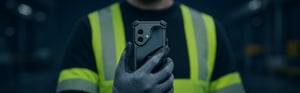
Intrinsically Safe iPhones - Your Zone 1 and Zone 2 Options
Apple does not make intrinsically safe products, so no standard iPhone is certified for use in hazardous areas. However, the big caveat to that is a number of iPhones can be used in Zone 1 and Zone 2, provided each one sits inside a case certified for that zone. In this guide, we walk through the options you have, answer the questions buyers ask most often and clear up a few common myths along the way.
We start with why a standard iPhone cannot go on site and how a certified case changes that. From there, we compare the models available, look at how their features translate into field work and finish with what to check before you commit to a fleet. If you already know the background, you can go straight to the iPhone comparison.
Are iPhones intrinsically safe?
No, Apple does not make an intrinsically safe iPhone, nor does it seek ATEX or IECEx certification for any model.
A standard iPhone is a potential ignition source for three reasons. Its lithium-ion battery stores a large amount of energy in a small space, and physical damage or an internal fault can lead to overheating, venting or sparking. Its radio transmitters, charging circuits and display electronics can produce sparks or hot surfaces under fault conditions, and nothing in the design keeps that energy below ignition thresholds. It also carries no Ex certification, so from a regulatory point of view an uncased iPhone has no place in a classified area, however good its condition.
When people search for an "intrinsically safe iPhone" or an "intrinsically safe iPhone case", they are usually looking for a compliant way around those three problems. The good news is that route does exist.
How you can use an iPhone in a hazardous area
iPhones can be used within hazardous areas, including zone 1, when they are paired with a case certified for the zone. In practice that means an explosion-proof case.
It's worth noting briefly that 'explosion proof' and 'intrinsically safe' are two different protection methods. Intrinsic safety limits the electrical and thermal energy available inside a device so that it cannot ignite the surrounding atmosphere, even under fault conditions. An explosion-proof enclosure does the reverse. It accepts that an ignition may occur inside, and it is built to withstand the resulting pressure and stop flame from reaching the atmosphere outside. It does not seal the phone away from the surrounding air. Both approaches are permitted in Zone 1 and Zone 2, and the difference mostly matters when you read certificates and site standards. We compare the two in more depth in our guide to the difference between intrinsically safe and explosion-proof phones.
Zone 1 or Zone 2?
Zone 1 is an area where an explosive gas atmosphere is likely to occur occasionally in normal operation. Zone 2 is an area where one is unlikely in normal operation and, if it does occur, persists only for a short time. Equipment certified for Zone 1 can also be used in Zone 2, provided the gas group and temperature class on the certificate suit the site. Equipment certified only for Zone 2 cannot go into Zone 1, and Zone 0 has stricter requirements still. The cases in this guide are not certified for Zone 0.
So if you are looking for a Zone 2 iPhone case, a Zone 1 certified case is often the simpler choice. Technicians rarely stay inside one zone for a whole shift, and one certified device per person keeps procedures and stock straightforward. Our guide to ATEX, IECEx and zone classifications for mobile phones covers the classification system in full.
With the certification question settled, the decision moves to the phone itself.
Which iPhones can be used in Zone 1 and Zone 2?
Any iPhone used in Zone 1 or Zone 2 needs an enclosure certified for that exact model. Xshielder currently makes ATEX and IECEx Zone 1 certified explosion-proof cases for three, the iPhone 17 Pro Max ATEX Zone 1 case, the iPhone 17 ATEX Zone 1 case and the iPhone 16 Pro Max ATEX Zone 1 case. All three can be used in both zones, so the choice comes down to the work your team does and the size of the rollout.
| iPhone 17 Pro Max | iPhone 17 | iPhone 16 Pro Max | |
|---|---|---|---|
| Best for | Inspection, detailed data capture and remote support | Communication, permits, checklists and everyday documentation | Large fleets that want the Pro Max feature set at a lower cost per unit |
| Choose it if | Image quality, 3D scanning and battery endurance matter most | A lighter, more compact device suits the role and you want current-generation hardware | You are standardizing many users or your team already runs the iPhone 16 Pro Max |
| Certification | ATEX and IECEx, Zone 1 and Zone 2 | ATEX and IECEx, Zone 1 and Zone 2 | ATEX and IECEx, Zone 1 and Zone 2 |
| Display | 6.9-inch | 6.3-inch | 6.9-inch |
| Chip | A19 Pro | A19 | A18 Pro |
| Rear cameras | 48 MP Pro system, up to 8x optical-quality zoom | 48 MP Dual Fusion, 2x optical-quality zoom | 48 MP Pro system, 5x optical zoom |
| LiDAR scanner | Yes | No | Yes |
| Battery* | Up to 37 hours (39 on eSIM-only models) | Up to 30 hours | Up to 33 hours |
| Weight in case | 410 g | 330 g | 415 g |
| Size in case (mm) | 184 x 89.6 x 17.8 | 170.5 x 83.3 x 16.1 | 187 x 93 x 17.6 |
| Next step | Request a quote View the case |
Request a quote View the case |
Request a quote View the case |
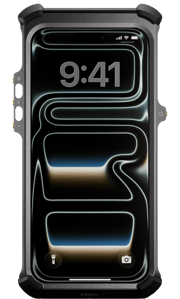
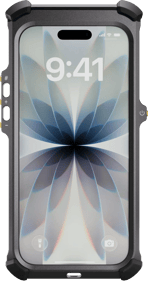
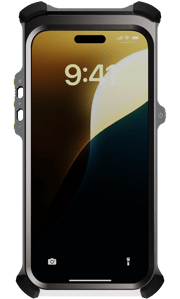
*Battery figures are Apple's video playback ratings for the iPhone. Weight and size are for the iPhone in its Xshielder case.
The comparison covers current models. If your team still carries an older iPhone, we look at the options and trade-offs in how to make an iPhone 14 intrinsically safe and whether you can make an iPhone 15 intrinsically safe.
The iPhone features that matter in hazardous areas
Each row in that table connects to a specific part of hazardous area work. Inspections, permits, maintenance records and remote support now run through the phone, so the hardware determines how much a technician can finish without walking back to a safe area.
Camera and remote support
Inspection photos, corrosion records and video calls with onshore experts all depend on image quality. The Pro Max models add telephoto zoom for capturing detail on equipment an inspector cannot safely reach, and the iPhone 17 brings the same 48 MP main camera to everyday documentation and video calls. We cover what to look for in our guide to intrinsically safe cameras.
LiDAR and 3D capture
The LiDAR scanner on the iPhone 17 Pro Max and iPhone 16 Pro Max supports 3D scanning, measurement and as-built capture, which is why teams working on digital twins and modification projects tend to choose a Pro Max. We have tested LiDAR accuracy through an Ex-proof cover, and the results are worth reading before you plan a scanning workflow.
Battery and charging
Battery endurance carries extra weight in a hazardous area, because charging usually has to happen somewhere else. Xshielder's certificates for the iPhone 17 and iPhone 17 Pro Max, for example, require the battery to be charged only outside the hazardous area. That makes capacity a planning question, and the Pro Max models carry the largest batteries in the range. For how charging fits into daily routines, see our post on wireless vs USB charging for explosion-proof iPhones.
Software support and security
Apple supports each iPhone with iOS updates for several years after release, so a newer model keeps a fleet on current security patches and features for longer. A certified iPhone also enrolls in the same MDM platform as the rest of the fleet, and our guide on locking down an iPhone for ATEX Zone 1 work covers the setup.
For IT and OT teams weighing the security case, we explain what iPhone's NATO approval means for Zone 1 mobile security. We have also documented how we recovered an iPhone inside an explosion-proof case on iOS 27.
What to look for in a Zone 1 iPhone case
Once you know which model fits the work, the case deserves the same scrutiny. Whether you search for an intrinsically safe phone case, an ATEX phone case or an explosion-proof enclosure, certification is what gets it onto site, and daily usability determines whether people keep using it. Work through these points with your HSE, operations and IT teams before committing to a fleet.
- Certification. Look for a valid ATEX and IECEx certificate from a recognized body, with a certificate number you can verify. Wording such as "designed to meet ATEX standards" is a claim, and it is no substitute for a certificate.
- Model fit. The case must be certified for the exact iPhone model your team will carry.
- Touchscreen and glove use. Try the screen with the gloves your crews actually wear, in wet conditions as well as dry.
- Camera access. Check that the lenses, flash and LiDAR scanner, where fitted, have a clear view, and ask for sample photos taken through the case.
- Charging. Confirm where the phone may be charged under the certificate's conditions of use, and plan charging points outside the hazardous area if that is required.
- Impact and ingress protection. Look for a stated IP rating and read the certificate's conditions of use on impact, then match both to your conditions, whether that means washdown, spray or offshore weather.
- Weight and grip. Workers tend to pocket a device that feels heavy or slippery. Consider grip, lanyard points and compatibility with tool-tethering systems for work at height.
- Static. Case materials and surfaces should reduce the risk of electrostatic buildup, which is an ignition hazard in its own right.
Why teams choose an iPhone over a dedicated Ex phone
All of this assumes an iPhone is the right platform in the first place. Purpose-built intrinsically safe phones have their place, particularly where a site standard specifies intrinsic safety, but many operators would rather choose an iPhone in a certified explosion-proof case for a variety of reasons.
Field teams keep the apps they already use, from Microsoft 365 and Teams to inspection, permit and CMMS tools. Users need no retraining, because the device is the one they use every day. The camera and processing power are well ahead of most rugged Ex handsets, and when a new iPhone generation arrives, moving to the case certified for that model keeps the same apps, MDM profiles and habits in place.
For a side-by-side view of both routes, see our guide to intrinsically safe phones, options and costs. On cost, total cost of ownership over the life of a device is usually a more useful comparison than unit price, and we break it down in how much intrinsically safe phones cost.
Find the right iPhone for your site
Start with the zones your team works in and the work the phone needs to support, then use the comparison above to narrow the choice. When you are ready, request a quote or browse the full Xshielder range, and we will help you match the right model to your site.
Frequently asked questions
Are iPhones intrinsically safe?
No. Apple does not make an intrinsically safe iPhone, and a standard iPhone carries no ATEX or IECEx certification for hazardous areas.
Which iPhones can be used in a Zone 1 hazardous area?
An iPhone can be used in Zone 1 only inside an enclosure certified for that specific model. Xshielder's ATEX and IECEx Zone 1 certified cases cover the iPhone 17 Pro Max, iPhone 17 and iPhone 16 Pro Max.
Is the iPhone ATEX certified?
No. ATEX certification applies to a specific case and iPhone pairing, and it is valid only for the model named on the certificate.
Is my iPhone explosion proof?
No, a standard iPhone is not explosion-proof, even in a rugged or waterproof case. It needs a certified explosion-proof enclosure rated for the zone before it can enter a hazardous area.
Can a Zone 1 iPhone case be used in Zone 2?
Yes. Equipment certified for Zone 1 can also be used in Zone 2, provided the gas group and temperature class on the certificate suit the site.
Are Apple devices intrinsically safe?
No Apple device is intrinsically safe as sold, and the iPhone can only enter a hazardous area inside a certified enclosure. Need a bigger screen? See the iPad Pro 11" case.