

Class I Division 2 explained: what C1D2 means for mobile devices
Class I Division 2 covers places where flammable gas or vapor should only be present when something goes wrong - ie. not in daily operations. That definition can make it sound permissive, and a question that comes up again and again from people who carry phones and tablets on-site is whether Division 2 is relaxed enough for an ordinary device.
This page explains what C1D2 means, what the National Electrical Code (NEC) asks of equipment used there, and how to read a rating. It then looks at phones, tablets and cameras specifically, including how sites handle unrated devices and where zone-certified equipment fits.
What Class I Division 2 means
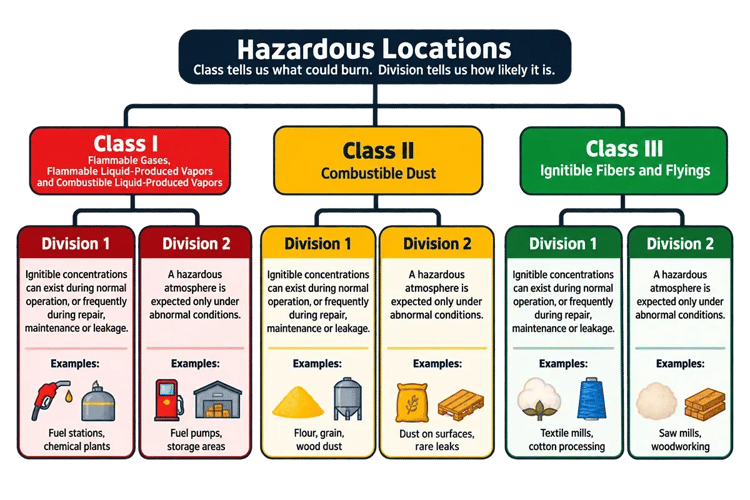
The NEC sorts hazardous locations first by what could burn. Class I covers flammable gases, flammable liquid-produced vapors and combustible liquid-produced vapors. Class II covers combustible dust, and Class III covers ignitible fibers and flyings, such as those found in textile mills and sawmills.
The Division then describes how likely the hazard is. Division 1 applies where ignitible concentrations can exist during normal operation, or frequently during repair, maintenance or leakage. Division 2 applies where a hazardous atmosphere is expected only under abnormal conditions. Our comparison of Class I Div 1 vs Div 2 looks at what that difference means for phones, tablets and cameras.
The three Class I Division 2 situations
The NEC describes three situations that make a Class I location Division 2. In plain English, they are:
- Contained materials. Flammable liquids, gases or vapors are handled or used, but they normally stay inside closed containers or systems and escape only through accidental rupture, breakdown or abnormal operation.
- Ventilated areas. Positive mechanical ventilation normally prevents ignitible concentrations, and the area could become hazardous if that ventilation fails.
- Adjacent areas. The location borders a Division 1 area, and gas or vapor could occasionally drift across unless clean-air positive-pressure ventilation with safeguards against failure prevents it.
The logic behind Division 2 is that an ignition needs two independent events at the same time. Something has to release gas, and something has to ignite it. Equipment in a Division 2 location must therefore avoid being an ignition source during normal operation. It is generally not required to stay safe after its own internal fault, because a device failure coinciding with a gas release is considered unlikely.
That principle is where the question about phones becomes interesting. A smartphone's normal operation includes a lithium-ion battery, several radios transmitting, and a charging port that people plug and unplug, so the "normal operation" test covers more than it first appears to.
Where C1D2 sits in the NEC and CEC
In NFPA 70, the National Electrical Code, Article 500 sets the general rules for the Class and Division system. It covers how locations are classified (Section 500.5), the material groups, the accepted protection techniques and how equipment is marked. Article 501 then applies those rules to Class I locations specifically, including wiring methods, sealing and equipment requirements. Both remain the governing articles in the 2026 edition.
Article 505 is the zone-based alternative for Class I locations, using Zone 0, Zone 1 and Zone 2 in line with the IEC zone system used in most of the world. A facility can classify Class I areas under either system, and our comparison of Zone 1 vs Zone 2 explains how those zones are defined.
If you are working from older material, note that the definitions moved. Terms such as "nonincendive circuit" once sat in Section 500.2. They moved to Article 100 in the 2017 edition, were grouped into a separate Part III of Article 100 in 2020, and since 2023 sit in the main alphabetical list with the other NEC definitions.
For how the NEC relates to the European and international schemes, see our comparison of ATEX vs IECEx vs NEC.
Area classification itself is an engineering task carried out by the facility owner, using guidance such as NFPA 497 or API RP 500, and accepted by the authority having jurisdiction (AHJ). The NEC tells you what equipment is acceptable once that classification exists.
Canada takes a different route. Section 18 of the Canadian Electrical Code uses the zone system, and new facilities are classified under it. The Class and Division rules now sit in Annex J, which can be used for additions, modifications, renovations and the operation and maintenance of existing facilities already classified by Division.
Class I Division 2 electrical requirements for wiring and seals
For electricians and engineers, most Division 2 installation questions land in Part II of Article 501. Section references below follow the 2023 NEC.
Section 501.10(B) permits every Division 1 wiring method in Division 2, plus several lighter options. These include rigid metal and intermediate metal conduit with listed threaded or threadless fittings, enclosed gasketed busways and wireways, Type PLTC and ITC cable, and Type MC, MV, TC and TC-ER cable terminated with listed fittings. Nonincendive field wiring may use any wiring method permitted for unclassified locations, installed in line with the control drawing.
Under 501.15(B)(2), a conduit run leaving a Division 2 location for an unclassified location needs a seal within 3.05 m (10 ft) of the boundary, on either side of it. The seal must be identified for limiting the passage of gas but does not need to be explosionproof, and there are exceptions, for example unbroken metal conduit that passes completely through the classified area.
Arcing equipment is where Division 2 relaxes the most. Under 501.115(B), switches, circuit breakers and motor controllers can sit in general-purpose enclosures when they interrupt current inside a hermetically sealed or factory-sealed explosionproof chamber, use oil-immersed contacts, or are solid-state controls with no contacts and a limited surface temperature. Under 501.125(B), squirrel-cage induction motors without brushes or other arcing devices can use open or general-purpose enclosures.
These rules govern fixed installations. Portable devices such as phones and tablets are judged on the equipment requirements below.
Requirements for Class I Division 2 equipment
Equipment used in a C1D2 location needs to be identified for the specific class, division, gas group and temperature it will see. Several things go into that.
Certification for the location
The usual route is listing by a Nationally Recognized Testing Laboratory, such as UL, CSA Group, Intertek or FM Approvals, with the rating marked on the equipment. The NEC also allows other evidence acceptable to the AHJ, but for portable electronics a third-party listing is what most sites expect to see.
An accepted protection method
Each protection method reduces ignition risk in a different way. Some are accepted only in Division 2, while others also qualify for Division 1. The table below compares the main options and how practical each one is for phones and tablets, and our guide to non-incendive vs intrinsically safe protection goes deeper on the two energy-limiting methods.
| Method | How it reduces ignition risk | North American standard | Also accepted in Div 1? | Practical for phones and tablets? |
|---|---|---|---|---|
| Nonincendive | Circuits cannot release enough energy to ignite the atmosphere during normal operation | UL 121201 | No | Yes, for devices certified to it |
| Intrinsically safe | Limits electrical and thermal energy so that ignition is unlikely even with faults present | UL 913 | Yes | Yes, though the energy limits constrain battery, display and radio design |
| Explosionproof | An enclosure contains any internal explosion and cools escaping gases before they reach the surrounding atmosphere | UL 1203 | Yes | Possible, with enclosure size and weight as the main design challenge |
| Purged / pressurized | Protective gas at positive pressure keeps the flammable atmosphere out of the enclosure | NFPA 496 | Yes | No, as it needs a continuous air or gas supply |
| Nonsparking / hermetically sealed | Avoids arcing contacts in normal operation, or seals sparking parts so gas cannot reach them | UL 121201 | No | Applies to components, not to a whole device |
| Zone-listed (AEx) equipment | Uses an IEC-based protection concept, such as flameproof or intrinsic safety, listed for Class I zones | UL 60079 series | Only if listed for Zone 0 | Yes, where the device carries an accepted marking |
Gas groups A to D
Class I materials fall into four groups based on how easily they ignite and how an explosion propagates. Group A is acetylene. Group B includes hydrogen and gases with similar behavior. Group C includes ethylene, and Group D covers the largest set of common materials, including propane, gasoline, methane and natural gas. Equipment rated for Group D alone is unsuitable for a hydrogen area, so the group on the label has to cover every gas present.
Temperature class against autoignition temperature
Any surface of the equipment must stay below the autoignition temperature of the gas or vapor in the area. The temperature class, or T code, states the maximum surface temperature the equipment can reach, from T1 at 450°C down to T6 at 85°C. Matching the two is a simple comparison, and it has to be made against the lowest autoignition temperature of any gas present.
Control drawings and conditions of use
Many certifications come with conditions. For nonincendive and intrinsically safe field wiring, a control drawing defines what the equipment may be connected to and the electrical parameters that keep the system within its rating. Portable devices usually carry conditions in their safety instructions instead, such as which batteries are approved and where charging is permitted. Using a device outside those conditions takes it outside its certification.
How to read a C1D2 rating
A typical marking on a Division 2 device reads "Class I, Division 2, Groups A-D, T4". Each part answers a separate question.
"Class I" means the device is assessed for flammable gases and vapors. It says nothing about combustible dust, which needs a Class II rating. "Division 2" limits use to locations where the hazard is present only under abnormal conditions, so the device cannot be taken into a Division 1 area on this rating.
"Groups A-D" means the device covers all four Class I gas groups, including acetylene and hydrogen. A device marked "Groups C, D" would be restricted to areas where only Group C and D materials are present.
"T4" means the maximum surface temperature is 135°C. That suits most common hydrocarbons, whose autoignition temperatures are well above 135°C. Carbon disulfide is a well-known exception, with an autoignition temperature around 90°C. Also check the ambient temperature range on the label. Where no range is marked, the rating assumes a standard ambient of up to 40°C (104°F), which matters on a hot deck or near process equipment.
What C1D2 means for phones, tablets and cameras
A smartphone packs several potential ignition sources into a small, warm device. A certifier assesses each one against the normal-operation test.
The battery is the largest single energy store. A lithium-ion cell holds far more energy than an ignition needs, so certified devices control how that energy can reach exposed contacts and how the cell behaves if damaged. Charging is a related concern, because plugging and unplugging a connector can produce a small arc. Many hazardous-area devices restrict charging and battery changes to non-classified areas for that reason.
Radios add another layer. A current phone may run cellular, Wi-Fi, Bluetooth and ultra-wideband at once, and transmit power, antenna design and the circuitry behind them all fall within the assessment. Optical emitters such as the camera flash and LiDAR scanner are also considered.
Accessories count as equipment too. A certified phone paired with an uncertified power bank, wired headset or charging cable brings the uncertified item into the area with it. Surface temperature rounds out the list, since phones get warm under heavy processing, fast charging or direct sun, and the T code has to account for the worst case within the rated ambient.
How sites handle unrated devices
The NEC is written around installed electrical equipment, and portable devices sit awkwardly within it. In practice, what workers can carry into a classified area is decided by the employer's safety program and site rules, informed by the NEC, OSHA requirements and the AHJ.
Where sites permit unrated phones or tablets in Division 2 areas, they usually do so under controls. Common examples include a work permit, continuous gas monitoring with a personal or area detector, a rule to leave the area if the detector alarms, and a ban on charging inside the classified boundary. Other sites prohibit unrated devices in classified areas altogether.
For sites weighing this decision, UL 121203 is a recommended practice with guidance for owners and operators on evaluating uncertified portable electronics for Division 2 and Zone 2 locations, along with certain dust and fiber locations. It is written for site decisions, separate from product certification.
Some of that variation reflects published risk work. A 2006 IEEE PCIC paper by Bozek, Martin and Cole, "Cellular Phones in Class I, Division 2/Zone 2 Hazardous Locations", estimated the probability of a commercial cell phone igniting a Division 2 or Zone 2 atmosphere at about one in a million. The same study found that none of the phones evaluated met the ISA-RP12.12.03 requirements for a Division 2 portable electronic product. A low estimated risk can support a site's risk assessment, but it does not make an unrated device compliant, and the site's permit controls are there to manage the remaining risk.
Why crews want current iPhones and iPads
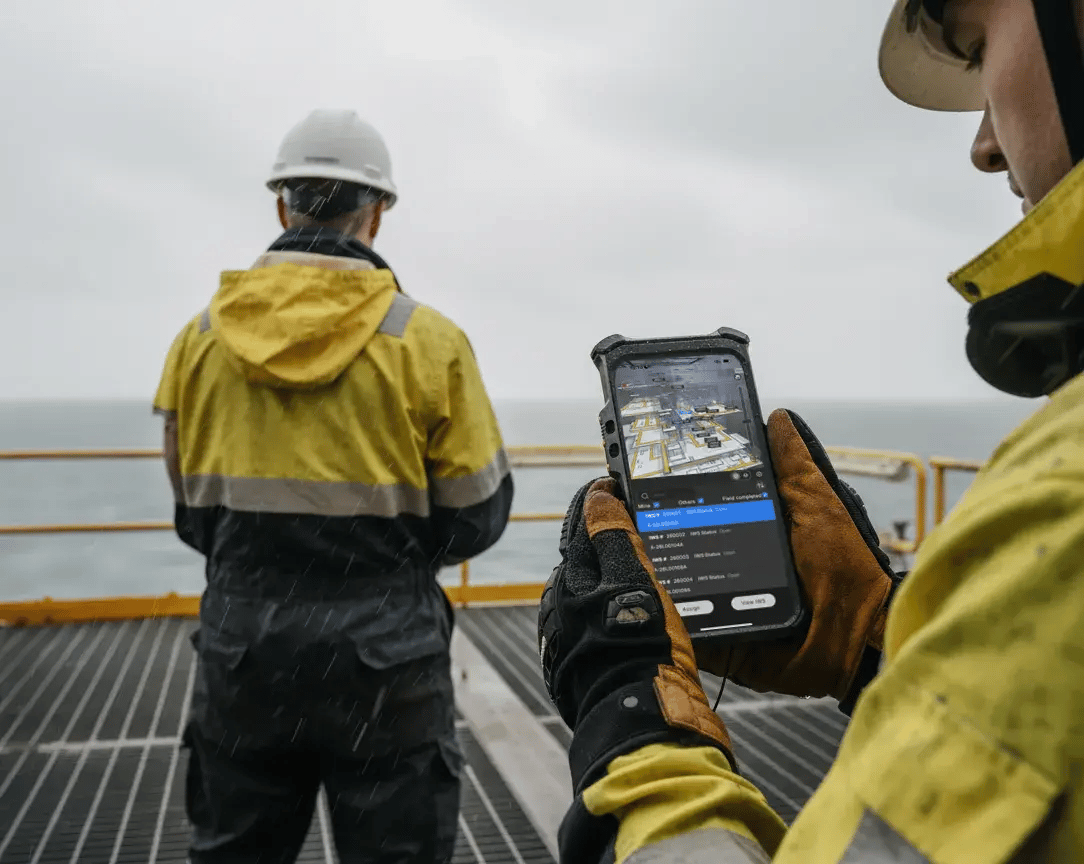
Field teams increasingly do their inspections, permits and reporting on a phone or tablet, and the device they want is usually the one they already know. Current Pro iPhones bring an all-48MP rear camera system with strong low-light performance and long optical zoom, which helps with corrosion checks, gauge readings and documenting defects at a distance. The Pro iPhones and iPad Pro also have a LiDAR scanner, which supports quick measurements and 3D scans of equipment and spaces.
The software side matters as much as the hardware. Inspection, permit-to-work and maintenance apps are often built for iOS first, and IT teams can manage iPhones and iPads through the same mobile device management (MDM) platforms they already run, such as Microsoft Intune or Jamf. That keeps security policies, app deployment and remote wipe consistent across the fleet.
Purpose-built hazardous-area handhelds can trail consumer flagships on cameras, processors and app support, partly because each new model needs its own certification. That gap is why many operators look for a certified way to bring current Apple devices into classified areas.
Using zone-certified devices in Class I Division 2: the NEC 501.5 route
Section 501.5 of the NEC bridges the two classification systems. Equipment listed and marked for Class I Zone 0, Zone 1 or Zone 2 under Article 505 is permitted in Class I Division 2 locations, provided it is suitable for the same gas and has a suitable temperature class. Only equipment listed for Zone 0 is also permitted in Division 1.
Matching the gas means translating between group systems. Zone Group IIC corresponds to Class I Groups A and B, Group IIB to Group C, and Group IIA to Group D. A device marked IIC therefore covers the full A to D range.
The listing requirement is the detail that most often trips people up. Section 501.5 refers to equipment marked under the NEC's zone rules, which in the United States means an AEx marking. Our explainer on Ex ic, Ex ec and Ex nA breaks down how a full zone marking reads. An ATEX or IECEx certificate on its own does not meet that wording, although many manufacturers hold several certifications for the same product, and the AHJ has the final say on what it accepts.
If you are considering zone-certified equipment for a Division 2 site, check which markings the certificate carries and confirm that your AHJ accepts them before deployment. Xshielder's current covers for iPhone and iPad are certified under ATEX, and the iPhone covers also under IECEx. They do not carry an AEx marking, so on a US Division 2 site, your AHJ's acceptance is the deciding step.
Bringing current Apple devices into hazardous areas
Xshielder designs explosion-proof covers that let crews use the iPhone 17 Pro Max and iPad Pro 11" in Zone 1 and Zone 2 hazardous areas, so field teams can keep working with the devices and apps they already rely on. Get in touch to discuss your site's classification and which certifications you need.
Frequently asked questions
What does Class 1 Div 2 mean?
Class 1 Division 2 is an NEC hazardous location classification for areas where flammable gases or vapors are present only under abnormal conditions, such as a leak, equipment breakdown or ventilation failure.
What are the requirements for Class 1 Div 2 equipment?
Class 1 Div 2 equipment must be identified for the location, typically through listing by a recognized testing laboratory, use an accepted protection method such as nonincendive or intrinsically safe, and match the area's gas group and temperature class.
Which NEC article covers Class 1 Div 2 locations?
NEC Article 500 sets the general rules for Class and Division locations, and Article 501 covers Class I specifically, including Division 2 wiring and equipment.
What does a C1D2 rating mean on a phone or tablet?
A C1D2 rating means the phone or tablet has been certified for use in Class I Division 2 locations within the marked gas groups and temperature class, and it does not cover Division 1 or combustible dust areas.
Can you use a regular smartphone in a Class 1 Div 2 area?
A regular smartphone is not certified for Class 1 Div 2, so it does not meet the equipment requirements for the area. Some sites permit unrated phones under a work permit with continuous gas monitoring, but that decision rests with site policy and the AHJ.
What are the electrical requirements for Class 1 Div 2 wiring?
NEC 501.10(B) permits all Division 1 wiring methods in Class 1 Div 2, plus lighter options such as Type MC, MV and TC-ER cable and enclosed gasketed busways, and 501.15(B)(2) requires a seal within 10 feet of the boundary where conduit leaves the classified area.