
Ex nA, Ex ec and Ex ic explained: protection types for Zone 2 equipment
When it comes to equipment for Zone 2 hazardous areas, several protection types can appear on datasheets, nameplates and certificates. These are ExnA, Ex ec, and Ex ic. All three offer the same equipment protection level (EPL) and are suitable for Zone 2, but they achieve this in different ways and apply to different types of equipment. Understanding what each marking means, how the protection methods differ and where they are used helps make sense of both legacy equipment and new Zone 2 certifications.
One important thing to note upfront is that Ex nA is no longer used. However, though it has been withdrawn from the current standard, it still appears on older equipment and documentation, often alongside the newer Ex ec and Ex ic markings.
This guide covers what happened to Ex nA, where Ex ec and Ex ic fit, how ATEX categories line up with zones, and how to read a full Zone 2 marking. It finishes with what this means for phones and tablets carried into hazardous areas.
What happened to Ex nA?
Ex nA was the non-sparking subtype of protection type "n", defined in IEC 60079-15. Equipment marked Ex nA is built so that, in normal operation, it produces no arcs, sparks or hot surfaces capable of igniting the surrounding gas. For years it was the standard choice for motors, luminaires and terminal boxes in Zone 2.
The 2015 edition of IEC 60079-7 introduced two levels of increased safety. Ex eb covers the traditional Zone 1 increased safety concept, and Ex ec took over most of the non-sparking requirements from Ex nA. The fifth edition of IEC 60079-15, published in 2017, then dropped nA and kept the remaining "n" subtypes, such as nC and nR. The energy-limited subtype nL had already been replaced by Ex ic, introduced in IEC 60079-11 in 2006, and was dropped from IEC 60079-15 in its 2010 edition.
Certificates issued against older editions remain valid for the equipment they cover, so Ex nA motors and light fittings installed years ago can generally stay in service, subject to normal inspection and maintenance. You will also see Ex nA on datasheets for older product lines and on spares for existing installations. When specifying new equipment, expect Ex ec instead, and treat an Ex nA marking as a sign that the certificate was issued against a superseded edition. Check whether your site specification and inspection regime accept that before ordering.
Ex ec: increased safety for fixed equipment
Ex ec is increased safety at level of protection "c". Like Ex nA, it relies on construction measures that keep arcs, sparks and excessive temperatures from occurring in normal operation, such as secure terminations, defined creepage and clearance distances, and a minimum degree of ingress protection. It carries EPL Gc and is suitable for Zone 2.
The concept suits equipment with simple, robust electrical parts. Typical examples are induction motors, light fittings, junction and terminal boxes, and some heaters. Ex ec is rarely used for handheld electronics. Phones and tablets for Zone 2 are almost always certified to intrinsic safety instead, because limiting energy suits compact battery-powered designs better than construction measures do.
Ex ic: intrinsic safety at level "c"
Ex ic belongs to intrinsic safety, defined in IEC 60079-11. Intrinsic safety limits the electrical and thermal energy available in a circuit so that it cannot ignite the atmosphere. There are three levels. Ex ia is assessed with up to two countable faults applied and is suitable down to Zone 0, Ex ib is assessed with one fault for Zone 1, and Ex ic is assessed in normal operation with no faults applied, for Zone 2 only.
This is the main reason Ex ic is the usual route for intrinsically safe phones, tablets, radios and gas detectors intended for Zone 2. Battery-powered handhelds combine a battery, a processor and several radios, and energy limitation fits that kind of design far better than construction rules aimed at motors. Assessment in normal operation also keeps the requirements achievable for complex electronics, whereas Ex ia or Ex ib for a full smartphone involves fault analysis across the entire device. For more on how intrinsic safety applies to mobile devices, see our guide to intrinsically safe phones, and for the North American counterpart of Ex ic, our comparison of non-incendive vs intrinsically safe equipment.
Ex nA vs Ex ec vs Ex ic at a glance
| Ex nA | Ex ec | Ex ic | |
|---|---|---|---|
| Principle | Non-sparking construction in normal operation | Increased safety: construction measures against arcs, sparks and excessive temperatures in normal operation | Intrinsic safety: energy limitation, assessed in normal operation |
| Standard | IEC 60079-15 (up to the 2010 edition) | IEC 60079-7 (2015 edition onward) | IEC 60079-11 |
| Current status | Legacy; removed from IEC 60079-15 in 2017, existing certificates remain valid | Current; replaced Ex nA | Current; replaced Ex nL |
| EPL | Gc | Gc | Gc |
| ATEX category | 3G | 3G | 3G |
| Permitted zones | Zone 2 | Zone 2 | Zone 2 |
| North American equivalent | AEx nA (Class I, Zone 2); broadly comparable to nonincendive for Division 2 | AEx ec (Class I, Zone 2) | AEx ic (Class I, Zone 2); broadly comparable to nonincendive for Division 2 |
| Typical equipment | Older motors, luminaires, terminal boxes | Motors, light fittings, junction and terminal boxes | Instrumentation, sensors, battery-powered handhelds |
| Relevance to mobile devices | Low; mostly seen on legacy fixed equipment | Low; rarely applied to handheld electronics | High; the common route for Zone 2 phones and tablets |
ATEX Category 3G vs Category 2G
Under the ATEX Equipment Directive 2014/34/EU, Group II equipment is split into Categories 1, 2 and 3, with a "G" suffix for gas and "D" for dust. The UK applies the same categories under UKEX, with the UKCA mark in place of or alongside CE. Categories sit on the equipment side, zones come from your area classification under DSEAR or the ATEX Workplace Directive, and EPLs are the IEC system's way of expressing the same protection levels.
The practical rule is simple. Category 2G equipment can be used in Zone 1 and Zone 2, while Category 3G equipment is limited to Zone 2. The conformity route differs too. Electrical equipment in Category 2 needs EU-type examination by a notified body, whereas Category 3 equipment can be placed on the market under the manufacturer's internal production control, so you may see a declaration of conformity rather than a third-party certificate.
| ATEX category | Level of protection | EPL | Permitted zones | Example protection types |
|---|---|---|---|---|
| 1G | Very high | Ga | Zone 0, 1 and 2 | Ex ia, Ex ma |
| 2G | High | Gb | Zone 1 and 2 | Ex ib, Ex db, Ex eb, Ex mb, Ex pxb |
| 3G | Normal | Gc | Zone 2 only | Ex ic, Ex ec, Ex nC, Ex nR, Ex mc, Ex pzc |
Reading a Zone 2 marking
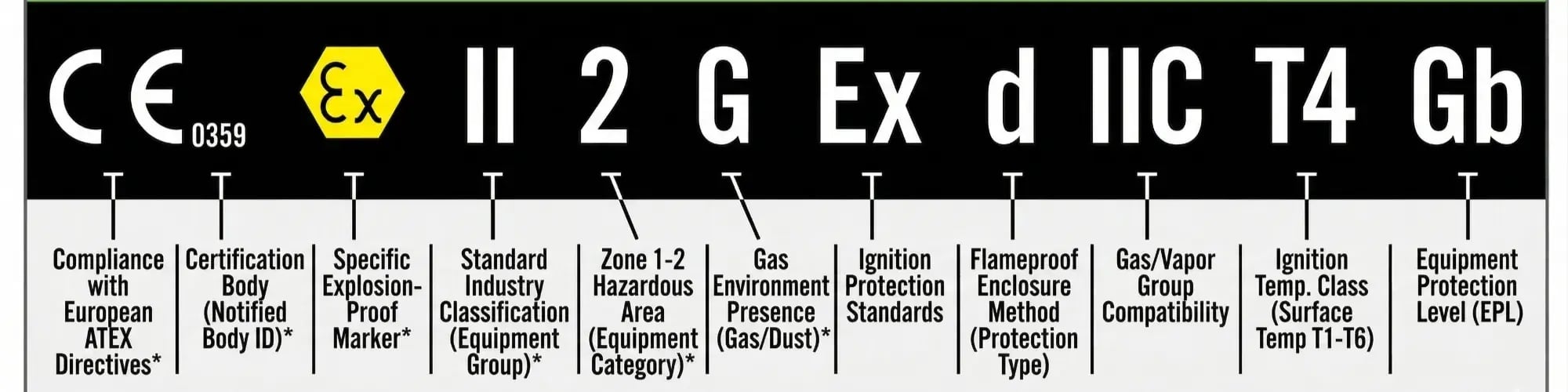
A typical ATEX marking on a Zone 2 handheld reads "II 3G Ex ic IIC T4 Gc", usually preceded by the CE or UKCA mark and the hexagonal Ex symbol. Taken piece by piece, it breaks down as follows.
- II is the equipment group, covering surface industries. Group I is reserved for mining.
- 3G is ATEX Category 3 for gas atmospheres, so the equipment is suitable for Zone 2 only.
- Ex ic is the protection type, intrinsic safety at level "c".
- IIC is the gas group. IIC includes hydrogen and acetylene, and IIC equipment is also suitable for IIA and IIB gases.
- T4 is the temperature class, meaning a maximum surface temperature of 135 °C. The gas present must have an autoignition temperature above that.
- Gc is the equipment protection level, matching Category 3 and Zone 2.
The IECEx marking drops the ATEX group and category and reads "Ex ic IIC T4 Gc". An "X" at the end of the certificate number means there are specific conditions of use, which you need to read before deployment. Older equipment may carry markings such as "EEx nA II T3", from the CENELEC era before EPLs were added. For a Zone 1 marking broken down the same way, see our guide to ATEX labels on intrinsically safe phones.
In the US, the equivalent Zone marking under NEC Article 505 would read "Class I, Zone 2, AEx ic IIC T4 Gc", with the equipment certified to UL 60079-11. Sites using the Division system will instead see "Class I, Division 2, Groups A, B, C, D, T4" on nonincendive equipment, and our guide to Class I Division 2 for mobile devices explains how to read that rating.
What this means for phones and tablets
Before approving a phone or tablet for a hazardous area, look the certificate up on the IECEx online certificate system. Confirm that the certificate is current, that the model and accessories in your hand match the ones listed, which standards and editions it was issued against, and whether any specific conditions of use apply. For ATEX Category 3 devices, ask the supplier for the EU declaration of conformity.
Then check the marking against the zones the device will actually enter. An Ex ic Gc phone suits a site that is entirely Zone 2, while crews whose routes cross into Zone 1 need Category 2 (EPL Gb) equipment. Our comparison of Zone 1 vs Zone 2 covers how to map that against the way people actually move around a site.
Xshielder's current range is Category 2, with explosion-proof covers for the iPhone 17 Pro Max, iPhone 17, iPhone 16 Pro Max and iPad Pro 11". That gives crews current Apple hardware in Zone 1 and Zone 2, including the 48MP cameras used for inspection records and the LiDAR scanner on Pro models for measurement and 3D capture.
If you are checking Ex markings ahead of a phone or tablet rollout, our team can take you through the certificate for each Xshielder cover and how it matches the zones on your site. Browse the Xshielder range for iPhone and iPad, or get in touch to talk it through.
FAQs
What does Ex nA mean?
Ex nA is a legacy Zone 2 protection type meaning "non-sparking", where equipment produces no ignition-capable arcs, sparks or hot surfaces in normal operation. It was defined in IEC 60079-15 until 2017.
Has Ex ec replaced Ex nA?
Yes. The non-sparking requirements of Ex nA moved into IEC 60079-7 as Ex ec, and nA was removed from IEC 60079-15 in 2017, although existing Ex nA certificates remain valid.
What is the difference between Ex ec and Ex ic?
Ex ec uses construction measures to keep arcs, sparks and hot surfaces from occurring, while Ex ic limits the energy in a circuit so it cannot cause ignition. Both are EPL Gc for Zone 2, but Ex ec suits motors and junction boxes and Ex ic suits instruments and battery-powered handhelds.
What is ATEX Category 3G?
ATEX Category 3G is equipment with a normal level of protection for gas atmospheres, equivalent to EPL Gc. It is suitable for Zone 2 only.
What is the difference between ATEX 2G and 3G?
Category 2G equipment provides a high level of protection (EPL Gb) and can be used in Zone 1 and Zone 2, while Category 3G equipment provides a normal level of protection (EPL Gc) and is limited to Zone 2.
Can Ex ic equipment be used in Zone 1?
No. Ex ic equipment carries EPL Gc and is only permitted in Zone 2, so Zone 1 requires Ex ib, Ex ia or another protection type rated EPL Gb or higher.