

Zone 1 vs Zone 2: how to compare hazardous area phones and tablets
Most people comparing Zone 1 and Zone 2 already know their site requires hazardous area devices. The practical question is which phones and tablets their crews should carry, and whether a Zone 2 device will be enough, whether a Zone 1 upgrade is worth the investment.
This guide covers how the two zones are defined, what ATEX Zone 2 means for European and UK sites, and how Zone 1 and Zone 2 equipment differs. It then looks at the buying decision itself, including when choosing Zone 1 today can save an expensive fleet replacement later.
Zone 1 and Zone 2 under IEC 60079-10-1
IEC 60079-10-1 is the international standard for classifying areas where explosive gas atmospheres can form. Zones are assigned according to how often, and for how long, a flammable gas or vapor mixture is expected to be present.
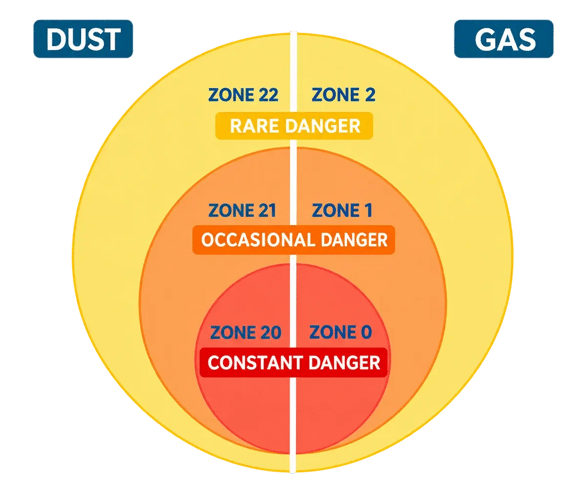
A Zone 1 area is one where an explosive gas atmosphere is likely to occur occasionally during normal operation. Typical examples include the space around tank vents, sampling points and open drains, where releases are part of routine operation.
A Zone 2 area is one where an explosive gas atmosphere is unlikely during normal operation and, if one does form, will persist for a short period only. Zone 2 commonly surrounds Zone 1 areas and covers process equipment such as flanges, valve stems and pump seals, where a release would come from an abnormal event like a failed gasket.
Many engineers use rough hours-per-year figures as a rule of thumb, with Zone 1 at around 10 to 1,000 hours per year and Zone 2 at under 10 hours per year. These figures come from industry guidance and are not part of the standard's text, so they should never stand in for a proper classification. Zone 0 and the dust zones 20, 21 and 22 are covered in our guide to ATEX, IECEx and zone classifications.
What ATEX Zone 2 means
In Europe, the zone definitions sit in the ATEX Workplace Directive, 1999/92/EC. Under it, employers are responsible for classifying areas where explosive atmospheres may occur, using definitions that closely match IEC 60079-10-1. ATEX Zone 2 therefore describes a place where an explosive atmosphere of gas, vapor or mist is unlikely during normal operation and short-lived if it does occur.
Equipment is handled separately by the ATEX Equipment Directive, 2014/34/EU, which sorts products into categories. Category 3G equipment provides a normal level of protection and is suitable for Zone 2. Category 2G provides a high level of protection and is suitable for Zones 1 and 2, and Category 1G covers all three gas zones. A phone sold as ATEX Zone 2 approved should therefore carry at least a Category 3G marking. We set out the practical difference between ATEX Category 2G and 3G in our guide to Zone 2 protection types.
ATEX Zone 2 in the UK: DSEAR and UKEX
In Great Britain, the Dangerous Substances and Explosive Atmospheres Regulations 2002 (DSEAR) bring the workplace requirements of 1999/92/EC into UK law, with the same Zone 0, 1 and 2 definitions. On the equipment side, UKEX is the post-Brexit regime under the Equipment and Protective Systems Intended for Use in Potentially Explosive Atmospheres Regulations 2016, using the UKCA marking.
The UK government has since removed the end date for recognizing CE marking on ATEX equipment in Great Britain, through regulations in force since October 2024. In practice, sites in Great Britain can currently use phones and tablets carrying either ATEX or UKEX certification for the relevant zone.
How Zone 1 and Zone 2 equipment differs
The IEC system, including IECEx certificates, describes equipment protection through Equipment Protection Levels (EPLs). For gas atmospheres, EPL Ga is suitable for Zone 0, EPL Gb for Zone 1 and EPL Gc for Zone 2. The difference between levels comes down to how many fault conditions the equipment is designed to tolerate while remaining an unlikely source of ignition.
EPL Gb equipment is designed to stay safe in normal operation and during expected malfunctions. Common protection types include flameproof enclosures (Ex db), increased safety (Ex eb), intrinsic safety at level ib (Ex ib), pressurization (Ex pxb or Ex pyb) and encapsulation (Ex mb).
EPL Gc equipment is designed to stay safe in normal operation, which can allow simpler and lighter construction. Examples include increased safety at level c (Ex ec), intrinsic safety at level ic (Ex ic), restricted breathing enclosures (Ex nR) and encapsulation at level c (Ex mc).
Intrinsically safe phones and tablets typically rely on Ex ib for Zone 1 or Ex ic for Zone 2, limiting the electrical and thermal energy available inside the device. Explosion-proof enclosures built to Ex db take a different route, containing any ignition inside a housing designed to withstand the pressure and stop flame from reaching the surrounding atmosphere. Our guide to non-incendive vs intrinsically safe protection compares energy limitation with explosion-proof enclosures, and our explainer on Ex ec, Ex nA and Ex ic covers the EPL Gc protection types in more depth.
Zone 1 vs Zone 2 at a glance
Here are the main differences side by side, including what to look for on a phone or tablet marking.
| Zone 1 | Zone 2 | |
|---|---|---|
| Definition | Explosive gas atmosphere likely to occur occasionally in normal operation | Explosive gas atmosphere unlikely in normal operation, and short-lived if it does occur |
| Rough frequency (rule of thumb only) | Around 10 to 1,000 hours per year | Under 10 hours per year |
| ATEX category | Category 2G (or 1G) | Category 3G (or 2G or 1G) |
| EPL | Gb | Gc |
| Example protection types | Ex db, Ex eb, Ex ib, Ex pxb, Ex mb | Ex ec, Ex ic, Ex nR, Ex mc |
| North American equivalent | Class I, Zone 1 (NEC 505); falls within Class I, Division 1 | Class I, Zone 2 (NEC 505); broadly comparable to Class I, Division 2 |
| Use in the other zone | Can be used in Zone 2 if the gas group and temperature class suit the area | Not suitable for Zone 1 |
| Example phone or tablet marking | II 2G Ex db IIC T6 Gb | II 3G Ex ic IIC T4 Gc |
Choosing between Zone 1 and Zone 2 phones and tablets
Area classification sets the minimum requirement for each part of a site. Choosing devices for a workforce is a broader decision, because phones and tablets travel with the people carrying them.
Map where your crews actually work
Start with the area classification drawings and compare them with how people move through the site during a typical shift. A technician based in a Zone 2 area may still pass through Zone 1 on the way to a job, or need to photograph a gauge next to a tank vent. On offshore installations, refineries and chemical plants, operators frequently cross between zones several times a day. If any part of a person's route enters Zone 1, the device they carry needs Zone 1 certification.
Contractors deserve the same attention. A crew working on a Zone 2 site this year may be on a client's Zone 1 plant next year, and some operators require Zone 1 equipment for everyone on site regardless of the task.
When Zone 2 devices make sense
If your teams will only ever work in Zone 2 and safe areas, Zone 2 devices are a reasonable choice. For example, a facility where the classification drawings show only Zone 2 around well-ventilated equipment, and where nobody's role takes them near the vents or sumps that create Zone 1. Zone 2 phones and tablets are generally lighter and less expensive, and buyers often have a wider choice of models.
When Zone 1 devices make sense
Zone 1 equipment is also suitable for Zone 2, so it suits crews whose routes cross into Zone 1, and teams where a new contract, a plant modification or a reclassification could bring Zone 1 areas into scope. Moving a fleet from Zone 2 to Zone 1 partway through its life usually means a second set of devices, new enrollment in mobile device management, replacement accessories and retraining, so weigh that against the price difference today.
Zone 1 devices have historically been heavier and several generations behind consumer phones. That gap has narrowed. The iPhone 17 Pro Max weighs around 410 grams in its Xshielder cover and keeps the 48MP Pro camera system, up to 8x optical-quality zoom, LiDAR scanner and A19 Pro chip. Long zoom helps technicians read nameplates and gauges from a safe distance, and LiDAR supports measurement and 3D scanning apps.
Other factors to check
Beyond the zone, check that the gas group and temperature class on the marking suit your site. A device marked IIC covers IIA, IIB and IIC gases, including hydrogen, and a T6 rating satisfies areas requiring any temperature class from T1 to T6. If teams also work around combustible dust, look for a dust marking such as II 2D Ex tb IIIC Db, which covers Zones 21 and 22. The ambient temperature range on the certificate also deserves a look for outdoor and cold-climate sites.
Certification also needs to match the jurisdiction, whether that is ATEX, IECEx, UKEX or the NEC in the United States.
Zones in North America
The United States uses two parallel systems for flammable gas hazards. NEC Article 500 uses the traditional Class I, Division 1 and Division 2 system, while NEC Article 505 uses Class I, Zone 0, Zone 1 and Zone 2, following the IEC approach. Equipment certified to the US zone system carries an AEx marking, for example Class I, Zone 1, AEx db IIC T6 Gb.
ATEX Zone 2 and Class I, Division 2 describe broadly similar conditions, where a flammable atmosphere is unexpected in normal operation. They belong to separate systems with separate certification, though. US installations generally require equipment listed by a Nationally Recognized Testing Laboratory, so ATEX or IECEx certification on its own is usually insufficient. Division 1 also spans both Zone 0 and Zone 1 conditions, so zones and divisions do not map one to one. Our comparison of Class I Div 1 vs Div 2 shows how the two systems line up, and our guide to what Class I Division 2 means for mobile devices covers when zone-certified equipment is accepted in a Division 2 area.
Xshielder's covers for the iPhone 17 Pro Max, iPhone 17, iPhone 16 Pro Max and iPad Pro 11-inch are certified for ATEX Zone 1/21, which also makes them usable in Zone 2/22. Browse the Xshielder range or get a quote to match a device to the zones your crews work in.
Frequently asked questions
What is the difference between Zone 1 and Zone 2?
In Zone 1, an explosive gas atmosphere is likely to occur occasionally in normal operation, while in Zone 2 it is unlikely and short-lived if it occurs. Zone 1 equipment needs EPL Gb (ATEX Category 2G), and Zone 2 equipment needs at least EPL Gc (Category 3G).
What does ATEX Zone 2 mean?
Under ATEX Directive 1999/92/EC, Zone 2 is a place where an explosive atmosphere of gas, vapor or mist is unlikely in normal operation and would persist only briefly. Equipment used in ATEX Zone 2 must be at least Category 3G.
What is a Zone 2 hazardous area?
A Zone 2 hazardous area is one where flammable gas or vapor would only form an explosive atmosphere through abnormal events such as leaks or equipment failure, and only for short periods. It often surrounds Zone 1 areas or covers well-ventilated process plant.
Can a Zone 2 phone be used in a Zone 1 area?
No. A Zone 2 phone carries EPL Gc (ATEX Category 3G) and is assessed for normal operation only, so Zone 1 requires EPL Gb (Category 2G) or higher.
Is ATEX Zone 2 the same as Class 1 Div 2?
They describe broadly similar conditions but belong to different classification systems with different certification requirements. Equipment for US Class I, Division 2 locations generally needs NRTL listing, so ATEX certification alone is usually insufficient.
How many hours per year is Zone 1 vs Zone 2?
IEC 60079-10-1 sets no fixed hours, but a common industry rule of thumb is around 10 to 1,000 hours per year for Zone 1 and under 10 hours per year for Zone 2.