

Non-incendive vs intrinsically safe: how the two protection concepts differ
When searching for a phone or tablet certified for use in hazardous areas, the term ‘intrinsically safe’ dominates the results. While intrinsic safety is a specific protection concept, the term is also commonly used as an umbrella term for the wider category. Yet much of the mobile equipment marked for Class I, Division 2 locations relies on a related but separate protection concept, non-incendive design.
The two share a lot of engineering logic, but they are certified to different standards, assessed against different fault conditions and permitted in different places. This guide covers what non-incendive means under the National Electrical Code (NEC), how it compares with intrinsic safety, where explosion-proof enclosures fit, and what to check before deploying a phone or tablet.
What non-incendive means
Non-incendive protection works on a simple principle. Under normal operating conditions, the circuit or equipment cannot release enough energy, as a spark or as heat, to ignite the specified flammable gas, vapor or dust mixture. No component failures are assumed.
The NEC spells the term as one word, "nonincendive", and defines four related terms.
- Nonincendive circuit: a circuit, other than field wiring, in which any arc or thermal effect produced under intended operating conditions is incapable of igniting the specified flammable mixture under specified test conditions.
- Nonincendive component: a component with contacts for making or breaking an incendive circuit, where the contacting mechanism is constructed so it cannot ignite the specified mixture. Its housing is not intended to exclude the flammable atmosphere or contain an explosion.
- Nonincendive equipment: equipment whose electrical or electronic circuitry is incapable, under normal operating conditions, of causing ignition through arcing or thermal effects.
- Nonincendive field wiring: wiring that enters or leaves an equipment enclosure and, under normal operating conditions of the equipment, cannot cause ignition. Normal operation here includes opening, shorting or grounding the field wiring.
Non-incendive equipment is permitted in Class I, Division 2 locations, and the concept also applies in Class II, Division 2 and Class III. In Division 2, a flammable atmosphere is expected only under abnormal conditions such as a leak or ventilation failure. Ignition would need that release and an equipment fault to coincide, which is unlikely. Our comparison of Class I Div 1 vs Div 2 sets out how the two Divisions differ.
UL 121201 explained
In the United States, non-incendive equipment is evaluated to UL 121201, Nonincendive Electrical Equipment for Use in Class I and II, Division 2 and Class III, Divisions 1 and 2 Hazardous (Classified) Locations. It replaced ANSI/ISA 12.12.01, which still appears on older certificates and control drawings. The Canadian counterpart is CSA C22.2 No. 213.
The scope covers nonincendive circuits, components and field wiring, along with other Division 2 techniques such as nonsparking and hermetically sealed devices, including spark ignition tests and temperature classification. A phone or tablet listed for Division 2 will most likely reference UL 121201.
How intrinsic safety differs
Intrinsic safety also keeps energy below what can ignite the atmosphere, then adds fault tolerance. An intrinsically safe circuit has to remain incapable of ignition after a defined number of faults. That margin is why intrinsically safe equipment certified to UL 913 is permitted in Division 1, and why Ex ia is permitted in Zone 0, where flammable atmospheres can be present during normal operation.
Fault tolerance
Assessors apply "countable faults", such as a failed component, a shorted capacitor or an open connection, and confirm that the circuit still cannot ignite the test gas. Safety factors are applied on top. Non-incendive assessment applies no countable faults, which is the core technical difference.
Protection levels ia, ib and ic
The Zone system grades intrinsic safety into three levels. Ex ia remains safe with two countable faults and is suitable for Zone 0, 1 and 2 (EPL Ga). Ex ib remains safe with one countable fault and suits Zone 1 and 2 (EPL Gb). Ex ic is assessed under normal operation only and is limited to Zone 2 (EPL Gc). Intrinsically safe apparatus certified for Division 1 is assessed with two faults, which puts it closest to ia.
UL 913
For the Division system, intrinsically safe apparatus and associated apparatus are evaluated to UL 913, Intrinsically Safe Apparatus and Associated Apparatus for Use in Class I, II, and III, Division 1, Hazardous (Classified) Locations. Zone-system equipment is evaluated to UL 60079-11, based on IEC 60079-11.
Entity parameters and barriers
Fixed intrinsically safe systems pair field apparatus in the hazardous area with associated apparatus, such as a zener barrier or galvanic isolator, in the safe area to limit voltage and current. Entity parameters confirm compatibility. The barrier's output (Voc, Isc, Po) must not exceed the field device's ratings (Vmax, Imax, Pi), and the allowed capacitance and inductance (Ca, La) must cover the device plus the cable, all per the control drawing. A phone or tablet carries its own energy source, so the certified battery pack becomes part of the protection concept.
Ex ic, the closest IEC counterpart
Under IECEx and ATEX, the nearest match for non-incendive is Ex ic, which replaced the older energy-limited Ex nL type. Both are assessed under normal operation for Zone 2 or Division 2. They are similar but not interchangeable, since they are certified to different standards and marked under different systems. Our guide to Ex ic, Ex ec and Ex nA covers the Zone 2 protection types and how to read their markings.
Where explosion-proof enclosures fit
Explosion-proof protection takes a third route. Instead of limiting energy, an explosion-proof enclosure accepts that the flammable atmosphere can enter and that ignition can happen inside. The enclosure is built to withstand the pressure of that internal explosion, and its flame paths cool escaping gases so that flame does not travel to the surrounding atmosphere.
Because the protection comes from the enclosure, the electronics inside do not need to be energy-limited. Explosion-proof equipment is evaluated to UL 1203 and permitted in Class I, Division 1 and 2. The closely related IEC concept is flameproof, Ex d, evaluated to IEC 60079-1 for Zones 1 and 2. We compare the two main approaches for handsets in our guide to intrinsically safe vs explosion-proof phones.
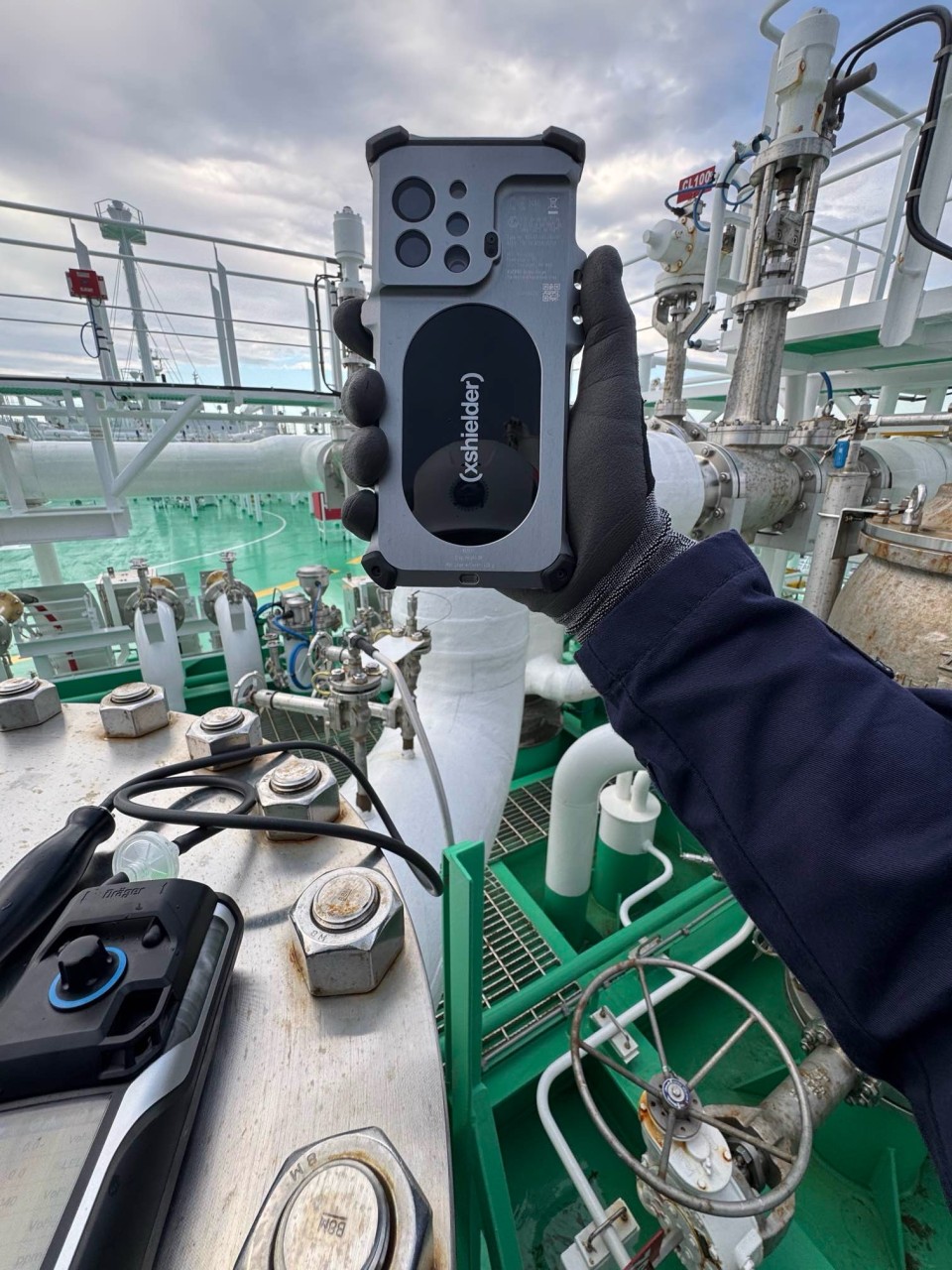
This is where Xshielder's current range sits. Our covers for the iPhone 17 Pro Max, iPhone 17, iPhone 16 Pro Max and iPad Pro 11" take this enclosure approach and are certified under ATEX for Zone 1 hazardous areas. Teams can choose a device for its capabilities, such as the 48MP camera system and LiDAR scanner on the iPhone 17 Pro Max, and keep the apps they already run.
What this means for phones and tablets
Battery energy and fault conditions
A phone or tablet is a difficult device to make energy-limited. The lithium-ion battery stores far more energy than any ignition threshold. Designers of intrinsically safe handhelds have to restrict what the battery can deliver under fault conditions, typically with encapsulation and current limiting in the certified pack, which shapes battery capacity, display brightness and component choice.
A non-incendive device is assessed under normal operation only, so its design can sit closer to a conventional rugged phone, a common route for Division 2 phones and tablets. Faults such as a damaged battery fall outside the assessment, which is acceptable only because Division 2 is not expected to hold a flammable atmosphere in normal operation.
What buyers should check
Whichever concept a device uses, check the following before deployment.
- Marking: the Class, Division, gas groups and temperature code, or the Ex protection type, gas group and EPL, must match your area classification.
- Control drawing and certificate: read the conditions of use, including any flagged by an "X" suffix on IECEx or ATEX certificates.
- Approved accessories: use only the listed batteries, chargers and headsets. A substitute battery can invalidate the certification.
- Charging outside the area: many certified devices may only be charged in a non-hazardous location, because charging ports often fall outside the protection concept.
Non-incendive vs intrinsically safe vs explosion-proof: comparison
| Non-incendive | Intrinsically safe | Explosion-proof enclosure | |
|---|---|---|---|
| Protection principle | Limits arc and thermal energy so it cannot ignite the atmosphere in normal operation | Limits energy so it cannot ignite the atmosphere in normal operation or after specified faults | Accepts ignition inside the enclosure, contains it and cools escaping gases through flame paths |
| Fault conditions assessed | Normal operation only (field wiring may be opened, shorted or grounded) | Two countable faults for Division 1 and ia, one for ib, none for ic | Assumes internal ignition; enclosure tested for pressure and flame transmission |
| Where it's permitted | Class I, Division 2 (also Class II, Division 2 and Class III) | Class I, Division 1 and 2; ia in Zones 0, 1 and 2; ib in Zones 1 and 2; ic in Zone 2 | Class I, Division 1 and 2; Ex d in Zones 1 and 2 |
| Standard | UL 121201 (replaced ISA 12.12.01); CSA C22.2 No. 213 in Canada | UL 913 (Division); UL 60079-11 and IEC 60079-11 (Zone) | UL 1203 (Division); UL 60079-1 and IEC 60079-1 (Zone) |
| Nearest IEC equivalent | Ex ic (similar, not interchangeable) | Ex ia or Ex ib | Ex d (flameproof) |
| Marking (examples) | Class I, Division 2, Groups A, B, C, D, T4 | Class I, Division 1, Groups A, B, C, D, T4, IS; Ex ia IIC T4 Ga | Class I, Division 1, Groups B, C, D, XP; Ex db IIC T4 Gb |
| What it means for a phone or tablet | A rugged Division 2 device; check accessory and charging restrictions | A purpose-built device with a certified, energy-limited battery pack | A standard device operates inside a certified enclosure; Xshielder's current iPhone and iPad covers take this approach under ATEX for Zone 1 |
If your crews need the latest Apple hardware in Zone 1, Xshielder's explosion-proof covers take the enclosure route, so you can pick the device for its camera and LiDAR with protection provided by the cover. Explore the full Xshielder range or get in touch to match a cover to your site's area classification.
FAQs
What does non-incendive mean?
Non-incendive means a circuit or piece of equipment cannot release enough spark or thermal energy to ignite a specified flammable atmosphere under normal operating conditions. Under the NEC, it is a protection method for Division 2 hazardous locations.
What is the difference between non-incendive and intrinsically safe?
Non-incendive equipment is assessed under normal operation only and is limited to Division 2. Intrinsically safe equipment certified for Division 1 must stay incapable of ignition after two countable faults, which is why it is permitted there.
What is a non-incendive circuit?
A non-incendive circuit is a circuit, other than field wiring, in which any arc or thermal effect produced under intended operating conditions cannot ignite the specified flammable gas, vapor or dust mixture under test conditions.
What is UL 121201?
UL 121201 is the US standard for nonincendive electrical equipment used in Class I and II, Division 2 and Class III hazardous locations. It replaced ANSI/ISA 12.12.01.
Can non-incendive equipment be used in Class 1 Div 1?
No. Non-incendive equipment is assessed under normal operation only, so it is limited to Division 2, and Class I, Division 1 calls for a method such as intrinsic safety or explosion-proof protection.
Is Ex ic the same as non-incendive?
Ex ic is the closest IEC counterpart, since both are assessed under normal operation for Zone 2 or Division 2 use. They are certified to different standards and marked under different systems, so they are not interchangeable.