

ATEX Marking Explained: How to Read Ex Labels on Phones and Tablets
Every phone, tablet or camera certified for hazardous areas carries a marking which designates what areas and environments it's suitable for. This is via a specific string of characters and numbers, such as 'II 2G Ex ib IIC T4 Gb'. While it looks like a serial number, each part of the string references a specific limit or type of protection, and all of this dictates where the device can be used. Two devices that are both "ATEX certified" can be suitable for very different sites, and this marking can help differentiate that.
This guide breaks an ATEX marking down part by part, shows how IECEx, UKEX and North American markings differ, and decodes two real examples. If you only need a quick reference, go straight to the ATEX marking at a glance.
What an ATEX marking is
The ATEX Directive 2014/34/EU requires equipment for explosive atmospheres sold in the EU to carry a set of markings. Some come from the directive itself, such as the CE mark, the Ex hexagon, the equipment group and the category. The rest come from the IEC 60079 series of standards, which every certification scheme uses, and describe the protection concept, gas or dust group, temperature and equipment protection level.
Together they show which zones the equipment suits, which gases or dusts it covers and the conditions it was certified under. The certificate and the manufacturer's instructions hold the detail, but the marking is the first thing to check on site.
ATEX marking at a glance
A full ATEX marking for a Zone 1 intrinsically safe phone might read II 2G Ex ib IIC T4 Gb, preceded by the CE mark with a four-digit notified body number and the Ex hexagon. This table breaks it down in order.
| Example | What it shows | |
|---|---|---|
| CE and notified body number | CE plus four digits | The product meets EU requirements, and the number identifies the notified body that monitors production quality |
| Ex hexagon | Ex in a hexagon | The equipment is certified for explosive atmospheres under ATEX |
| Equipment group | II | Surface industries (Group I is for mines) |
| Category and atmosphere | 2G | Category 2 equipment for gas, suitable for Zone 1 and Zone 2 |
| Protection concept | Ex ib | Intrinsic safety at level b |
| Gas group | IIC | Suitable for the most easily ignited gases, including hydrogen, and for IIA and IIB |
| Temperature class | T4 | Maximum surface temperature of 135 °C |
| Equipment protection level | Gb | High protection for gas, matching Zone 1 |
Reading each part of the marking
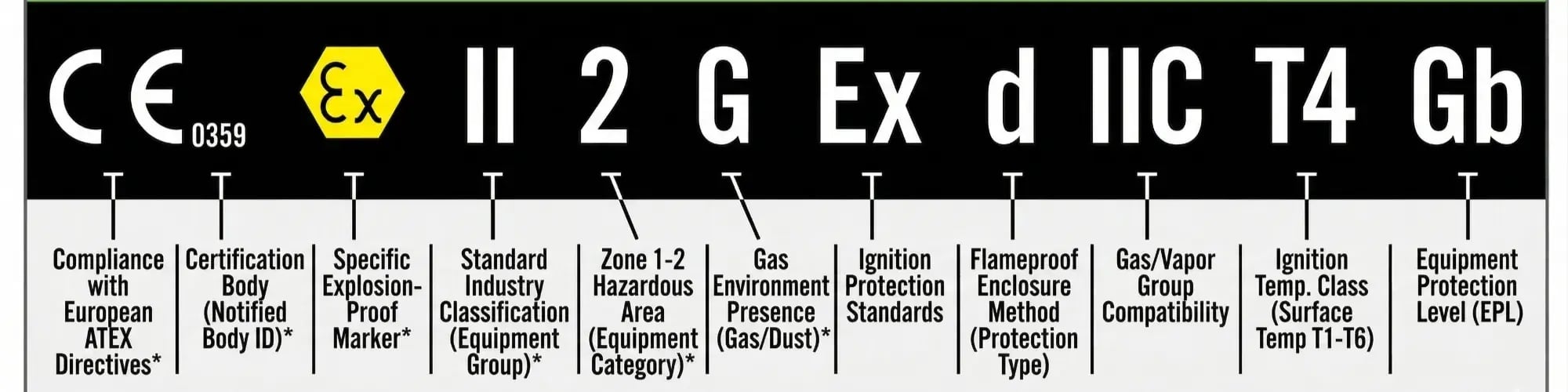
CE mark and notified body number
The CE mark shows the product meets the EU requirements that apply to it. For Category 1 and Category 2 equipment, a four-digit number follows it. That number identifies the notified body responsible for assessing the manufacturer's production quality, which is often different from the body that issued the type-examination certificate. Category 3 equipment does not need a notified body number.
The Ex hexagon
The letters Ex inside a hexagon are the specific marking for explosion protection under ATEX. On a physical label, it sits directly before the equipment group and category.
Equipment group: I or II
Group I covers underground mines, where firedamp (methane) and coal dust are the hazards, and its categories are M1 and M2. Group II covers every other location where an explosive atmosphere can form, including refineries, offshore platforms, chemical plants and pharmaceutical sites. Most hazardous area phones and tablets are Group II equipment.
Category and atmosphere: 1, 2 or 3, G or D
The category number sets the level of protection, and the letter shows the atmosphere it was assessed for. G covers gases, vapors and mists, and D covers combustible dust. Equipment of a higher category can also be used in the zones of the lower ones.
| Gas | Dust | Suitable zones | |
|---|---|---|---|
| Category 1 | 1G | 1D | Zone 0, 1 and 2 / Zone 20, 21 and 22 |
| Category 2 | 2G | 2D | Zone 1 and 2 / Zone 21 and 22 |
| Category 3 | 3G | 3D | Zone 2 / Zone 22 |
Equipment marked only with G has not been assessed for combustible dust, so it should not be used in dust zones. A device suitable for both carries two markings, such as II 2G and II 2D. Our guide to Zone 1 vs Zone 2 explains how the zones themselves are defined.
Protection concept: Ex ia, Ex db, Ex tb and others
The code after "Ex" names the protection concept and its level. The letter shows the method, such as i for intrinsic safety, d for a flameproof enclosure, e for increased safety, m for encapsulation and t for dust protection by enclosure. The final letter shows the level, from a, the highest, which suits Zone 0 or Zone 20, to c, which suits Zone 2 or Zone 22 only. A device that uses more than one concept lists them together, as in Ex ib mb.
Our guide to intrinsically safe vs explosion-proof explains how each concept works, and our guide to Ex nA, Ex ec and Ex ic covers the codes used on Zone 2 equipment.
Gas or dust group: IIA, IIB, IIC, IIIA, IIIB, IIIC
The group shows which substances the equipment is suitable for. Gases are grouped by how easily they ignite and how readily a flame passes through a narrow gap, and dusts by type and conductivity. Equipment rated for a more demanding group also covers the groups below it.
| Covers | Example substances | Can also be used in | |
|---|---|---|---|
| IIA | Gases ignited least easily | Propane, butane | IIA only |
| IIB | Gases ignited more easily | Ethylene | IIA and IIB |
| IIC | Gases ignited most easily | Hydrogen, acetylene, carbon disulfide | IIA, IIB and IIC |
| IIIA | Combustible flyings | Cotton and wood fibers | IIIA only |
| IIIB | Non-conductive dust | Grain, flour, sugar | IIIA and IIIB |
| IIIC | Conductive dust | Aluminum, magnesium, carbon black | IIIA, IIIB and IIIC |
Standardizing on IIC equipment for gas zones reduces the work of checking each device against every substance on site, because IIC covers all three gas groups.
Temperature class: T1 to T6
The temperature class shows the maximum surface temperature the equipment can reach, including under the fault conditions its protection concept covers. That temperature must be below the autoignition temperature of every gas or vapor that could be present.
| Maximum surface temperature | Suitable for gases igniting above | Example gases | |
|---|---|---|---|
| T1 | 450 °C | 450 °C | Hydrogen, methane, ammonia |
| T2 | 300 °C | 300 °C | Butane, ethylene, acetylene |
| T3 | 200 °C | 200 °C | Gasoline, diesel, kerosene, hydrogen sulfide |
| T4 | 135 °C | 135 °C | Acetaldehyde, diethyl ether |
| T5 | 100 °C | 100 °C | Few common gases |
| T6 | 85 °C | 85 °C | Carbon disulfide |
A higher number means a lower maximum temperature, so T6 is the strictest class and T1 the least strict. A T4 device covers any gas classified T1 to T4, which includes most gases and vapors found in industry. Carbon disulfide is a common exception, and sites that handle it need T6 equipment.
Dust markings usually state the maximum surface temperature in degrees, such as T80 °C. The site compares it against the ignition temperatures of the dust as a cloud and as a layer, with the safety margins set out in IEC 60079-14.
Equipment protection level: Ga, Gb, Gc, Da, Db, Dc
The EPL closes the marking and states the level of protection in a form that is the same in every scheme. ATEX markings carry both the category and the EPL, while IECEx markings carry the EPL alone.
| Gas | Dust | ATEX category | Zones | |
|---|---|---|---|---|
| Very high | Ga | Da | 1 | Zone 0 / 20 |
| High | Gb | Db | 2 | Zone 1 / 21 |
| Enhanced | Gc | Dc | 3 | Zone 2 / 22 |
Ambient temperature range
Equipment is certified for an ambient range of -20 °C to +40 °C unless the marking states otherwise, usually as Ta or Tamb. A wider range, such as -20 °C to +50 °C, matters for crews working in hot climates or near process heat.
Certificate number, X and U
The certificate number names the certification body, the year and the certificate, as in FIDI 26 ATEX 0016X. An X at the end means the certificate sets specific conditions of use, which the user must read and follow. A U means the certificate covers an Ex component, a part intended to be built into other equipment, which cannot be used on its own.
ATEX, IECEx, UKEX and North American markings
The core of the marking is the same across schemes, because it comes from the IEC 60079 standards. The differences sit around it. IECEx is an international certification scheme, accepted directly or as a basis for national approval in many countries. Our guide to ATEX, IECEx and zone classifications covers how the schemes relate.
| Example marking | What changes | |
|---|---|---|
| ATEX (EU) | II 2G Ex db IIC T6 Gb | Preceded by the CE mark, notified body number and Ex hexagon, and includes the group and category |
| IECEx | Ex db IIC T6 Gb | Drops the CE mark, group and category, and lists an IECEx certificate number |
| UKEX (Great Britain) | UKCA II 2G Ex db IIC T6 Gb | Follows the ATEX format with the UKCA mark and a UK approved body |
| NEC zones (US) | Class I, Zone 1, AEx db IIC T6 Gb | Uses the AEx prefix for equipment listed to US zone standards |
| NEC divisions (US) | Class I, Division 1, Groups A, B, C, D, T4 | Uses divisions and gas groups A to D instead of zones and IIA to IIC |
| Older European | EEx ia IIC T4 | Pre-dates EPLs and current standards, so check the certificate before accepting the device |
US sites classified under the Division system use a different structure altogether. Our guides to Class I Division 2 and Class I Div 1 vs Div 2 explain how to read those ratings and how they map to zones.
Two markings decoded
A purpose-built intrinsically safe phone
II 2G Ex ib IIC T4 Gb describes Group II equipment for Zone 1 and Zone 2 gas atmospheres. It uses intrinsic safety at level b, so it stays safe with one fault. It covers every gas group, including hydrogen, and its surface stays at or below 135 °C. It carries no dust marking, so it is not suitable for dust zones, and it is not suitable for Zone 0.
Xshielder's iPhone 17 Pro Max case
The iPhone 17 Pro Max ATEX Zone 1 case carries two markings, II 2G Ex db IIC T6 Gb and II 2D Ex tb IIIC T80 °C Db, under ATEX certificate FIDI 26 ATEX 0016X and, for a specific variant, IECEx certificate IECEx FIDI 26.0016X.
The gas marking describes a flameproof enclosure for Zone 1 and Zone 2, suitable for every gas group, with a T6 temperature class that covers gases down to an autoignition temperature of 85 °C. The dust marking adds Zone 21 and Zone 22 for all dust groups, with a maximum surface temperature of 80 °C. The certified ambient range is -20 °C to +50 °C.
The X at the end of each certificate number points to specific conditions of use. For this case, they include charging the battery only outside the hazardous area and not opening the enclosure inside it. Certificates for each case are on our downloads page, and our guide to the intrinsically safe iPhone compares the models available.
Common mistakes when reading a marking
Reading the temperature class backwards
T1 allows the highest surface temperature and T6 the lowest. A T3 device in an area where a gas ignites at 160 °C is a mismatch, whatever certification it carries.
Checking the zone and stopping there
A Zone 1 rating does not confirm that the gas group and temperature class suit your substances. A IIA device is not suitable where hydrogen is present, whatever its zone rating.
Assuming a gas marking covers dust
Gas and dust are assessed separately. Without a D category or a Da, Db or Dc EPL, the device is not certified for dust zones.
Overlooking the conditions of use
An X certificate can restrict charging, accessories, impact risk or how the device is opened. Those conditions are part of using the equipment safely, and they belong in site procedures.
Trusting the label without the certificate
Check that the certificate is current, that it names the exact model and variant you hold, and which standards it was issued against. IECEx certificates can be looked up on the IECEx online certificate system, and ATEX equipment comes with an EU declaration of conformity from the manufacturer.
How to check a marking against your site
Start with the hazardous area classification drawings and the list of substances on site. They give you the zones, the gas and dust groups and the lowest autoignition temperature you need to cover. Then check each part of the device marking against them, in this order.
- Zone: category and EPL suit every zone the device will enter.
- Atmosphere: G for gas, D for dust, or both where both are present.
- Group: the gas or dust group covers every substance present.
- Temperature: the temperature class or maximum surface temperature sits below the lowest ignition temperature on site.
- Ambient range: the certified range covers the conditions crews work in.
- Certificate: it is valid, matches the model, and its conditions of use fit your procedures.
Our buyer's guide and checklist for intrinsically safe mobile devices turns these checks into a specification, and the hazardous areas glossary defines the terms you will meet on certificates.
Xshielder's ATEX Zone 1 cases for the iPhone 17 Pro Max, iPhone 17, iPhone 16 Pro Max and iPad Pro 11" are all marked IIC T6 for gas and IIIC for dust, which covers a wide range of site requirements. Send us your zones, substances and ambient conditions, and we will check them against our certificates for you.
FAQs
What does II 2G mean on an ATEX label?
II 2G means Group II equipment for surface industries in ATEX Category 2 for gas atmospheres. It can be used in Zone 1 and Zone 2.
What does IIC T4 mean on a phone?
IIC means the phone suits every gas group, including hydrogen and acetylene. T4 means its surface stays at or below 135 °C, so it suits gases with an autoignition temperature above that.
Is T6 better than T4?
T6 is stricter, with a maximum surface temperature of 85 °C against 135 °C for T4. A T6 device covers every gas that a T4 device covers, plus those that ignite between 85 °C and 135 °C.
What is the difference between an ATEX and an IECEx marking?
An ATEX marking adds the CE mark, the Ex hexagon, the equipment group and the category to the Ex code. An IECEx marking carries the Ex code, groups, temperature class and EPL without them.
What does the X at the end of an ATEX certificate number mean?
An X means the certificate sets specific conditions of use. You need to read and follow them for the equipment to be used as certified.
Can a device marked 2G be used in a dust zone?
No. A 2G device is certified for gas atmospheres only, and it needs a dust marking such as 2D or EPL Db before it can be used in Zone 21 or Zone 22.